
By Yuki Nakayama, Ecology Center Writer, and Bailey Flannery, Environmental Storyteller Fellow
Organic grass turf is cheaper and safer, yet artificial turf is marketed as an "innovative green solution" that's recyclable and maintenance-free. Despite the greenwashing, artificial turf pollutes through microplastics, hazardous plastic additives, and PFAS, making it an environmental issue. Now, public athletic fields are the battleground for key decisions on environmental and health safety at various levels of local government.
The Ecology Center interviewed Diana Carpinone and Tracy Stewart, community organizers who oppose artificial turf. Carpinone created Non Toxic Communities to provide toxic-free play spaces for her child. Stewart, a fourth-generation Medway, Massachusetts resident, fought her town’s plans for new artificial turf fields. Both women shared lessons from a decade in the artificial turf debate.
Artificial Turf: Plastic, Polluting, and More Expensive
Artificial turfs are made from plastic and often contain infill from tire waste. These materials create macro- and microplastic pollution and leach toxic chemicals. Stewart cited research by Dr. Zhenyu Tian showing artificial turf infill from tires contributes to salmon deaths. Human health is at risk, too. The Ecology Center co-authored a study linking artificial turf to illnesses like heart attack, stroke, and diabetes. Jeff Gearhart, Ecology Center Research Director, noted that ongoing studies suggest that older artificial turfs become more dangerous over time.
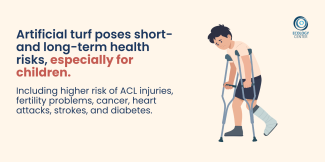
Children and youth athletes use athletic fields the most. Artificial turf poses short- and long-term health risks, especially for children. Studies show ACL injuries are more likely on artificial turf fields because it traps feet during pivots, increasing knee strain. Endocrine-disrupting chemicals in artificial turf are also a concern. Many of these risks can be reduced by using sustainably managed or organic natural grass fields.
Artificial turf is often not cost-effective. Stewart pointed out that installation can cost $2 million or more. This does not include ongoing maintenance costs, which increase as the field ages. Stewart noted that disposal and replacement costs are often not considered up front when schools or municipalities are making budgeting decisions. Carpinone said that not adequately maintaining existing artificial turf, or ensuring protective heat, hardness, and use policies are in place——may further increase the risks from inherent hazards. These include a harder surface with less impact absorption, exposure to toxic chemicals, higher infection risk from turf burns, and more heat-related illnesses because synthetic turf heats up.
Artificial turf has hidden costs. Many communities have had to install drinking water filtration systems to address chemical contamination from a variety of sources. Artificial turf can potentially add to the financial burden these communities already face.
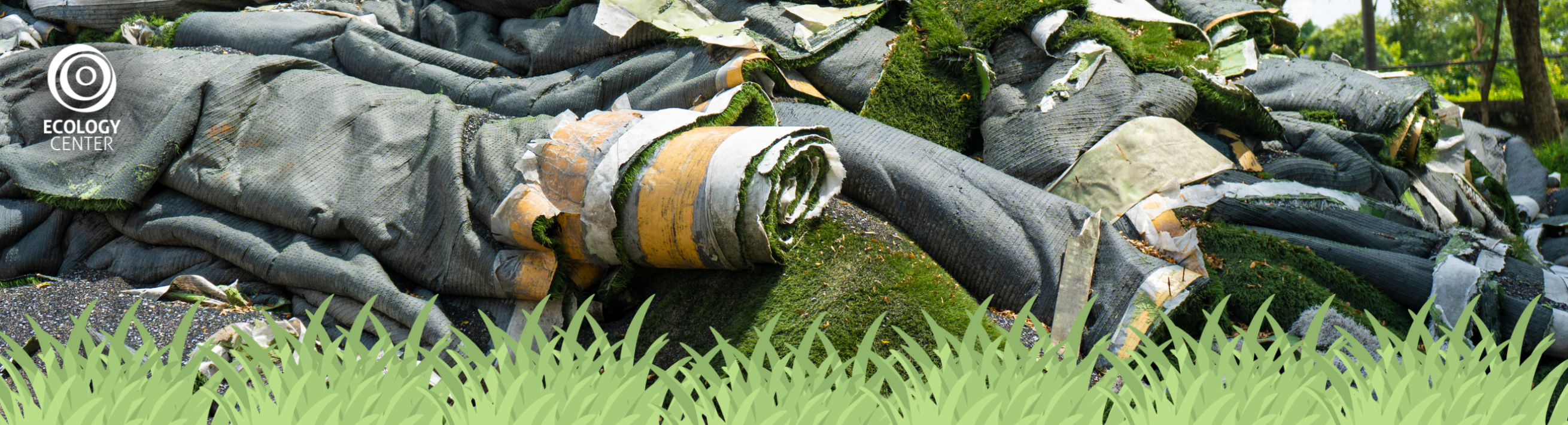
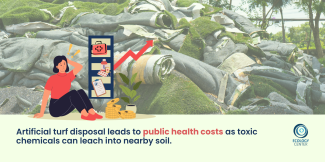
Stewart described how artificial turf disposal in Pennsylvania results in hidden costs. While turf is stored on farms at a low fee, toxic chemicals can seep into the soil. Farmers can be left with turf when disposal companies go out of business. Sometimes, turf is dumped illegally. These costs can burden communities for years. We need strong regulations to ensure turf is safely disposed of at the end of its life.
Carpinone offered guidance on how to prevent the industry from steamrolling local communities and their health and safety concerns: “To start, it’s important to carefully scrutinize the claims made by the artificial turf industry. Make sure grass experts are part of the planning, not just turf company engineers. And, make sure to push for industry accountability.”
Organic Grass: Cheaper, Safer, and Environmental
Organic grass fields are cheaper and safer thanks to advances in maintenance. Grass does not need synthetic pesticides; organic methods like frequent aeration, compost topdressing, proper mowing, and regular overseeding can control weeds and compaction. Choosing artificial turf to avoid pesticides ignores the toxic chemicals it contains. Carpinone also said organic management increases soil organic matter which holds more water, reducing the need for irrigation. And unlike artificial turf that requires potable water for irrigation, reclaimed water can be used for natural grass, reducing local water demand.
Actions Prioritizing People over Profits
The Ecology Center advocates for organic grass fields to keep children safe during activities. Children have no say in field decisions but take on the greatest risks as primary users.
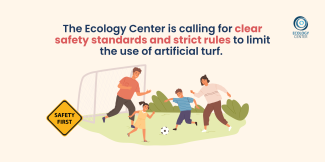
There are no federal bans on artificial turf. Some states and municipalities have adopted restrictions including Colorado, New York state and Vermont . The Ecology Center is calling for clear safety standards and strict rules to limit the use of artificial turf.
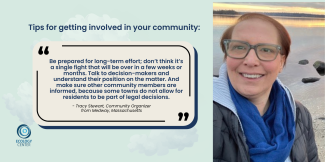
For those looking to join the fight in their own communities, Stewart reminds them: “Be prepared for long-term effort; don’t think it’s a single fight that will be over in a few weeks or months. Talk to decision-makers and understand their position on the matter. And make sure other community members are informed, because some towns do not allow for residents to be part of legal decisions.”
Fighting artificial turf puts children and communities before profits.
Bottom line: We should not pay more to expose children and communities to toxic chemicals.
Sources:
- Non Toxic Communities, “Synthetic Turf Bans & Moratoriums,” January 17, 2025, https://www.google.com/maps/d/u/0/viewer?mid=1pZ_Ryd5HKL3yplIhNNlcYnA6NinlYPk&ll=41.00444031104358%2C-82.63062813910773&z=6
- Ecology Center, “Toxic ‘Forever Chemicals’ Infest Artificial Turf,” October 10, 2019, https://www.ecocenter.org/toxic-forever-chemicals-infest-artificial-turf.
- Non-Toxic Communities, https://www.nontoxiccommunities.com/.
- Rebecca Goulding, “Artificial turf playing fields: A review of the health risks and environmental concerns,” November 19, 2025, https://ncceh.ca/resources/evidence-reviews/artificial-turf-playing-fields-review-evidence-health-risks-and.
- Illinois Sustainable Technology Center, “6PPD-Quinone and Beyond: Tire Rubber Additives and Transformation Products as Emerging Contaminants,” August 10, 2023, https://www.youtube.com/watch?v=qpjETu491iI.
- Kyle R. Siegel, Brooklynn R. Murray, Jeff Gearhart, and Christopher D. Kassotis, “In vitro endocrine and cardiometabolic toxicity associated with artificial turf materials,” Environmental Toxicology and Pharmacology, 111 (2024): 104562. https://doi.org/10.1016/j.etap.2024.104562.
- Micah Ngatuvai, Jingzhen Yang, Sandhya Kistamgari, Christy Collins, and Gary Smith, “Epidemiological Comparison of ACL Injuries on Different Playing Surfaces in High School Football and Soccer,” Orthopaedic Journal of Sports Medicine 10, no. 5 (May 5, 2022): 23259671221092321, https://doi.org/10.1177/23259671221092321.
- “Products Compatible with Organic Landscape Management,” Beyond Pesticides, https://www.beyondpesticides.org/resources/lawns-and-landscapes/tools-for-change/products-compatible-with-organic-landscape-management.
- "Mountains of plastic turf in limbo after Pa. recycling project falters", Go Erie https://www.goerie.com/story/news/environment/2026/02/02/artificial-turf-pa-cleanup-re-match/87949674007/