
Adding organic matter is important to a healthy garden.
Organic matter like compost made from yard and food waste helps create healthy soil and keeps food waste out of landfills. And, because PFAS stick to organic particles in the soil, compost may help prevent PFAS uptake in plants.
PFAS in Compost
Compost, or decomposed organic matter like leaves and food scraps is very important for home gardens and small-scale farms. Compost varies widely in PFAS contamination.
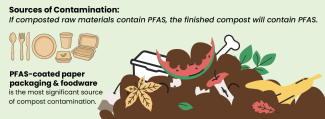
Make informed decisions when purchasing compost, ask your composter about their source materials. Also, while compostable plastic may not be a big source of PFAS contamination it may contain other hazardous chemical additives and contributes to microplastic contamination.
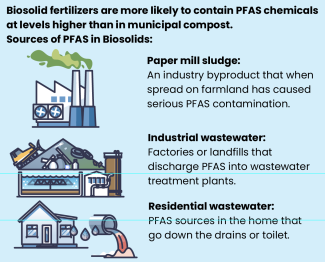
PFAS in Biosolids
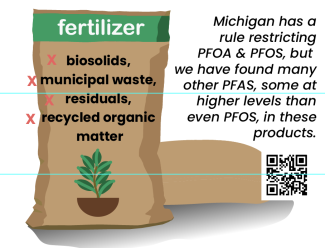
Home & industrial wastewater (sewage) flows to a treatment plant. The treated 'biosolids' can be sold as fertilizers at garden stores. When buying bagged fertilizer, avoid these ingredients: 'biosolids', 'residuals', 'recycled organic matter', or 'municipal waste'.
PFAS in U.S. Biosolids & Compost
The good news about soil amendments is that PFAS levels in many composts are low, as seen in the chart below, making them excellent choices for improving soil nutrients and texture. And there is a solution for composts that have higher PFAS levels: ensuring feedstocks exclude PFAS-containing compostable containers.
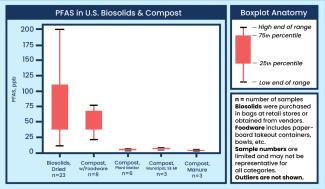
The major takeaways from the chart are:
- Among compost products, those that include paper-based, compostable foodware like takeout bowls are likely to have significantly higher PFAS levels than composts made from plant and food material without food containers.
- Biosolids typically contain much higher PFAS levels than composts of all types.
Research has shown that for most people, primary routes of PFAS exposure are drinking water, food, and household dust containing PFAS from furnishings and products. (See, for example, Minucci 2025 and Sunderland 2018.) Workers who handle firefighting foam or who manufacture products containing PFAS can have particularly high exposures.
There are no federal guidelines for how much PFAS can be safely present in biosolids, composts, or any other fertilizer sources. Facilities producing these soil amendments are not required to test for PFAS. We tested these types of soil amendments for PFAS to help farmers and gardeners avoid using PFAS contaminated products.
Data Sources for “PFAS in U.S. Composts and Biosolids” chart
- Biosolids, Dried: 2, 5
- Compost with Foodware: 1, 5
- Composted Plant Material: 1, 5
- Municipal Compost, SE MI: 3
- Composted Manure: 4, 5
- Choi, et al, 2019. Perfluoroalkyl Acid Characterization in U.S. Municipal Organic Solid Waste Composts, Environ. Sci. & Technol. Lett. 6 (6): 372–7
- Ecology Center and Sierra Club, Sludge in the Garden, 2021
- Ecology Center Healthy Stuff Lab, 2025 data not yet published
- Goossen, et al, 2023. Evidence of compost contamination with per- and polyfluoroalkyl substances (PFAS) from "compostable" food serviceware, Biointerphases 18 (3): 030501
- Lazcano, et al, 2020. Characterizing and Comparing Per- and Polyfluoroalkyl Substances in Commercially Available Biosolid and Organic Non-Biosolid-Based Products, Environ. Sci. Technol. 2020, 54, 8640−8648
PFAS in Animal Byproducts
Manure, bonemeal, feathermeal, and fish emulsion are examples of animal byproducts sold as soil amendments.

Only a few studies have measured PFAS in animal manure. More research is needed across the U.S. PFAS levels were generally lower in manure products than in other soil amendments in a few relevant studies we found.
Goossen 2023 (reference 4 above) found the sum of 28 PFAS in a dairy manure sample to be 3.7 ppb. Lazcano 2020 (reference 5 above) found the sum of 15 PFAS in animal manure to be 0.6 ppb. Munoz et al, 2022 (Env. Sci. Tech. v. 56 no. 10) studied animal byproducts in France, finding the sum of 78 PFAS in dairy manure to range from 0.3-2.1 ppb, hog manure 0.2-0.7 ppb, and poultry manure 0.2-1.9 ppb.