

What does PFAS uptake mean?
PFAS uptake refers to the buildup of PFAS chemicals in the tissues of fruit, vegetable, and other crops. This buildup occurs when plants are grown in soil or water that is contaminated with PFAS. Soil can be contaminated by applying amendments sourced from biosolids or paper mill sludge, or from past or current industrial pollution. If you suspect your soil or water is contaminated, here is a list of Michigan labs that test for PFAS. For questions about test results, contact MSU Extension at [email protected].
Pesticides can also be significant sources, especially of a type of PFAS called “ultrashort chain.” Unfortunately, ultrashort chain PFAS may go undetected as typical tests don’t include them.
Tips for Reducing PFAS Levels in Crops
- Fortunately, gardening practices that protect and build the soil also tend to reduce uptake into plants by increasing PFAS binding to soil particles: adding compost, minimizing disturbance (low or no-till practices), and having living roots (cover crops or perennials) in soil year round.
- Test your irrigation water to ensure it's not contaminated with PFAS. Contaminated irrigation water can be an important source of uptake in plants.
How do I know if my soil is contaminated with PFAS?
If you don’t know the history of your soil, are near industrial areas, or suspect biosolids might have been applied in the past, you may want to test your soil for PFAS (as well as for heavy metals). You can also contact MSU Extension with questions about soil testing, including interpreting results.
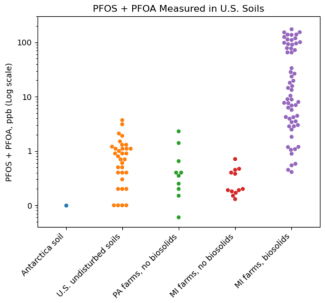
Health-based limits for PFAS in farm soil have not been established. Instead, we can compare PFAS levels in different soils of known history, using published scientific articles and government reports. The figure below shows levels of PFOS and PFOA (combined) in a variety of soil samples. Each dot on the plot represents a sample. A log scale is used to show detail in the lower-concentration categories (soils without biosolids history) as well as the higher-concentration category (biosolids-applied farm fields). Many of the soils with biosolids history had PFOS+PFOA levels 10 or more times higher than the other categories, up to nearly 200 parts per billion.
The farm soils without biosolids history and the "undisturbed" soils, which were taken from areas away from much human activity, all showed levels under 4 ppb and many under 1 ppb.
The lower levels can be considered "baseline" levels that can be expected in almost any soil due to the worldwide spread of PFAS.
What can I do if my soil is contaminated?
- Grow in raised beds or containers with purchased soil
- Add compost, particularly compost made without compostable food containers
- Consider growing plants on the lower end of PFAS uptake efficiency
- Use cover crops and/or perennial crops
- Note: One study showed washing fruits and vegetables did not reduce their PFAS content.

When soil contains PFAS chemicals, plants growing in the soil absorb some of the chemicals. This is one major way PFAS can end up in foods, such as fresh vegetables, processed ingredients, and animals fed silage or grain. (Other important routes are contaminated irrigation water and contaminated air via rain.)
To quantify how efficiently a plant (or a specific plant part) accumulates PFAS from contaminated soil, researchers typically measure the concentration of PFAS in the plant ratioed to the concentration in the soil in which the plant is growing. This quantity may be called a transfer factor, an accumulation factor, or a bioaccumulation factor.
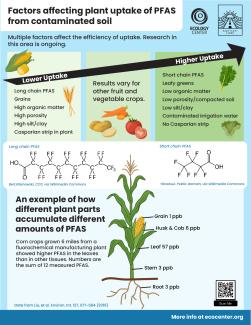
Predicting how much PFAS will be absorbed from contaminated soil by a given plant species, and into which plant tissues, is complex. A multitude of factors affect how much PFAS end up in an edible plant compared to how much PFAS are in the soil (Adu 2023, Lesmeister 2021, Mei 2021, Scearce 2023, Schilling Costello 2020), as summarized in the figure below. The figure is followed by more information on each of the listed factors.
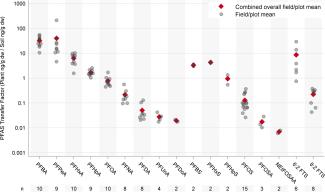
PFAS chain length strongly affects transfer to plants. Long chain PFAS--those with fluorocarbon chains longer than six carbons--transfer less efficiently to plants than short chain PFAS (Blaine, Gredelj 2020, Scearce 2023, Simones 2024). This is largely due to the fact that PFAS chemicals reach plant tissues through water uptake from soil. Long chain PFAS (for example, PFOA) are more hydrophobic, less water soluble, and more likely to sorb (become physically bound) to soil particles, making them unavailable for plant uptake. In contrast, short chain PFAS (for example, PFBS) are more water soluble and thus tend to be more available to plants through water uptake (Scearce 2023, Lee 2014).
The figure below from Simones, et al illustrates how plant uptake increases with decreasing chain length of PFAS. Note the logarithmic scale of the transfer factor; the increase in transfer factor with decreasing chain length is exponential.
PFAS functional group: In addition to chain length, the “head group” of a PFAS molecule influences the molecule’s uptake by plants. Per- and polyfluoro carboxylic acids (PFCAs) have been observed to transfer more efficiently than per- and polyfluoro sulfonic acids (PFSAs) (Blaine. 2013, Lesmeister 2021).
Plant species and plant parts: Several researchers have found that, among common food crops, PFAS accumulate more in leafy greens like lettuce, chives, and cabbage, and accumulate less in the edible grains of wheat and corn and in at least some fruiting vegetables, like tomato (Blaine 2013, Lasters 2024, Lesmeister 2021, Liu 2019, Pancras 2024). Leaves are thought to accumulate PFAS more rapidly due to water transpiration. Water is routed to leaves and evaporates from leaves, leaving nonvolatile pollutants like PFAS behind in the leaf tissue. In wheat and corn plants, PFAS have been found to accumulate most heavily in the leaves, less heavily in husks and roots, and the least in the grains (Liu 2019, Stahl 2009). This uneven distribution is an important consideration for using crop residue from contaminated soil as silage .
Findings on PFAS uptake have been mixed for various crops, in part due to inconsistent targeted PFAS test lists and different pollutant profiles in different soils. One study, for example, tested food crops grown near a major fluorochemical plant in Belgium (Lasters 2024). The researchers found legumes had higher overall PFAS levels than leafy greens, herbs, fruits, and root vegetables, driven by higher levels of two short-chain PFAS compounds (PFBA and 4:2FTS). In contrast, a study of crops grown near a fluorochemical plant in the Netherlands (Pancras 2024) found legumes to have lower average levels than leafy greens, herbs, fruits, and root vegetables. However, the Netherlands study didn’t include either PFBA or 4:2FTS, inhibiting comparison with the Belgium study. Additional studies reporting PFAS transfer factors for different crops under various conditions include Blaine 2013, Liu 2019, and Wen 2018.
Organic matter in the soil: PFAS chemicals, especially long chain PFAS, tend to stick to organic particles, making the chemicals less available for plant uptake. This is why adding compost rich in organic matter has been shown to reduce the amount of PFAS transferring from soil to plant (Blaine 2014, Ghaznavi 2025, Li 2024, Mei 2021). In one study (Blaine 2014), lettuce grown in contaminated soil that had 0.4% organic carbon content contained more than six times higher PFAS levels than lettuce grown in the same soil but with 6% organic carbon.
Soil porosity: High soil porosity tends to reduce uptake of PFAS (Scearce 2023). High porosity comes from a high density of pores and micropores that allow movement of water and oxygen. Water carries chemicals including PFAS. Abundant pores means more opportunity for PFAS chemicals to get “stuck” on soil particles as they are transported with water.
Silt or clay levels: Higher levels of silt or clay particles have been associated with lower PFAS plant uptake, as long as the soil is not overly dense and remains porous. Silt and clay particles tend to be very small, so in high concentrations they increase the total surface area to which PFAS may sorb (become physically bound) (Scearce 2023).
Mature roots have been associated with reduced PFAS uptake. This means perennial plants with older root systems might take up PFAS more slowly (Scearce 2023).
Biological barriers: Many plants contain tissue layers in the roots that act as partial barriers to PFAS and other pollutants. The Casparian strip is such a barrier layer. Species vary in whether they have this layer and how thick it is. The layer inhibits uptake of chemicals into the plant’s vascular system. Researchers have observed that plants with no or little Casparian strip, such as carrots and radishes, transport more PFAS to the aboveground plant parts (Lasters 2024, Mei 2021). For example, radish leaves grown in PFAS-contaminated soil contained several times more PFAS than tomato, pea, or celery, likely because radish lacks the Casparian strip the others have.
Cambium also has a barrier function within plants (Lesmeister 2024).
Soil sorbents
A sorbent is a substance added to soil that will sorb chemical contaminants, meaning chemicals absorb into the bulk or physically bind to the surface. Sorbents do not alter or destroy PFAS. Instead they “trap” PFAS chemicals, keeping them in the soil and preventing uptake into plants. When a sorbent reaches capacity, however, it cannot accommodate more chemicals and might even desorb some, making them again available.
Bits of organic matter in soil amendments like compost act as natural sorbents for many PFAS chemicals, especially long-chain PFAS (Li 2024). Compost is usually a beneficial addition to gardens for all aspects of soil health. Gardeners and farmers whose soil contains elevated PFAS levels may, however, wonder whether there are other sorbent types that will help.
Soil sorbents for PFAS are largely in the research stage, although a few products are on the market. They include activated carbon, specialized clays, mixtures thereof, and biochars. Research on their effectiveness is limited. One study found activated carbon sorbed most strongly to PFAS compared to sorbents based on montmorillionite or modified clays (Wang 2024). Regardless, all sorbents showed a decrease in ability to bind PFAS after about 20 days, suggesting that sorbents may require frequent reapplication to remain effective.
Another study (Zhang and Liang 2022) found biochar actually slightly enhanced PFAS plant uptake, while others have found wood biochar or wood ash to reduce PFAS uptake (Openiyi 2025). These inconsistencies reflect the multitude of both soil and biochar characteristics that influence plant uptake (Ramos 2024).
References
Blaine, et al. Perfluoroalkyl acid distribution in various plant compartments of edible crops grown in biosolids-amended soils. Environ Sci Technol 48, 7858 (2014)
Gredelj, et al. Uptake and translocation of perfluoroalkyl acids (PFAAs) in hydroponically grown red chicory (Cichorium intybus L.): Growth and developmental toxicity, comparison with growth in soil and bioavailability implications. Sci. Total Environ. 720, 137333 (2020).
Joerss, et al. Pesticides can be a substantial source of trifluoroacetate (TFA) to water resources. Environ. Int. 193, 109061 (2024).
Lee, et al. Fate of Polyfluoroalkyl Phosphate Diesters and Their Metabolites in Biosolids-Applied Soil: Biodegradation and Plant Uptake in Greenhouse and Field Experiments. Environ. Sci. Technol. 48, 340–349 (2014).
Lesmeister, et al. Extending the knowledge about PFAS bioaccumulation factors for agricultural plants - A review. Sci. Total Environ. 766, 142640 (2021).
Li, Y. et al. Commercial compost amendments inhibit the bioavailability and plant uptake of per- and polyfluoroalkyl substances in soil-porewater-lettuce systems. Environ. Int. 186, 108615 (2024).
Liu, et al. Multiple crop bioaccumulation and human exposure of perfluoroalkyl substances around a mega fluorochemical industrial park, China: Implication for planting optimization and food safety. Environ. Int. 127, 671–684 (2019).
Maine Department of Environmental Protection. Sample Collection - Data Report Summary (2017).
Mei, et al. Per- and polyfluoroalkyl substances (PFASs) in the soil–plant system: Sorption, root uptake, and translocation. Environ. Int. 156, 106642 (2021).
Michigan Department of Health and Human Services. Evaluation of PFOS in frozen wholesale beef from cattle exposed to PFOS through contaminated crops and soil due to biosolids applications at a farm in Livingston County, Michigan (2023).
Michigan PFAS Action Response Team Land Application Workgroup Research/Studies and Reports at https://www.michigan.gov/pfasresponse/workgroups/land-application
Moavenzadeh Ghaznavi, et al. A critical review of per- and polyfluoroalkyl substances adsorption by soil. J. Hazard. Mater. Org. 1, 100001 (2025).
Openiyi, E. Mitigation of PFAS in agricultural fields using sorbents materials. (Purdue University Graduate School, 2025). doi:10.25394/PGS.29414726.v1.
Pancras, et al. Large scale study on PFASs levels in fruits, vegetables and soil from allotments and gardens contaminated by atmospheric deposition from a Dutch fluorochemical production plant. Chemosphere 368, 143651 (2024).
Ramos & Ashworth. Per- and poly-fluoroalkyl substances in agricultural contexts and mitigation of their impacts using biochar: A review. Sci. Total Environ. 927, 172275 (2024).
Rankin, et al. A North American and global survey of perfluoroalkyl substances in surface soils: Distribution patterns and mode of occurrence. Chemosphere 161, 333–341 (2016).
Scearce, et al. Linking drivers of plant per- and polyfluoroalkyl substance (PFAS) uptake to agricultural land management decisions. Biointerphases 18, (2023).
Simones, et al. Uptake of Per- and Polyfluoroalkyl Substances in Mixed Forages on Biosolid-Amended Farm Fields. J. Agric. Food Chem. 72, 23108–23117 (2024).
Wang, et al. In vitro and in vivo remediation of per- and polyfluoroalkyl substances by processed and amended clays and activated carbon in soil. Appl. Soil Ecol. Sect. Agric. Ecosyst. Environ. 196, 105285 (2024).
Wen, B. et al. Behavior of N-ethyl perfluorooctane sulfonamido acetic acid (N-EtFOSAA) in biosolids amended soil-plant microcosms of seven plant species: Accumulation and degradation. Sci. Total Environ. 642, 366–373 (2018).
Zhang, & Liang. Performance of different sorbents toward stabilizing per- and polyfluoroalkyl substances (PFAS) in soil. Environ. Adv. 8, 100217 (2022).