
By Yuki Nakayama, Ecology Center Writer
Last year, Becca Nielsen was appointed the Director of the Environmental Education department at the Ecology Center. She is an experienced science educator and place-based, EcoJustice practitioner with experience in both traditional and non-traditional educational settings for a wide variety of audiences. Nielsen worked with Al Gore on his Inconvenient Truth Project, co-led a statewide coalition connecting children with nature, and is also one of the original members of the leadership team that built the Southeast Michigan Stewardship (SEMIS) Coalition, a group focused on integrating EcoJustice-focused place-based education (PBE) across K–12 and higher education.
Nielsen became interested in education because her parents were teachers and she experienced struggles as a young student within the traditional education system. She wanted to find ways to effectively support students and teachers who are often limited by the rigidity of the standardized curriculum.
Despite her career as a science educator, she initially thought she was “bad” at science until a biology professor she worked for at the Museum of Natural History in college scouted her to switch from English to biology. This experience pushed Nielsen to reconnect with her love for nature and the outdoors and develop her dedication to helping all students find the right path for learning through science education. It also demonstrates the power of one teacher to turn a challenging subject into a lifelong career path.
Nielsen’s specialty, place-based education (PBE), is a practice that views physical, cultural, and historical aspects of our environment as crucial starting points for teaching and learning. She also uses an EcoJustice approach in her place-based education practice. Nielsen describes EcoJustice as environmental justice that digs into the root causes of issues that we see. An EcoJustice approach treats environmental and cultural issues as intertwined and inseparable. Using a place-based, EcoJustice approach purposefully connects scientific knowledge to local places to solve real-world cultural and ecological issues that are directly experienced by students. PBE expands the classroom into the community and places collective care and justice at the center of learning alongside the content. The power of a PBE approach is its ability to connect students to place and community, to help students learn content more deeply, and to empower students to take action on local issues around them.
Nielsen aims “to equip people with the skills and knowledge necessary to thrive in healthy, sustainable, and just communities.” For her, EcoJustice is the core of her educational work because “teaching and learning isn’t possible without a safe and healthy environment.” Nielsen sees “EcoJustice work as where all of [my] interests and the pressing issues of our time coalesce.”
Nielsen explained that, “the secret to framing a lesson with a place-based, EcoJustice lens is to use larger questions of inquiry [that are action-oriented and locally specific] upfront at the beginning of a lesson or unit and to tailor the unit around answering those questions.” Applying that idea to some of the Ecology Center’s environmental education program topics, she offered the following questions as examples: “How can I participate in the circular economy in my local community? What zero waste practices can I use at my school and at home to make better decisions for my environment and my community?” These questions allow students “to connect with community partners, get out into the community to learn more about the practices, and design action projects to showcase what they’ve learned in the classroom and to make a difference in their community at the same time.”
The Cody Youth Ambassadors program is one example of a place-based educational approach from Nielsen’s previous work with the SEMIS Coalition. The Youth (student) Ambassadors worked with teachers and local partners to embed Rouge Park into the ninth-grade curriculum across subjects. Through this program, students learned about the history of the land and water in the Cody Rouge community, the ongoing litter and pollution issues at the park, and the Rouge River’s water quality problems. The students gained a multi-perspective exploration of their community, experienced the importance of stewardship, and witnessed the power of civic action. The program was the first of its kind to integrate such topics into all core subjects during regular school days instead of isolated one-off lessons. (More examples of PBE programs are available on the SEMIS student gallery page)
Integrating environmental topics into subjects beyond science may be difficult for some to imagine — but it is not only possible but can also lead to deeper, more meaningful learning and a more engaging experience for students. For example, in January, Nielsen led Green Training workshops for all 10th graders in their geometry classes at Ypsilanti High School. “We connected landfill construction, zero waste, and circular economy ideas to geometry. We also discussed other sustainability projects at the schools that connect to math, science, and community.” As part of the Washtenaw County Recycling Education Program, these individual lessons can feed into “larger inquiries such as a schoolwide waste audit to investigate how they are doing at keeping recyclable things out of the trash.”
PBE conducted with an EcoJustice lens offers a grounded approach to connect traditional education to the material realities of our lives. It answers the common “why do we need to know this” question in a powerful and local way, and it calls on us to apply our education to actions that connect to a future beyond ours.
Ecology Center’s Environmental Education Department
Nielsen joined the Ecology Center staff because its mission and work align with her lifelong interests and allow her to take PBE even further. She is thoroughly impressed by past Ecology Center Environmental Education initiatives. She sees her job as deepening the connections between existing environmental education programs and other Ecology Center programs, as well as working more closely with other campaigns in the future. She also would like to strengthen partnerships with other organizations doing complementary work to build capacity for transformative programs across the region.
One of her major goals is to “get a seat at the table” in larger conversation spaces as a way to connect environmental education to effective policy decisions. Environmental education is not just about informing children or concerned residents about recycling and composting; it is about educating decision-makers and voters about making systemic choices that ensure a safe and healthy future. Effective environmental education reaches not only youth, but also community members who can model stewardship and civic actions as a result of their education experiences.
According to Nielsen, a “lack of answers” is a core shortcoming for many education programs. Many programs present overwhelming information about environmental challenges, much of which can sound depressing or scary. Often, those programs do not include insights about what is being done to find solutions or how to take action at the individual level, which can leave learners feeling paralyzed or helpless. She believes that information about environmental concerns “should always include actionable opportunities to make a difference” as a result of what has been learned, especially at the K-12 level. Using a place-based, EcoJustice approach to environmental education builds in those connections between science, community, and the call to action that can lead to deeper understanding as well as protective and regulatory policies in the real world.
Making Decades of Environmental Education Available to Everyone
The Environmental Education team is launching an Education Resources Online Library (EROL), a digital library of downloadable resources to help K-12 students, educators, and families take action on key environmental issues. These materials focus on topics like renewable energy, green chemistry, and waste reduction, providing practical tools to inspire informed, hands-on learning and positive community impact.
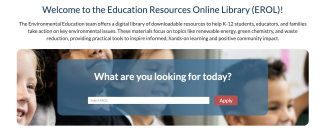
While going into the classroom to lead students, teachers, and families through various lessons is incredibly powerful, it is not always possible. This is why we created the EROL library that provides lesson plans and activities that people can use on their own. These resources transform our engaging lessons on environmental issues from one-time special events into opportunities for on-demand, easily accessible, long-term learning.
EROL is available to everyone. Each lesson is labeled by target grade level, but can be used by a variety of different age groups. For example, an adult who is new to a concept might benefit from a lesson meant for a 3rd grade classroom. On the other hand, a student who has had multiple experiences with a topic may be successful with a lesson that is above their grade level. This resource has been created with flexible learning goals in mind for anyone in the community who is interested in learning more about environmental issues.
The Environmental Education team has many other exciting ideas in the works. Nielsen looks forward to expanding EROL offerings, infusing PBE into existing programs, and continuing to develop new place-based education experiences around different Ecology Center topics with her team.