

Guest blog by Jenny Miller, University of Michigan graduate student in the School of Environment and Sustainability and Ecology Center volunteer
I have always been a no shoes, out-in-nature person. In fact, right before my high school graduation, I ditched my nice heels and headed into a creek to look for crustaceans. I have always had a passion for nature and animals, which led me to get my bachelor's degree in Zoology and work in environmental education. Now, I am pursuing a Masters in Environment and Sustainability.
A few years ago, I moved to Michigan, a state whose culture is heavily influenced by the water of the Great Lakes. Living here opened my eyes to how water connects everyone. However, I still did not think much of the pollutants that contaminated many communities’ drinking water until Tony Spaniola, co-chair of the Great Lakes PFAS Action Network (GLPAN), gave a talk about PFAS in my water politics class. PFAS are a class of nearly 15,000 synthetic chemicals, commonly known as forever chemicals, that take thousands of years to break down in the environment. Even in low quantities, the PFAS chemicals that have been extensively studied are linked to ailments such as cancers, birth defects, and decreased immune response. I was shocked to learn that PFAS have been used in goods since the 1940s and are commonly found in nonstick pans, water resistant clothing, firefighting foam, and have even been found in cosmetics products. The PFAS in these products inevitably ends up in our drinking water, and filtration systems cannot remove all PFAS from getting into our water. I wanted to be proactive about my own health and environmental impact and ensure the products I use are free of PFAS.
To start, I wanted to ensure that the beauty products I use in my everyday life are not adding PFAS into the water supply, but found it very difficult to find this information. With the Ecology Center’s support, I decided to go to Meijer and look at every body wash — nearly 120 body washes — to see which ones contained PFAS. It must have been an interesting sight as I went through the aisles taking pictures of each body wash product I could find. With the pictures in hand, I went home and compiled a list of the products. For each product, I searched online to see if I could find any information out there about whether or not they contain PFAS.
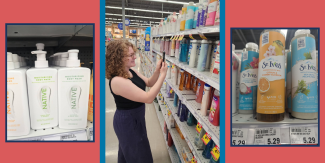
During my research, I was unable to find body washes that were explicitly identified to contain PFAS. Instead, I learned that in order to know for sure if a product contains PFAS, it has to be tested for specifically. Companies are not required to test if their products contain PFAS, and there is very limited information about items that both have and have not been tested. This means that just because a product is not known to contain PFAS, it does not necessarily mean that they are free from PFAS. This lack of information was frustrating to say the least, as there is no clear way for us as consumers to know whether a product is exposing us to these harmful chemicals.
The process of looking at brands was extremely time consuming, as it took me hours to go through hundreds of body washes at only one store. It should not take this much time and effort for consumers to make informed purchases since the average consumer does not have the amount of time and resources I had. Especially since there is not enough information out there for a consumer to truly make an informed decision.
I found that an effective way for consumers to limit their PFAS exposure from cosmetic products is to focus on finding which products test for PFAS and do not contain any. I found the websites Green Science Policy and EWG to be extremely helpful with finding products that are PFAS-free. However, this is not a perfect solution.
We cannot shop our way out of PFAS, and a way to help everyone in limiting their exposure to PFAS is to get laws passed that limit their use. In order to make our concerns known, contact your state representatives and tell them to push forward legislation that holds brands accountable for putting PFAS in their products. There have been bills proposed previously in the state of Michigan that would help limit people’s exposure to PFAS. The bill “The Hazardous Products Act” that was introduced in Michigan would ban the intentional use of PFAS in products such as cookware, cosmetics, children’s products, and firefighting foam. Another bill is the “PFAS Product Labeling Bill,” which would require companies to provide notices or warnings if products contain PFAS. Bills such as these can truly help make a difference by reducing the amount PFAS that we are exposed to and help keep our community safe.
This experience made me aware of the difficulty in identifying products that contain PFAS, and how one person does not have the capacity to do it all. As consumers we should work collectively to voice our concerns surrounding PFAS not only to our representatives, but also to the companies that produce them. Our voices can make a difference in stopping the use of PFAS.
For more resources check out:
EWG Skin Deep