
By Yuki Nakayama, Ecology Center Writer
The Ecology Center’s Healthy Stuff Lab is teaming up with local experts to learn about microplastics. While we do our own testing when we can, collaborating with local scholars and academic institutions is also important to us. It allows us to access labs with high tech equipment resulting in more data and builds our network of academic institutions doing important microplastics research for future collaborations.
Our most recent collaboration is with local scientist, Dr. Yongli Wager and the team at Sustainable Water-Environment-Energy Technologies Lab at Wayne State University to tackle the microplastics issue at the local level.
Examining Crucial Fresh Water Resources with Dr Yongli Wager
Dr. Yongli Wager, Ph.D., is an associate professor of civil and environmental engineering and director of the Sustainable Water-Environment-Energy Technologies Lab at Wayne State University (WSU). She has been at WSU since 2014 after receiving her doctorate in Civil Engineering at the University of Virginia. Her research interests are water use, quality, treatment, availability, management, energy, and sustainability.
In particular, she is interested in contaminants referred to as “Chemicals of Emerging Concern,” like microplastics. These chemicals unfortunately already exist in our environment, but we still need a better understanding of how they impact the environment and human health. Since arriving in Michigan, she has focused on working on how such chemicals affect water quality in the Great Lakes ecosystem.
She is interested in looking at water because “fresh water resources are critical for humans.” It is so fundamental to our health and survival, and yet it's currently at risk. She stresses that, “In Michigan, we are lucky to have this precious fresh water through the Great Lakes and we need to think about how to preserve it for the future.” In other words, Dr. Wager is working on ensuring that we have a deeper understanding of water contaminants like microplastics so that we can continue to have access to clean water. (You can read a recent paper by her and her team here.)
Dr. Wager’s Work at Her Lab at Wayne State University
Dr. Wager and her lab do a combination of work that fits under three main categories: lab work, fieldwork, and system modeling approach to collect data. Environmental systems modeling is an analytical framework used to capture how various environmental elements currently interact (as a system) and to predict how changes impact the system’s behavior to help stakeholders make better decisions.
The lab focuses on microplastics because of the rising concerns over the long-term presence of microplastics in our environment as they break down into small particles without fully biodegrading. In addition to data collection, Dr. Wager develops more effective analytical methodologies, such as modifying existing methods, creating new tools, and updating analysis protocols.
Due to the complexity of microplastics research, Dr. Wager is concurrently developing methodologies and collecting data. Microplastics pose a unique challenge for scientists due to their small particle size and their need to be separated from other particles, making sample collection, processing, and extraction difficult. For example, in some bodies of water, microalgae are the same size as microplastics, so scientists cannot extract microplastics solely by size. For this reason, there are significant hurdles to data collection and analysis. If microplastics cannot be accurately identified and extracted, we will not be able to assess current pollution levels or sources reliably.
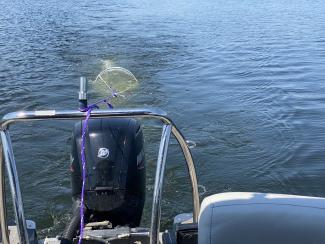
Microplastics research is also complicated by the need for cross-disciplinary efforts to develop analytical tools and solutions. Dr. Wager and the lab are collaborating with Dr. Mark Cheng (University of Alabama) and Dr. Weisong Shi (University of Delaware) on a project to develop a real time microplastic monitoring system funded by the Great Lakes Protection Fund since 2018. They have since developed a sensor prototype that can monitor microplastics that are 300-700 micrometers. This project is one of many examples that show the wide ranging expertise and human labor needed for collecting data on microplastics.
A Mutually Beneficial Collaboration With Community Partners
The lab collaborates with many different communities with distinct concerns, creating what Dr. Wager calls a “mutually beneficial mechanism.” The lab provides access to testing that is not readily available to local groups while expanding its data collection. Additionally, the lab offers expertise for strategies, processing, and analysis for preliminary sample testing. Their partners can use it to understand their early results before deciding to send samples for further testing with advanced lab equipment. Community partners like the Ecology Center can use early data for developing necessary methodologies, providing evidence for funding applications, and more.
Dr. Wager’s work with the Ecology Center focuses primarily on microplastics in local compost and soil. The lab is currently developing methods to analyze microplastics in samples collected by our Healthy Stuff research team. Compost can contain a wide variety of materials, like yard waste, food waste, and compostable packaging, making testing complicated.
In many cases, food waste has microplastic contamination from food containers and packaging that does not biodegrade, including those that claim to be “biodegradable.” Dr. Wager points out that we need to change the way we compost to help prevent microplastic pollution. (Sign up for our email list if you’re interested in staying informed about our work on microplastics.)
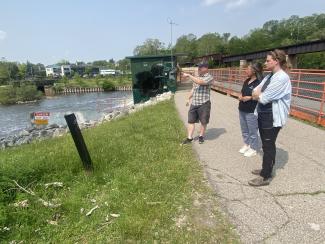
In collaboration with the Huron River Watershed Council, the WSU lab is examining how terrain differences and human activities affect microplastic levels in the Huron River. This project will help expand our understanding of the factors that influence contamination pathways. The Huron River plays a vital role in our ecosystem and local culture. Looking at both environmental conditions and human behavior provides the data needed to create protections that ensure the river remains part of our way of life in Ann Arbor.
Understanding Local Geography’s Impact on Pollution Levels.
Dr. Wager stressed the importance of increasing “geospatial analysis of local communities,” or examining local geography’s influence on pollution levels. She also encourages more collaborations between labs and community groups. Finding a federal-level solution that serves all communities may be too slow and costly. Instead, working to expand community-based geospatial analysis will help build the detailed data on microplastics we still need while allowing stakeholders to find robust actions to tackle local situations. This gives agency and power to residents in building a safer future for themselves.
By emphasizing community collaborations, the WSU lab hopes to maximize its impact, by working creatively within their partners' (often limited) resources in order to offer more than the lab’s testing capabilities. For the average person, scientific work done by Dr. Wager and the WSU Lab can often feel out of reach, but community-based analysis brings science to the people. It brings us together to fight against microplastics as a team.
Reducing Plastic Use Is Key
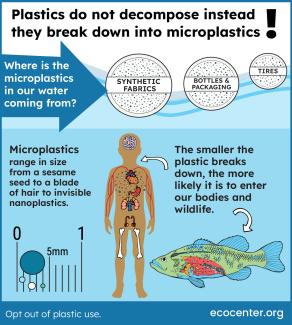
Our ability to understand the pathways of microplastic pollution and levels of contamination is critical to protecting communities and ensuring our healthy future. However, reducing plastic use before it becomes microplastic pollution is paramount to addressing the problem. While the scientific community is working on crucial components such as the development of data tools and alternative materials with industry stakeholders (e.g., manufacturers), there is a lot we can do:
- Opt out of plastics: avoid purchasing single-use plastic items.
- Choose reuse instead: carry your own take out food containers, reusable bottles, bags, and utensils.
- Increase public awareness about the issue. Help us spread the word by sharing this information with friends and family.
- Support protective policies. We urgently need policies that limit single-use plastic and require stronger waste management protocols.
- Tell your local representatives that you care about microplastic prevention policies and vote for local initiatives.
Doing everything on this list may not be possible, but look for areas where you can contribute. It can start with just one small action and help to reduce the microplastics Dr. Wager might find in the samples they collect through their projects. Dr. Wager and her team are scientists, but they are also residents. They care about this issue because it affects them too.