

By Keanu Heydari, Environmental Storyteller Fellow, Rackham Graduate School
From Crisis to Leadership
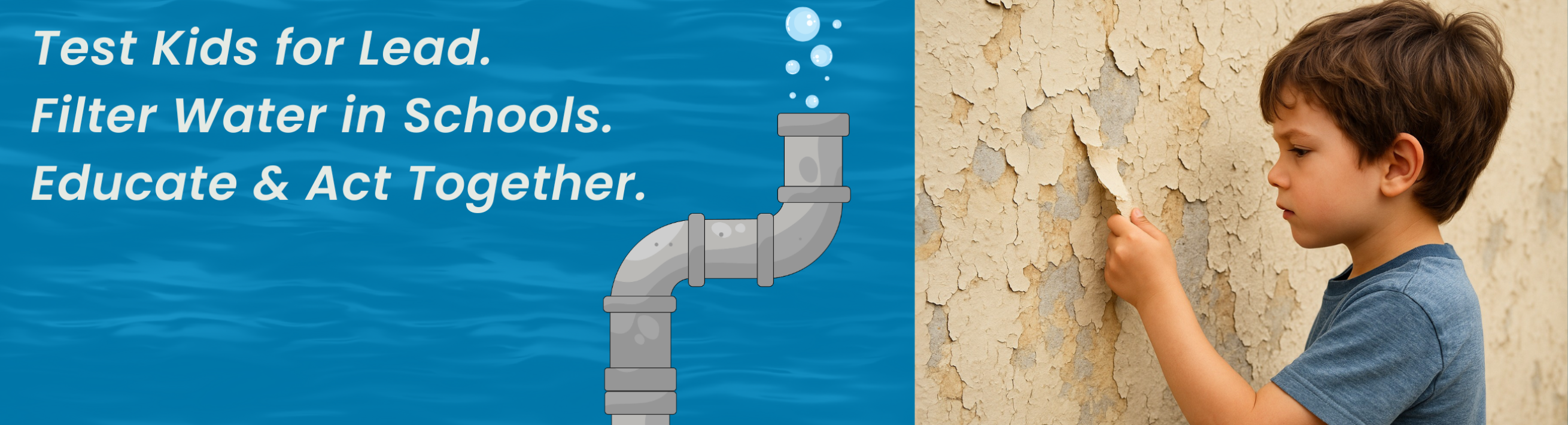
Lead exposure remains one of Michigan’s most significant, yet solvable public‑health challenges. The state crossed an important threshold on July 2, 2025, when Flint announced completion of its court‑mandated lead service line replacements — an arduous, years‑long project that became a national touchstone for drinking‑water safety. That milestone matters. But even with pipes replaced, the principal sources of ongoing exposure for most Michigan children are older housing, deteriorating paint and dust, unsafe renovation and demolition practices, and contaminated soil. Put bluntly: Flint’s headline was never the whole story.
The scientific consensus is unsparing: there is no safe level of lead exposure for children. The policy implication follows directly — prevention, not merely response, is the standard against which progress should be judged. The Ecology Center (EC) and its coalitions have worked to that standard for decades — before, during, and after Flint — through research, education, and policy advocacy in Lansing and Washington.
Policy Successes — Two Years of Momentum
The last two years mark a genuine turning point. Working alongside partners across the state, the Ecology Center helped shape two major Michigan policies that move the needle from reaction to prevention.
Filter First in schools and child care centers. In October 2023, Governor Gretchen Whitmer signed bipartisan “Filter First” legislation requiring the installation of filtered drinking water stations in schools and child care centers and establishing ongoing testing and maintenance. Implementation deadlines are specific and near‑term: Drinking Water Management Plans by January 24, 2025; filtered sources in child care by October 24, 2025; and approved filters on all consumptive fixtures in schools by the end of the 2025–26 school year. These details matter because the law’s promise will be realized only if districts are supported to purchase, install, maintain, and monitor the systems equitably. EC and partners will continue to support implementation toward that end.
Universal childhood blood‑lead testing. Also in 2023, Michigan enacted age‑based screening for all children at 12 and 24 months and at age 4 if not tested earlier, with data reporting to immunization records — rules that MDHHS finalized on May 5, 2025. Expanded screening will almost certainly increase the number of documented cases. That should be read not as a worsening epidemic, but as a clearer picture — one that enables faster, targeted interventions. Policy succeeds only if testing is paired with prompt environmental investigation, remediation, and support for families most at risk.
None of this happened in isolation. EC worked in coalition — with the Michigan Alliance for Lead Safe Homes (MIALSH), the Healthy Homes Coalition of West Michigan, Michigan Environmental Council, DLEAD (Wayne State University Center for Urban Studies) and other Detroit‑based partners, regional health departments up north, and many others — to craft proposals, brief lawmakers, and bring community voices into committee rooms. Coalition is not a flourish in a press release; it is how durable policy gets made.
Community Empowerment — The LIFT Program
Policy sets guardrails; people shift culture. The Lead Impacted Families Together (LIFT MI) program is the on‑the‑ground counterpart to these legislative wins. Funded by the Michigan Health Endowment Fund, in 2025, EC and partner organizations ran a seven‑month, bilingual training that equipped families to understand exposure pathways, navigate testing and health systems, and advocate effectively at city halls, health departments, and the Capitol. Graduates are now applying what they learned at neighborhood scale.
LIFT MI’s 2025 cohort convened through the Detroit Hispanic Development Corporation (Southwest Detroit), Parents for Healthy Homes (Grand Rapids), the Healthy Homes Coalition of West Michigan (Grand Rapids), and the Delta & Menominee County Public Health Department (Upper Peninsula). Participants designed action projects that reflect their communities: a Kahoot! game to teach lead safety basics; a lead prevention cookbook; social‑media posts on the importance of testing; and a pregnancy handout on exposure prevention. As Melissa Cooper Sargent, EC’s Environmental Health Advocate, puts it: “We want to give people the tools to be a voice to share what they’ve learned.”

The organizing philosophy is simple and intentional: environmental justice requires meeting people where they are and stitching together rural and urban Michigan in the same conversation. Meli Garcia, EC’s Regional Environmental Health Organizer, underscores the point: “It’s important to bring different groups of people together … They’re coming from different areas, rural and city. It’s been great working with the participants because they have different ideas on which education spoke to them most and what their action project’s going to be.” That pluralism — of place and strategy — is why the program travels so well.
National Impact — Michigan as a Model
Michigan’s trajectory is being noticed nationally. EC staff carry that story to Washington, D.C., not to celebrate but to persuade. In May 2025, while traveling in the region, Melissa Cooper Sargent met with congressional offices — including those of Senators Gary Peters and Elissa Slotkin and Representatives Shri Thanedar and Hillary Scholten — to make a practical case for sustained federal investment in lead prevention and healthy housing. Those meetings complement EC’s long‑running Lead Education Day at the Michigan Capitol — most recently on May 7, 2025 — where families and practitioners brief lawmakers directly.
National partners reinforce the strategy. Tom Neltner, National Director of Unleaded Kids, emphasizes that data and stories must travel together: “We can calculate the billions of dollars that would be saved if we could reduce exposure to lead. That helps on the Hill. But the anecdotes matter. Real stories from real people matter a lot.” His organization has spotlighted — and helped propel — state‑level transparency measures, including California’s AB 899, which requires baby‑food manufacturers to test monthly for heavy metals and publicly disclose results, and New Jersey’s 2025 law requiring landlords to disclose lead drinking‑water hazards to tenants. The point is not to replicate policy wholesale, but to show that states can act decisively while federal budgets and rules remain contested.
At the federal level, advocates have pushed back against proposed reductions and program changes; even amid debate, key lead programs continued to move resources in FY2025 — for example, EPA’s school and child‑care lead testing and reduction grants were allotted in June. The lesson is straightforward: appropriation lines shift; momentum must not.
Looking Ahead — The Work Isn’t Done
Michigan has new laws on the books and new community capacity in the field. But vigilance is the price of progress. Are schools and child care centers receiving timely technical assistance and funding to meet Filter First deadlines? Are replacement filters maintained and sampling protocols followed equitably across districts? Are pediatric practices prepared for universal testing workflows so that families are not lost between screening, confirmatory testing, and environmental intervention? These are not rhetorical questions; they are implementation checklists.
For the Ecology Center’s lead program, the next phase is clear:
- Support four lead prevention bills that were recently introduced in the Michigan State Legislature. The bills, HB 4864-4867, would assure that lead poisoned children get the services they need, families and contractors are protected while renovation, repairs and painting are taking place in homes built before 1978, and baby food in Michigan is made safer.
- Implementation with integrity. Track and support Filter First and universal screening so compliance translates into exposure reduction — especially in communities with the oldest housing and fewest resources.
- Community education at scale. Expand LIFT MI cohorts and alumni networks; connect graduates to Lead Education Day to move neighborhood insights into statewide policy.
- Policy and budget advocacy. Continue coalition work in Lansing and D.C. to strengthen housing, renovation, and soil‑safety protections and to secure federal and state funding streams that match the scope of the problem. Maintain focus on transparency measures that help parents and tenants act.
“Sometimes when you do this work, it starts to feel like you’re all alone,” Tom Neltner, National Director at Unleaded Kids, told us. “Getting past that loneliness — and the ability to share with others — is important. Ecology Center not only does the science right, but it allows people to do the networking so they can learn from it. A learning community on lead is so valuable.”
Two years of policy success give us momentum — and responsibility. Michigan has shown that prevention can be legislated and that communities can be trained to own the work. Now is the time to build on it, measure it rigorously, and insist that every child in Michigan drink water and live in homes that are truly lead‑safe.
Sources
- Flint completion (July 2, 2025): Michigan Advance; Inside Climate News.
- No safe level of lead for children: American Academy of Pediatrics, Pediatrics policy statement.
- Filter First law + implementation timeline: Governor’s press release (Oct. 19, 2023); EGLE program page.
- Universal testing law + rule finalization (May 5, 2025): Governor’s press release (Oct. 3, 2023); MDHHS.
- LIFT MI program and 2025 cohort/graduation coverage: Ecology Center; Concentrate/Model D feature.
- Lead Education Day (May 7, 2025): Michigan Environmental Council.
- Unleaded Kids (Tom Neltner) + state actions: Unleaded Kids; CA AB 899 (CDPH); NJ lead‑hazard disclosure law.
- EPA FY2025 school/child‑care lead‑testing allotments (June 12, 2025): EPA memo.
Thanks to our partners — including MIALSH, Detroit Hispanic Development Corporation, Parents for Healthy Homes, Healthy Homes Coalition of West Michigan, Delta & Menominee County Public Health Department, the Great Lakes Lead Elimination Network, and Unleaded Kids — whose ongoing work grounds and accelerates everything above.