


Co-authored by Molly Burger, Ecology Center Clean Transportation Coordinator & Trilby MacDonald, Ecology Center Writer
Road funding in Michigan is a growing concern among state government officials as revenues continue to fall short of what’s needed to fix highways, roads, bridges, and supporting infrastructure, and debts from previous bond financing come due. As policymakers discuss solutions to make up the revenue gap, the question of whether increasing fuel efficiency or the growth of electric vehicles is contributing to those shortfalls is frequently a topic of debate. This policy brief is an attempt to dig into the details of this debate and to explore some fair and reasonable approaches for moving forward.
First, let’s start with a basic primer. State revenues to support the maintenance of Michigan roads is primarily collected in two ways:
- Yearly vehicle registration fees
- Gas taxes paid at the pump. Part of this tax is designated as “highway funding” and part is designated as a “sales tax” which goes towards other services like schools.
A smaller portion of state funding also comes from an earmark of income taxes, marijuana excise taxes, and other restricted funding.
Since fully electric cars (BEVs) don't use gas, drivers of EVs have also been assessed additional registration fees, or surcharges, to make up for what they don’t pay at the pump. Drivers currently pay an additional EV surcharge of $160, which is on top of their annual registration fees each year. Plug-in Hybrids (PHEVs) pay an additional $60 in annual surcharges. Heavier models of these vehicles (over 8,000 lbs) pay an additional $100 fee.
Many people overlook these EV and PHEV surcharges when comparing the gas taxes that drivers pay, leading to unfair claims that EVs drivers don’t pay their fair share. According to our analysis, however, the evidence indicates that EV and PHEV drivers actually pay more than drivers of their gasoline counterparts.
Battery Electric Vehicles [BEVs] are paying significantly more
To compare the fees and taxes that EV and non-EV drivers face, we identified popular Michigan EV models with gas model versions. Comparing the electric and gas versions of the same model helps to ensure that the discrepancy in road funding contribution is the result of different tax levels applied to electric and gas cars as opposed to other differences between vehicle models.
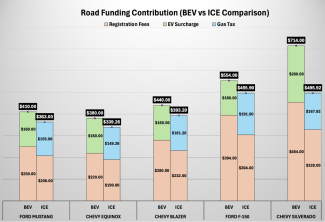
Take the Ford Mustang. The driver of a 2025 electric Ford Mustang (the Ford Mustang Mach-E) will pay about $410 in road funding this year (registration fee + $160 EV surcharge). At the same time, the driver of a 2025 base model gas Ford Mustang will only pay about $363 in road funding (registration fee + gas tax). That's $47 more that the Mach-E driver is contributing to Michigan roads than a gas Mustang driver.
This overcontribution by EV drivers is also observed in other popular EVs in Michigan when compared to their gas counterparts.
- An electric Chevy Equinox driver contributes $40 more per year than a gas Chevy Equinox driver.
- An electric Chevy Blazer driver contributes $47 more than a gas Chevy Blazer driver.
- An electric Ford F-150 driver contributes almost $60 more than a gas Ford F-150 driver.
- The driver of an electric Chevy Silverado, a heavy EV, contributes a whopping $218 more toward road maintenance than the driver of a gas Chevy Silverado.
On average, drivers of popular EV models pay $47 more in road funding taxes per year when compared to their gas versions.
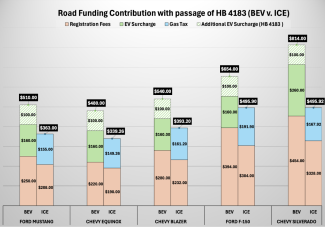
Current Legislation (HB 4183) could result in BEV’s paying hundreds more in EV surcharges
Under Michigan law, BEVs and PHEVs pay an extra registration fee based on the state’s gas excise tax rate. HB 4183 would shift the 6% sales tax on gasoline into the excise tax so more money goes to roads. This change wouldn’t raise the total price per gallon for gas drivers, but it would increase the official excise tax rate by 20 cents. Because EV fees are tied to that rate — not the total tax at the pump — this “swap” would automatically trigger a big jump in EV surcharges, from $160 to $260 for battery electrics and from $60 to $110 for plug-in hybrids. Gas drivers wouldn’t see much change in what they pay, but EV owners would be paying far more — an average of $147 more than their gasoline counterparts.
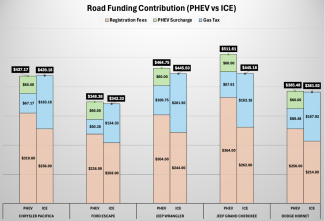
Plug-in Hybrid (PHEV) drivers pay more, too.
Another type of electric vehicle, Plug-in hybrids [PHEVs], can run entirely on electricity for everyday driving (typically in the 20-40 mile range) and can switch to gas on longer trips. Since PHEV drivers pay gas tax at the pump, their surcharge is lower — currently at $60. But they still end up paying $14 more than gas cars in road funding when all is said and done.
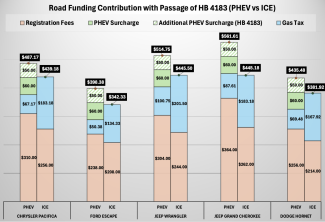
As mentioned above, HB 4183 would also have an impact on the fee that PHEV drivers pay, raising the fee from the current $60 to $110. This increase would result in PHEV drivers paying an average of $64 more than their gas car equivalents, and is illustrated in the graph below.
The Exception: Hybrid vehicle drivers [HEVs]
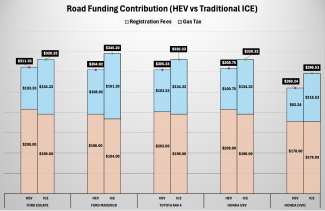
There have also been calls to place fees on drivers of hybrid vehicles that run on gas alone. Hybrids are more efficient than regular gas cars because of a small battery that is powered up while the owner drives and brakes. This power is then returned to the car. On average, drivers of popular hybrid models save about $27 per year in gas taxes compared to regular gas drivers.
Biggest Highway Funding Loss is from New Gas Cars
Close to 99% of all registered cars in Michigan are still gas powered and contribute to gas taxes. However, thanks to engineering advances in new engines, transmissions, and weight reduction, nearly all gas-powered cars have become more efficient, not just hybrids. This means that drivers of newer and more-efficient gas powered cars and trucks are paying less at the pump than drivers of older vehicle models. Since most cars are driven for about 14 years, most of the older, higher-tax-paying models are now being replaced with newer, lower-tax-paying models.
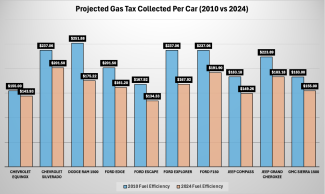
To provide a picture of the potential loss in revenue these replacements imply, we compared the gas taxes paid by the most popular car models in Michigan in 2025 that were also produced in 2010.
The blue bar in the chart below represents the gas tax paid today by a driver of a 2010 model. The orange bar represents the gas tax paid by a driver of the 2024 model of the same car. The result: owners of the 2024 models are paying an average of $43 less per year than owners of the 2010 models.
More efficient gas cars are great — both for the environment and our wallets. Still, when these lower contributions per new car are then applied across the millions of vehicles on Michigan roads, these lower contributions to road funding can really add up.
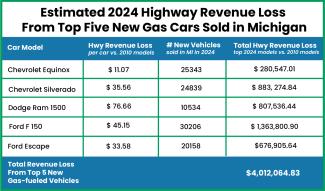
To illustrate this point, we estimated the FY 2024 potential revenue loss represented by the top 5 best selling models in Michigan, which incidentally were all gas-powered. Cumulatively, as shown in the table below, owners of these new gas vehicles contributed over $4 million less in 2024 than owners of older models of these same cars, most of which were likely retired.
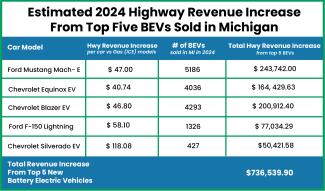
Conversely, owners of the top 5 BEV models in Michigan cumulatively contributed more than $700,000 in additional highway funding in 2024 compared to owners of their gas equivalents. Owners of the top 5 PHEV models paid nearly $100k more.
Conclusion:
Figuring out the best way to fill the gap in road funding revenue is a complicated question. But raising EV fees without addressing the real reasons for declining gas tax contributions would unfairly penalize a small but growing group of cleaner vehicle users — while ignoring the primary source of lost revenue. Passage of HB 4183, without additional provisions that would prevent a hike in EV fees, would further penalize drivers that are already paying more in overall highway funding compared to their gasoline driver counterparts.
Instead, Michigan policymakers should consider:
- Modernizing the road funding model to better reflect all vehicle types.
- Adjusting the language in HB 4183 to ensure that EVs owners don’t get hit with a big fee increase.
- Evaluating usage-based fees that are fair and sustainable.
- Encouraging EV adoption to reduce emissions, improve air quality, and support local jobs.
Bottom Line:
EVs aren’t draining road funds — they're actually overcontributing. Let’s stop the blame game and find solutions that allow all drivers to pay their fair share.
Analysis & Expertise provided by Charles Griffith, Ecology Center Climate & Energy Program Director and Molly Burger, Ecology Center Clean Transportation Coordinator