

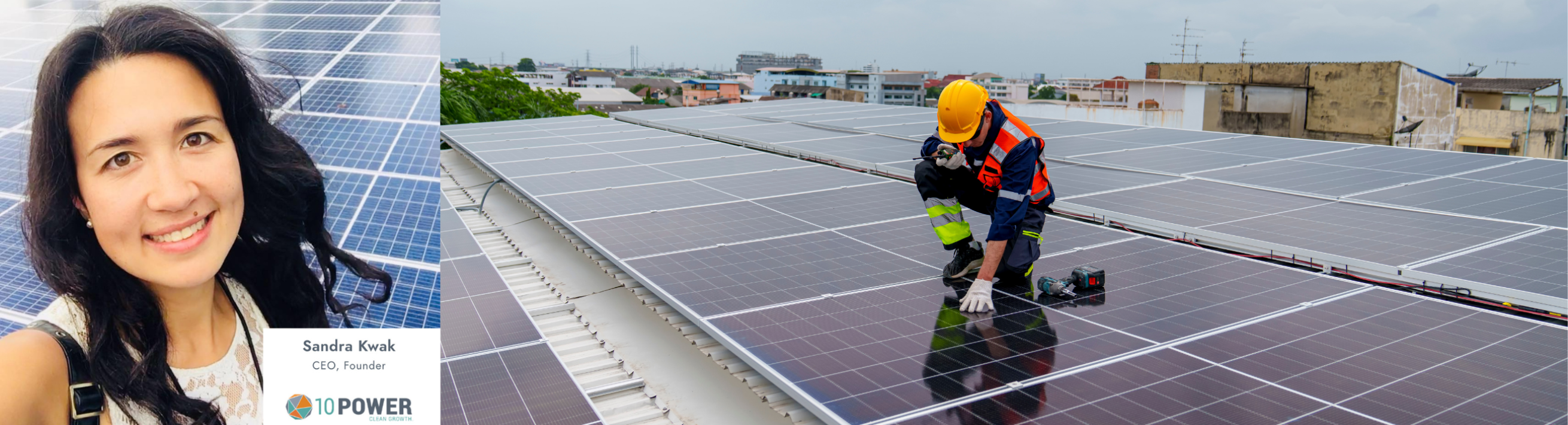
By Trilby MacDonald, Ecology Center Writer

Founded by Sandra Kwak, 10Power is a social impact enterprise that develops community-centered renewable energy projects in the United States and internationally. The Inflation Reduction Act's Direct Pay program opened the door for schools, nonprofits, houses of worship, tribes, and local governments to receive clean-energy tax incentives as direct rebates, making solar and battery projects financially feasible for many communities for the first time.
But organizations hoping to preserve those benefits now face a rapidly approaching July 4 deadline to safe harbor federal tax credits and secure up to four additional years to complete construction. As the window closes, 10Power is raising capital to help organizations lock in incentives using American-made solar panels it has already warehoused. Readers interested in learning more can visit tinyurl.com/10pwr-itc (access code: ITC2026). If you’re interested in supporting 10Power or would like more information, visit their website: https://10pwr.com/contact/
1. For readers who may not be familiar with it, what is Direct Pay, and why was it such a game changer for nonprofits, schools, local governments, houses of worship, and other tax-exempt organizations?
Historically, the Investment Tax Credit (ITC), established under President George W. Bush, provided tax advantages primarily to wealthy individuals, institutional investors, and corporations that invested in clean energy projects.
For the first time, Direct Pay—also known as Elective Pay—allowed tax-exempt entities, including schools, churches, nonprofits, tribes, and municipalities, to receive these incentives as direct rebates. The Inflation Reduction Act (IRA) not only made this possible but also increased rebate percentages based on specific qualifications. A solar-plus-storage project that lowered energy costs for low-income multifamily housing, provided resilience benefits, created green jobs, and was located in a community affected by a coal plant closure, for example, could receive as much as 60 percent of project costs back from the IRS upon completion.
This fundamentally changed who could benefit from renewable energy investments. Instead of being limited to wealthy investors, communities most harmed by fossil fuels and climate change could own their own power sources and immediately realize savings. For many organizations, these rebates brought projects within financial reach for the first time.
2. What exactly is changing on July 4, and why are so many organizations rushing to establish a "beginning of construction" date or safe harbor their projects before the deadline? What challenges are nonprofits encountering as they try to comply with new requirements, including domestic-content rules, documentation requirements, and increased scrutiny of Direct Pay claims?
July 4 is the deadline established by the current federal administration to sunset these tax credits. The recently enacted legislation already ended credits for residential owners. For other organizations, projects must establish a beginning-of-construction date by incurring at least 5 percent of project costs before July 4 in order to safe harbor the tax credits, after which they have four years to complete construction.
The alternative is to fully complete construction before the end of 2027, but many projects take years to develop and place into service, particularly because of lengthy utility interconnection processes.
The political uncertainty has been extraordinary. On June 6, the administration attempted to eliminate the 5 percent safe harbor provision altogether, but a federal court blocked the effort. At the same time, organizations must navigate prevailing wage requirements, domestic-content rules, and new restrictions concerning Foreign Entities of Concern (FEOC) and Prohibited Foreign Entities (PFE), which affect supply chains that include materials sourced from China.
This presents major challenges because China's manufacturing capacity dramatically reduced clean-energy equipment costs worldwide. Finding equipment with no Chinese components is difficult and significantly more expensive. Federal investments intended to expand domestic manufacturing were only beginning to take hold before many were curtailed.
Some organizations we work with have won federal grants but are now participating in class-action lawsuits against the federal government. We have also heard widespread concerns that the IRS is moving slowly in processing rebate claims.
3. Are some clean-energy projects becoming more difficult to finance or no longer financially viable under the new rules? What are you seeing on the ground among the organizations you work with?
Many projects will simply not move forward under these policy changes. Without the ITC, it becomes especially difficult to finance projects in states where utilities do not offer net metering or provide fair compensation for exported electricity.
The ITC created an unprecedented pathway for investment in community resilience and public-serving institutions. For a brief period, schools, nonprofits, local governments, and community organizations had meaningful access to the same financial tools long available to private investors.
A small number of organizations are still moving ahead despite the uncertainty, but most projects have stalled. In response, 10Power has been helping communities preserve access to federal incentives through safe harboring strategies, bridge financing, and forgivable loans.
4. Can you explain how those approaches work and why they are becoming necessary?
10Power is actively raising capital to rescue projects before the July 4 deadline. The company has qualifying American-made solar panels already in storage and can use that inventory to establish safe harbor status for projects. It also assists organizations with ITC (Investment Tax Credit) recordkeeping and Direct Pay filings.
The organization specializes in developing projects that maximize community benefits through blended capital structures. These may include forgivable loans, recoverable grants, and below-market financing that can function as construction bridge loans.
Flexible capital has become essential for managing political risk. If federal incentives disappear or change unexpectedly, organizations should not be left carrying high-interest debt whose repayment costs exceed the energy savings generated by the project. There remain tax-advantaged opportunities for philanthropically minded individuals to contribute, including anonymously if desired.
Readers can learn more at tinyurl.com/10pwr-itc using access code ITC2026.
5. Direct Pay was designed to democratize access to clean energy by extending federal incentives to organizations that had previously been excluded from tax credits. Looking ahead, do you think the program is still delivering on that promise, or are the increasing complexities creating new barriers for the very organizations it was intended to help?
The ITC is ending, and Direct Pay is ending. For a brief moment, there was an extraordinary opportunity for climate justice in this country, and we're trying to help as many communities as possible preserve access to these benefits before that window closes.
In my view, current policies are intentionally undermining the renewable energy sector at precisely the moment when we should be expanding clean generation and storage capacity, particularly to meet growing demand from energy-intensive industries such as data centers while protecting households from rising utility costs.
Whatever your boldest, most ambitious plan for advancing community renewable energy might be, now is the time to pursue it. This effort to safe harbor projects and preserve incentives is our Hail Mary.