

By Trilby MacDonald, Ecology Center Writer
Michigan’s slow but steady population decline is not news, but recent data from the Michigan Department of Management and Budget is alarming: 45,000 workers lost from March-September, 2025, most from the auto industry. And yet, 85% of employers in the clean energy sectors report having trouble filling open positions. In an effort to close the gap, government agencies, trade associations, and public-private partnerships have successfully leveraged corporate, state, and federal funding to train tens of thousands of workers in fast-growing fields like solar installation, energy efficiency, advanced manufacturing, and EV technologies.
But instead of ramping up these efforts to keep pace with the shifting sands of the workforce, the state is slashing the budget of one of its biggest and most successful programs, the GoingPro Talent Fund, by 42%. As a result, LEO projects about 300 fewer employers will receive awards and 10,000 fewer Michigan workers will receive training support over the two award cycles. Michigan's Community & Worker Economic Transition Office and EGLE clean energy grants continue supporting sector-specific training, but there will be no new funding to fill the gap. Without state investment, Michigan is poised to lose more workers than ever before.
Michigan has a vested interest in upskilling its workforce to ensure that the jobs in our state are filled by our workers. The Going PRO Talent Fund and Clean Energy Workforce Grants are examples of state-funded programs that partner with employers who upskill new and incumbent workers into higher-paying jobs with bright futures. This strategy allows companies to retain workers that may otherwise have been replaced with qualified candidates from out of state.
Trade associations such as Clean Fuels Michigan, along with public–private partnerships like the Michigan Economic Development Team Talent Action Team, BlueGreen Alliance, Michigan Energy Workforce Development Consortium, EV Jobs Academy, and the Community & Worker Economic Transition Office are aligning workforce training with evolving industry needs. Together, these initiatives are building strong pipelines that equip and place workers in clean energy careers, ensuring that employees, unions, and employers advance in step as Michigan leads the nation’s energy transition and advances towards MI Healthy Climate Plan goals.
In the story ahead, we look closely at how this ecosystem works in practice — spotlighting energy efficiency company Walker-Miller Energy, a B-Corporation that channels both novice workers and seasoned professionals into clean energy jobs using a braided mix of utility dollars, Workforce Innovation Opportunity Act funding, state grants such as the GoingPRO Talent Fund, and philanthropic support.
Walker-Miller Energy Services
Walker-Miller Energy Services is a Detroit-based, Black woman-owned B-Corporation delivering energy efficiency and clean energy solutions to residents, utilities, private companies, and nonprofits. As a B Corporation, Walker-Miller is bound to a triple bottom line that measures success by social equity, environmental sustainability, and financial stability metrics. This three-pronged approach makes it uniquely positioned to work at the intersection of public, private, utility, and nonprofit sectors to deliver MI Healthy Climate Plan workforce goals.
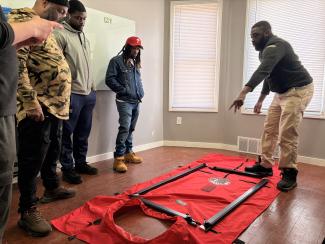
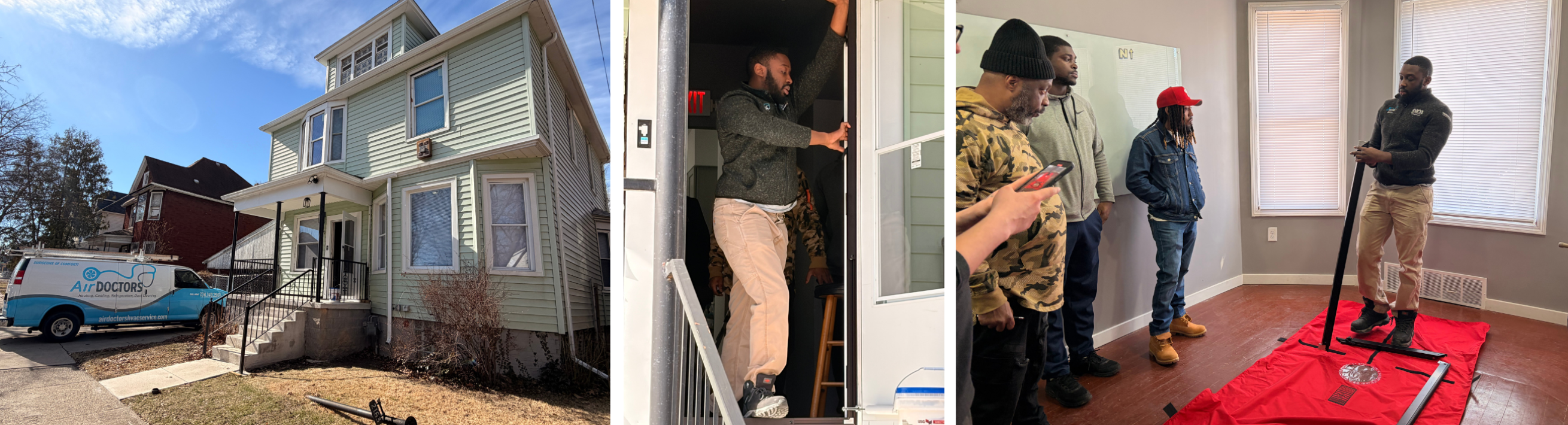
Walker-Miller has a number of programs designed to fill the energy sector’s employment gaps, from utility companies in search of energy efficiency experts, to small business incubation, to training and apprenticeships for a range of specializations. Walker-Miller collaborates with the LEO Going PRO Talent Fund and utility companies DTE and Consumers Energy to ensure that opportunity reaches all parts of the state. Walker-Miller is a registered proprietary school with the State of Michigan and graduates of the UpSkill Cohort and Building Performance Institute Training Program are qualified to accept state and utility company contracts.
Recruitment is keenly focused on communities of color and women. Of the over 200 graduates from Walker-Miller training programs since 2020, 92% are people of color, and 40% are women. Michigan’s Black labor force is on par with the White labor force relative to population sizes, but white men hold a 17% employment lead over Black men. This indicates that Black workers are entering the workforce but encounter barriers to actually landing a job. Women represent 50% of Michigan’s workforce, but nationwide only hold about 28% of clean energy jobs and 5% of construction apprenticeships. Factors like racism and sexism are out of a candidate’s control, but knowing how to perform well in a job interview can be just as important to employers as having the skills to do a job. Walker-Miller helps close the employment gap by providing soft skills training as part of workforce development.
Data from the Michigan Environmental Justice Screen Tool shows that communities with low income and low educational attainment have been disproportionately impacted by climate change and high energy costs. These communities also tend to be racially diverse. By focusing recruitment for clean energy workforce development in these areas, Walker-Miller is maximizing the benefits of family sustaining jobs that do not require a college degree.
Derrick Meeking, Director of Workforce Development at Walker-Miller, engages individuals and business owners looking to gain additional credentials that allow them to expand. “We are trying to grow and scale businesses, also introduce individuals to the clean energy economy through workforce trainings,” he explains. “We find ourselves really being that educational beacon and providing opportunities for folks to enter into these ecosystems.”

Most recruits can’t afford to take training programs, even if they’re tuition free. That’s why wraparound supports are crucial to the program’s success. Trainees receive a stipend and funding for basics like transportation and childcare, as well as instruction in interview skills, resume building, and money management to ensure that they get, and stay, employed. “Many people think the program is a scam because it seems too good to be true,” says Meeking. It costs $12,000 to put one person through the Upskill program, an investment the utilities believe is more than worthwhile to meet the demand for skilled energy efficiency professionals. Word has gotten around, and there are more than 20 applicants for each open spot in the next Upskill Cohort.
The program has created a positive feedback loop in the business community. “Our number one key performance indicator is employment,” says Meeking. “We train and place. We don’t train and pray.” He sees the results every day. “We found that empowering those businesses and helping them scale and grow, in return they come back and hire our folks that have gone through our novice program. So it’s kind of full circle.”

Jonathan Jenkins owns energy efficiency company Target AIR HVAC based in Livonia. He attended the Upskilled Cohort program to expand his business beyond installing high efficiency equipment, because “we’re just more efficient at wasting dollars if we don’t address the envelope as well.” Jonathan explains how a lot of homeowners have oversized heating and cooling equipment that pumps out more energy than they need. With efficiency measures in place, they can downsize equipment, and by adding solar panels, they can save even more money on utilities. He jokes that after the program, he realized how much he had to fix in his own house. “It’s an eye opener!”
Jenkins says there is tremendous room for growth in the field of energy efficiency. “Everybody’s a lot more conscious of their utility bills … So, it’s a great time for us, because it directly correlates with HVAC,” as well as installing clean energy alternatives like solar and geothermal energy.
Jonathan has hired two UpSkilled graduates and has an employee who is currently going through the program. Walker-Miller takes on a few students in each program for on the job training and commits to hiring students out of each cohort. Partnering businesses will typically invite workers that train with them to apply for open positions. “In the current cohort, all fourteen trainees have secured jobs with employment partners in week six in the program,” says Meeking.
Additional Walker-Miller training allowed Jenkins to open a second company, Michigan Energy Auditors, to help people see inefficiencies in their home and business energy systems. “It’s just been such a wonderful experience just from the top down in regards to the Upskilled program,” says Jenkins.

Michigan’s workforce development for clean energy exemplifies a “whole ecosystem” approach, where state tools, utility funding, and community-rooted employers like Walker-Miller Energy Services and Target Air HVAC/Michigan Energy Auditors forge tangible pipelines into high-demand careers in EV manufacturing, battery engineering, energy efficiency, and clean infrastructure trades. Integrating housing, transportation, competitive wages, benefits, and clear career ladders will be essential to attract, train, and retain talent, complementing initiatives like the MI Growth Office and Make MI Home. As federal funding dries up and state budgets tighten, programs like UpSkilled and GoingPro Talent Fund face uncertain futures despite their success in advancing equity and opportunity in clean energy.
With sustained synergy among government, business, nonprofits, and unions — bolstered by predictive planning — Michigan can bridge critical shortages and lead the national energy transition.