


The CDC blood lead reference value is now 3.5 micrograms per deciliter. The state of Michigan should adopt this value to identify at-risk children earlier. |
Lead has no safe level in the body. Scientific evidence shows that even very low levels of lead in the blood are associated with harmful effects in children.1-4
In 2021, the Centers for Disease Control and Prevention lowered its blood lead reference value from 5.0 to 3.5 micrograms per deciliter (µg/dL) of lead in the blood.5 This reference value is used to identify children with higher levels of lead in their blood compared to most children.
Michigan’s current blood lead reference value is 5.0 µg/dL. Aligning state action levels with the CDC’s updated standard means lead-impacted children can be identified and supported earlier.
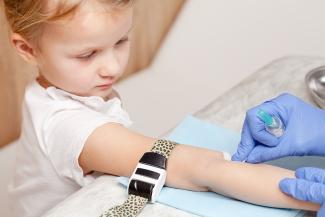
Why This Matters for Michigan Families
In Michigan, lead exposure is most often linked to older housing with lead-based paint and contaminated dust.6 Your family may be at higher risk if you live in an older home or in a community with known lead exposure risks.
In some areas, the percentage of children with elevated blood lead levels is higher than what was reported during the Flint water crisis.6
In fact, lead exposure affects rural, urban, and suburban communities across the state. In addition to Detroit and Grand Rapids, higher rates of elevated blood lead levels have been reported in Kalamazoo, Battle Creek, Jackson, Muskegon, and in the Upper Peninsula.
Acting Sooner Means Protecting Children Sooner
When elevated lead levels are identified earlier, families can take action sooner. Earlier action can help:
- Identify and reduce lead hazards in homes, schools, and child care settings
- Prevent continued exposure before levels increase
- Connect families to supportive services, including developmental programs such as Early On
Early identification creates an opportunity to reduce exposure and support your child’s development during important periods of growth.7
Michigan Policy Solution
HB 4864 (Rep. Julie Rogers) Elevated Blood Lead Level (EBLL) Definition : Drops Michigan's blood reference value (aka: level of concern or action threshold) for lead poisoned kids to the lower amount of either 3.5 µg/dL or the same value as determined by the Centers for Disease Control (currently 3.5 µg/dL), allowing more lead-poisoned kids to receive services.
Matching Michigan’s EBLL Definition to the CDC ensures consistent and science-based action thresholds for lead in children, thus reducing long-term public health costs.
By: Olivia Halabicky M.Sc., PhD, RN | University of Michigan, School of Nursing
*********************************************************************************
References
- Lanphear BP, Hornung R, Khoury J, et al. Low-level environmental lead exposure and children’s intellectual function: an international pooled analysis. Environ Health Perspect. 2005;113(7):894-899. doi:10.1289/ehp.7688
- Nigg JT, Nikolas M, Knottnerus GM, et al. Confirmation and extension of association of blood lead with attention-deficit/hyperactivity disorder (ADHD) and ADHD symptom domains at population-typical exposure levels. J Child Psychol Psychiatry. 2010;51(1):58-65. doi:10.1111/j.1469-7610.2009.02135.x
- Canfield RL, Henderson CR Jr, Cory-Slechta DA, et al. Intellectual impairment in children with blood lead concentrations below 10 µg per deciliter. N Engl J Med. 2003;348(16):1517-1526. doi:10.1056/NEJMoa022848
- American Academy of Pediatrics. Lead exposure in children. Updated May 12, 2025. Accessed February 10, 2026. https://www.aap.org/en/patient-care/lead-exposure/lead-exposure-in-children/
- Centers for Disease Control and Prevention. CDC updates blood lead reference value. Accessed February 10, 2026. https://www.cdc.gov/lead-prevention/php/news-features/updates-blood-lead-reference-value.html
- Institute for Public Policy and Social Research, Michigan State University. Childhood lead exposure in Michigan: it’s not just Flint. Accessed February 10, 2026. https://ippsr.msu.edu/public-policy/michigan-wonk-blog/childhood-lead-exposure-michigan-its-not-just-flint
- Lanphear BP, Dietrich K, Auinger P, Cox C. Cognitive deficits associated with blood lead concentrations <10 µg/dL in US children and adolescents. Public Health Rep. 2000;115(6):521-529. https://pmc.ncbi.nlm.nih.gov/articles/PMC2212280/