
An interview with Sanctuary Farms, co-founder, jøn kent
by Andrea Jacoby, Ecology Center Environmental Storyteller, Rackham Fellow
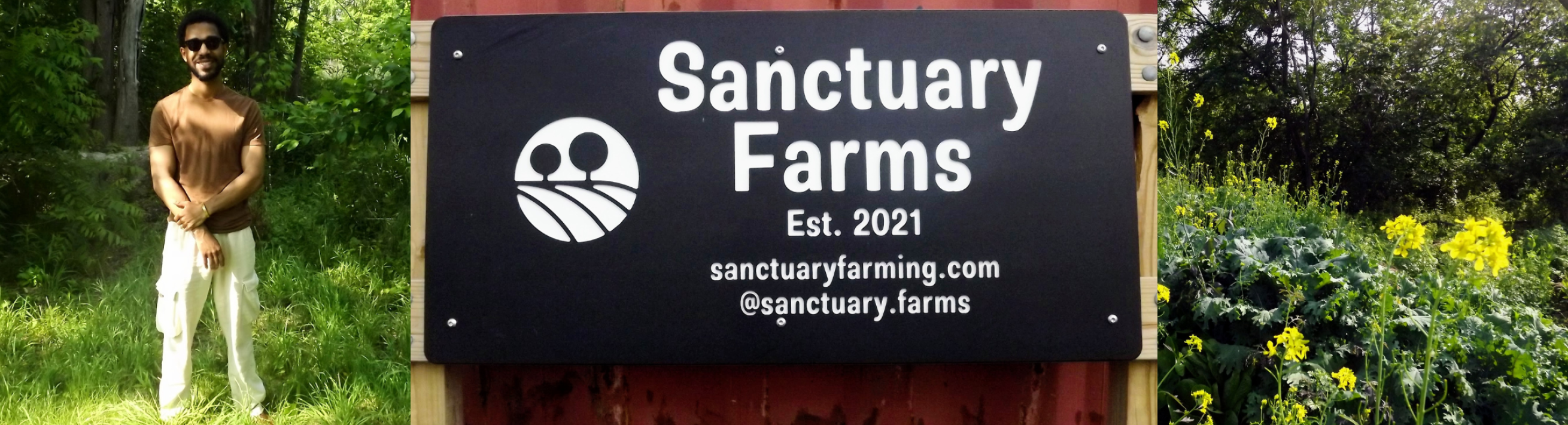
Less than 50 yards down Lakeview Street, off busy Mack Avenue near the edge of Detroit proper, Sanctuary Farms is a lush, quiet oasis that feels far removed from bustling city life. Bees buzz in the farm’s hives near the large hoop house, in which a crop of tomatoes, cilantro, and basil grow protected from the harshest light of the afternoon sun, while across the street, raised planters scent the air with mint. To the right of these planters sits a growing orchard with young fruit trees; on the left, a compost pile that well exceeds my 5’2” height. Now in its fourth season, Sanctuary Farms’ project – to restore the land and our connections to it, our food, and our larger ecosystem through stewardship rooted in reparative justice – exceeds a simple mission of growing food (though that is one of the many things they do). The philosophy of stewardship that guides Sanctuary Farms and Sacred Spaces is their coined acronym, WASANA (Water, Air, Soil, Agriculture, and Nature Access), which, by serendipitous coincidence, is also a Thai name translating to “lucky” or “fortunate.”

We were fortunate to sit down with jøn recently to talk about some of the ways in which Sanctuary Farms and Sacred Spaces enact WASANA through programming, advocacy, and collaboration (including as a partner organization of Ecology Center and Clear the Air). Born in Detroit, kent, a co-founder of the farm, Taubman College master’s student alumni, and former Hollywood actor (now he can be found on stages in the Detroit area), centers deep connection in his approach to the farm: the plants, the compost, the earth, the city and its citizens all have parts to play in realizing a transformative vision of food justice in Detroit.
(This interview has been edited for clarity and length.)

Andrea Jacoby: How did you start Sanctuary Farms?
jøn kent: I started Sanctuary Farm with Parker Jean, who is a brother of mine in this work. We were both in a situation where we were 27 — close to 25, because I usually say that was our quarter-life crisis — where we were just trying to figure out, like, how are we going to do something that was going to be a benefit to not only ourselves but the community and the environment? He mentioned that compost wasn't being fully done at the magnitude that it could be done in the city. This was, like, late 2019, then speeding into 2020, COVID was happening. We brought back an idea that I wanted to do back when we originally met at Santa Monica College to start a farm and I said 'why don't we start a farm too?' And unbeknownst to us at the time, we were on the journey of closing the food loop.
AJ: So how does one start a farm?
jk: I think the biggest thing is knowing where you want to root yourself. And being ambitious and passionate enough to move past your ignorance, but also being humble enough to learn. One of the biggest ways, and another thing, because we live in a world that requires it, you're going to have to have a little bit of money. Or at least try to figure out how to get access to the certain amount of money that you need to get started out.

AJ: How did you decide to root yourself in Detroit?
jk: I'm from Detroit.
AJ: You're from Detroit!
jk: Yeah, I have the great pleasure.
AJ: Is [Parker] from Detroit?
jk: He is not from Detroit. He is from Texas originally. But as life would have it … He has ancestry here. His great-great-grandfather immigrated here as an Italian immigrant. Raised his great-grandfather, and then his great-grandfather raised his grandfather, grandfather raised his mother here. They moved to California. Then their mother would move to Texas. So it's kind of retracing back to his roots.
AJ: So it makes a lot of sense, then, to decide. Where are we going to do this project? We're going to root ourselves in Detroit.
jk: Yeah. Yeah, you know, Detroit has a very rich history of farming — even, like, pre-colonial. Then, you know, hopping over the colonial age where you get into the V-gardens, Victory Gardens that were big around the country [during WWII]. Then you get into Farm-A-Lot programs during the Coleman Administration. Then you get into kind of the modern-day urban farms that took hold because of the massive amounts of austerity and systemic injustices that people had to endure. So, they just went back to the roots, and all puns intended.

AJ: You mentioned closing the food loop. What do you consider as Sanctuary Farm's mission, and how does closing the food loop figure in?
jk: Closing the food loop means that we want to make sure that this cycle is regenerative and in line with most of how nature operates. We, as species, are the only ones that I have been able to come across that create trash. And trash essentially means something that cannot be put back into use. That is not in line with the true harmony of nature. Everything, either biotic or abiotic, are all regenerative in nature. We want to get back to that indigenous way of living. So what that means is we're making sure food waste is not going to the landfill to push out methane, which is a very hard greenhouse gas. That could be used instead to create compost. We need really healthy soil, and that, unfortunately, is being impacted too by the proliferation of a lot of single-use plastics.
AJ: What are some ecological challenges that urban farms face that farms in traditional rural settings might not?
jk: I would say there is a lack of funding that comes from the federal government. A lot of programs are based on acreage and a traditional monocropping style of farming, and a lot of urban farms that I have come in contact with are mostly on the side of being regenerative permaculture. But there are a lot of commonalities that urban and rural farmers face. Farming is not something that a lot of young people are venturing into, so we're seeing our agricultural population dwindle, both on an urban and rural scale. There's also, particularly in spaces that are Black and Brown, that still face a lot of environmental injustice. So, as much as there is some difference, there is a lot of alignment in the challenges that we face. I think the biggest thing that really kind of connects us all is I think generally people who are in the space of agriculture want people to have access to good food, and they want to have a good living doing that work.
AJ: How does Sanctuary Farms benefit the surrounding community? Where have you seen the food that you're producing already impacting the community? Where do you get to watch the fruit…
jk: Fruits of our labor?
AJ: Yes, exactly!
jk: We're actually in the process of revamping our farm. We're really scaling back our agricultural production right now.
We have an outside growing area over there [pointing to the land further down the block] where we stripped out the grass and are now just growing yarrow, because we had, like, wood chips in the middle for the walking area. We want to redo that. The hoop house is our only growing space at the moment.

We got into this work, you know, saying, oh, we want to be able to provide fresh produce to community members at a very low cost. But in the process of doing that, as a business, we started to run away from that mission because we were trying to figure out how to make ends meet. We started to sell to high-end restaurants, until we started to think, you know, this is not what we got in this for. A lot of this work is very philanthropic in that it wants to just make sure that people have access to good food. Our whole food systems in general needs a recalibration of our connection to why we got into this work. Is it to make money, or is it to feed people good food? And a lot of times, those are at odds with one another, and we need to really situate which one matters most.
So now we have created Sacred Spaces, which is a sister organization to Sanctuary Farm. Sacred Spaces is a non-profit. Sacred Spaces will focus on farming, programming work, volunteer days, and teaching. Sanctuary Farms now would just be focused on the composting cultivation to bring that to market, so we can really hone in on our passion for giving away produce to people for free, if not for very low cost.
AJ: What are some ways that folks who want to get involved with this work can contribute? How can community members participate?
jk: We have this great opportunity called Rooted in Riverbend: Closing the Food Loop, in which we're going to be offering cooking classes, gardening classes, we'll be giving away free CSA boxes, and also composting classes. So it's kind of a robust program to connect the community to the work that we're doing and to provide an outlet for education and spaces in which they can grow and compost here. We're also big on food sovereignty, and what that means is that people have actual control and say over what is grown. And also, they have food justice and access to food directly in our community. The far-out goal is to be able to put some of this land into a community land trust, and that we're able to grow enough food to feed all the residents within Riverbend, about 2,600 people. I do think it's very doable with the amount of land that's in the neighborhood. And [we also want to promote] nature equity. Right now, we're sitting in our nature nook. We want folks to be able to know that they have the opportunity to freely come out and just be with and in nature.
AJ: What are some recent additions that you're really excited about?
jk: There's just so much. As I mentioned, we're working to acquire most of the block to turn most of it into a nature sanctuary, so we're working with landscape architects and our community members to push that work forward. We're, of course, doing the Closing the Food Loop programmatic work, which I really hope folks will tap into. We're gonna be doing some events out here. We have our June 20th Summer Solstice event coming up.
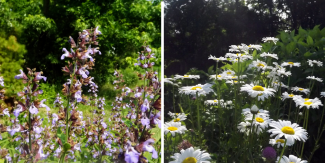
We're also going to be doing a Fall Equinox to just show love and respect to the seasons and show gratitude to the ancestors and nature.
I'm involved in a lot of policy work — pushing for the composting and that it can be increased on a decentralized scale, both backyard, community, and industrial. I'm also involved in the policy for urban farmers in Detroit. I believe, in order to scale the work that's happening in the city of Detroit. We need our council and mayor to subsidize some of this work. Especially at a time where we're seeing a lot of divestment at the federal level, how do we build that local autonomy?
AJ: What are some of the challenges that you’ve faced so far in policy work? For example, you mentioned that, like, you're trying to advocate for composting. What does advocating for compost look like in practice?
jk: Well, I think, using Riverbend as a microcosm for the City of Detroit, Detroit has faced so much divestment. Composting is just not a priority for a lot of people. When people are hungry and people need new roofs, when people don't have good mass transit to get to work, and you're like, 'we should compost.' They're like, what are you talking about, bro? You have to really reach people where they are, to show them that this is not going to be an encumbrance on your lifestyle, and this is also something very important for the land and community. That's something I've had to learn a lot about, because, you know, when we did some door knocking over here and told people about the work that we're doing, people would be like, "cool, alright," [as he says in a dismissive tone] you know.
AJ: "That's fine, but what does it have to do with me?"
jk: Mm-hmm. And it took me a while to understand that, because, you know, I'm an environmentalist. I've been able to make a pathway financially to make sense of this where a lot of folks are struggling, you know? How do we, again, reach people where they are? There's that, and then there's also people in positions of power who don't see this being feasible. They just see it being cumbersome, because it's another thing. Meanwhile, some of these people don't even live in Detroit, and where they live, they have composting services. But outside of that, I'm really encouraged by the community of folks that are diligent and are moving this work forward and care about this work. We have a very strong, strong environmental justice and food sovereignty movement, centering equity, and want to make sure that it goes to the most vulnerable of communities, particularly Black and Brown.
AJ: How does compost help the soil?
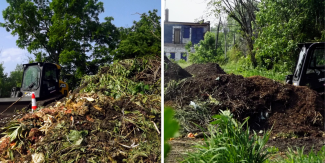
jk: Compost is a great soil amendment. Think of compost as like a supplemental pill you would take after a workout. You shouldn't be popping it in every day, you could actually kill a plant with too much compost, but with the proper proportion it could really help activate it stronger than regular dirt. We tested the soil here before we started composting and gardening, and it was, you know, in the clear. When we started, we didn't really have access to resources to see before and after we've composted in the area, and what that's done to the soil. We have observations that we feel that it has done great for the soil here, but we would like hard data to prove that. We do have hard data to show that our compost is very high quality. I'm very happy and impressed with what Parker [Jean, co-founder and Director of Operations at Sanctuary Farm] has been able to create, and Dan [Szczepanski, who runs the farm’s compost operation] has been able to extend.
AJ: Can you tell us about what work you've done with the Ecology Center so far?
jk: Shout out to the Ecology Center. My first introduction to the Ecology Center was through Jeff [Gearhart, Ecology Center Research Director] when we put up the air quality monitor. We were able to make connections with the folks at JustAir. And shout out to the folks there, Darren [Riley, Co-founder of JustAir] and the rest of the team. Through our connection made through Jeff, with Just Air, they then put another air quality monitor down the street. A second project that we're currently working on is our PFAS testing with the composting. As we know, PFAS are very dangerous chemicals that are in everything and everyone at this point. Erica [Bloom, Toxics Campaign Director at Ecology Center] and Gillian [Miller, Senior Scientist at Ecology Center] reached out to us to do a study on our compost and see what was in there — not so much the likelihood, because we kind of already know it's going to be there, but what is the extent of it, how much, and what exactly? We're part of Clear the Air as well, which is a coalition co-founded by the Ecology Center. And we’re working with the Ecology Center on funding for the Materials Management Plan at the county level.
AJ: How do you see collaboration emerge as a core value in your work here?
jk: I'm a person that just naturally believes in abundance. You just can't tell me what I can't do.
I knew people who knew people, and knew this work. Some of the people … like Erma [Leapheart, of Sierra Club Michigan], I never got the chance to really work hands-on with her, but I've always respected her, and I always thought she was just so graceful. And when that opportunity came up to work in water, I was like, okay, I'm calling her. I was just kind of forming a relationship. I also called Tepfirah [Rushdan] — she was at KGD [Keep Growing Detroit] at the time, which is a great organization that does a lot of work for urban growers across the city of Detroit. I also was in community with Canfield Consortium – there were more funds to be had if there was a partnership between us, so I reached out to them. They're just a couple neighborhoods away from us. I actually need to call them. It's been a minute. I'll just close off on … We were able to lobby the city to build Wabash systems for urban farmers across the city of Detroit. That's gonna be rolling out in a couple months or so. Pretty amazing what advocacy and lobbying could do, when we work together.

###
During the hourlong drive back to Ann Arbor, the very first thing I resolved as I mulled over our conversation was to get a compost bin. Ann Arbor, as jøn alluded, is a community blessed with a robust municipal compost program of the kind that Sanctuary Farms is working on building at this very moment. Talking with him reminded me that I already divert portions of my trash into alternate streams when I separate plastics, paper, and metal for recycling. Diverting food waste, first into a countertop bin and then into a curb cart, is even easier for me than the average person. Speaking for myself, the only reason I think I hadn’t been doing it all along was that I needed to be reminded why it was important.
While contributing in our small ways will always be important, systemic change is necessary to create a sustainable future for everyone. Despite our pessimism in the wake of the passage of the Big Beautiful Bill, which has gutted much of the federal financial support for environmental programs and initiatives (among the many other terrible outcomes forecasted), all is not lost. What we can and must do is turn to our local communities to make the changes we need to see. Recycle Ann Arbor is one of the largest recycling programs in the country. Ypsilanti is one of the top 20 solar-producing communities per capita in the entire United States thanks to the Solar Ypsi community-led project. If programs like these don’t operate where you live, the work of Sanctuary Farms and Sacred Spaces have shown us that all it takes to get things moving is having a “well, why couldn’t we?” attitude and just enough to get started.