


By Yuki Nakayama, Ecology Center Writer
The Ecology Center partnered with local Detroit environmental advocate, Theresa Landrum, to test soil for PFAS contamination in neighborhoods around the Gordie Howe International Bridge construction site. The testing provided a snapshot illustrating the need for stronger community protections and proactive monitoring for PFAS.
Landrum, who initiated the soil testing project, has been a local environmental justice advocate for 20 years. She is part of two statewide groups: the Michigan PFAS Action Response Team (MPART), and Michigan Advisory Council on Environmental Justice (MAC-J).
Through conducting science side-by-side with impacted communities, our testing collects necessary data to help shape local and national community-centered solutions. To date, the Ecology Center Healthy Stuff Lab has studied PFAS in air, surface water foam, drinking water, fish, and now soil. PFAS are a persistent form of environmental contamination that can cause serious health issues.
In Michigan, polluting facilities are permitted to be built close to residential areas. These residents are directly exposed to industrial pollution from toxic chemicals and may experience long-term health effects from contamination even after factories close or pollution stops. Gordie Howe Bridge Construction Project is no exception.
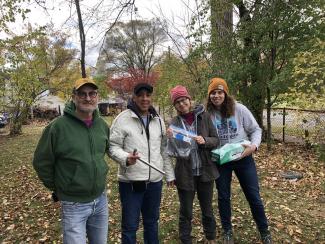
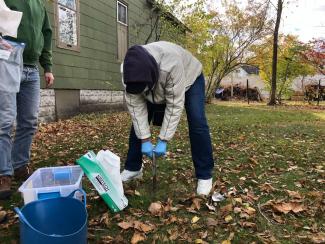
In November 2024, we collected soil samples as close as possible to the original land parcels sampled for the Baseline Health Impact Assessment report by the city of Detroit. The site is currently under construction, so the original land parcels that the state sampled were not accessible for sample collection. For this reason, we could not directly compare our samples with the report’s environmental samples. We used the EPA 1633 testing method, which tests for 40 different PFAS chemicals. It is important to test soil for PFAS in neighborhoods near potential pollution sources because there are no state or federal standards for PFAS levels in soil. This means that, unlike in drinking water, there are no maximum levels in soil that would trigger cleanup initiatives. Without standards and minimal testing, we are far behind in understanding PFAS in soil.
Results from the study reflect the continued need to raise community awareness, push for stronger regulations that immediately restrict the use of PFAS, and to hold industries responsible for both prevention and cleanup.
Prevention measures are critical because studies show that PFAS leaching into our environment is out-pacing current cleanup efforts. The challenge of PFAS cleanup comes from its widespread contamination, its inability to break down in the environment, and the serious health risks it poses.
What is the Gordie Howe International Bridge Construction Project?
Construction on the Gordie Howe International Bridge started in 2018. The construction spans about 190 acres of land in southwest Detroit (bound by Fort Street, Jefferson, Green Street, and Campbell in the Delroy area). Historically, the neighborhoods in this area have been surrounded by heavy industry and commercial properties.
For this new bridge, entire neighborhoods were relocated to make way for it. The communities impacted came together to make demands. The Bridge Project hired a service to do PFAS remediation work on the site.
In the last couple decades, industry has crowded the fenceline neighborhoods more and more. Large scale infrastructural developments like the bridge will bring more industry encroachment in the area. This bridge would likely increase diesel fuel traffic (by large trucks) in the area, contributing to air pollution and spurring additional polluting industrial facilities who would benefit from the close access to the bridge.
The cumulative impacts of pollution from large infrastructure projects often go unrecognized in urban planning. Ecology Center and its partners in its Clear the Air coalition support the enactment of the Protecting Overburdened Communities Act which would require all pollution sources surrounding a proposed project be considered prior to authorizing new sources of pollution into a neighborhood.
What Our Test Results Tell Us
The data shows that there are PFAS in the soil near the construction. We cannot determine how much PFAS were caused by previous industry presence before the construction, if construction activities contributed to PFAS, or if other factors (e.g. rain deposition) may have contributed to the results.
PFAS are everywhere, and even if PFAS are not found in a city’s drinking water, they can be in air pollution and soil contamination. We need strong and effective solutions with human health at the center to hold industry responsible for the harms they cause.
Our test results showed that PFAS levels near the bridge construction site were higher than in undisturbed areas away from human activity.
We found three "legacy" compounds in the samples (PFOS, PFOA, and PFNA), suggesting that their origin is from historical industrial activity. “Legacy” compounds are PFAS chemicals no longer in use, but due to their “forever” nature, continue to pollute for decades longer.
In the soil samples, PFOS were the major PFAS chemical detected. The chart below shows a comparison of PFOS levels in different samples. “Lawn near Gordie Howe Bridge” are samples collected by Landrum.
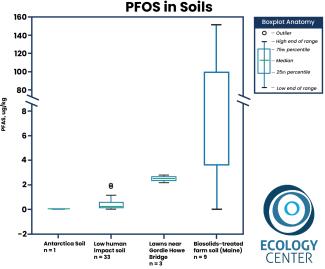
The PFAS compounds found in the Gordie Howe Bridge construction site samples point to contamination occurring through previous industrial activity in the area, showing the long lasting presence of PFAS even after its original pollution sources are removed. It shows that this community has higher PFAS levels than areas with little industry or human activity, but, as a comparison, the levels are lower than farm lands with biosolids. It does not show if or how much the Bridge construction is impacting PFAS contamination in the local communities.
Erica Bloom, Ecology Center Toxics Campaign Director, emphasized that “this is just a snapshot. It doesn’t tell the full story.” The results require contextualization — especially as to how PFAS leaches into water, soil, and air and can also dangerously interact with other chemicals. PFAS pollution is complex and strong prevention measures are immediately needed as we continue to monitor PFAS levels.
Urgent Need for State or Federal Regulations for PFAS in Soil
We need strong federal and state regulations to limit PFAS in the environment. Voluntary Industry phase-outs have started for legacy PFAS, but many industries are still creating and using new PFAS. For example, PFOS (a type of PFAS) have been banned from firefighting foam, but it will continue to exist in the environment long after the ban. These chemicals also continue to be used in areas that are not specifically banned contributing to ongoing contamination.
“Reports of high levels of PFAS (per- and polyfluorinated alkyl substances) in Michigan’s waterways came as little surprise to those of us at the Ecology Center in Ann Arbor. We’ve long advocated for stronger environmental protections when it comes to the tens of thousands of synthetic chemicals currently used by industry. Until our society commits to regulating harmful substances as chemical classes, rather than one by one, this story of chemical bad guys and disillusioned communities will continue to repeat.” - Gillian Miller, Ph.D. Ecology Center Senior Scientist
PFAS are not static — they move through the environment through the water cycle and leaches into other areas like dust, air, etc. There is a need to expand research on PFAS and how they behaves in different environmental media such as soil, air, and dust. Currently there is some research on PFAS in areas such as dust on farms, but because there are many different types of PFAS, it makes research results limited and difficult to compare.
EGLE consistently collects PFAS data and now has a growing number of data collected on local areas (Detroit) so that we can compare our results and place them in better context than before. Our test results will help contextualize future results. Building data collection is crucial to understanding PFAS contamination’s long-term impact.
The complexity of the PFAS issue pushes us to find a collaborative approach and collective solution. Community-based local testing projects like this one expand our knowledge of PFAS and help create solutions for people who are already impacted by it.
If you have PFAS contamination concerns about your water or soil, you can send samples of soil or water to a lab for testing. For a list of participating labs visit https://qrco.de/bgBwDe.
References
Data for Antarctica and low human impact U.S. soils from: Rankin, et al. A North American and global survey of perfluoroalkyl substances in surface soils: Distribution patterns and mode of occurrence. Chemosphere 161, 333–341 (2016).
Data for biosolids-treated farm soil in Maine from: Maine Department of Environmental Protection. Sample Collection - Data Report Summary (2017).