

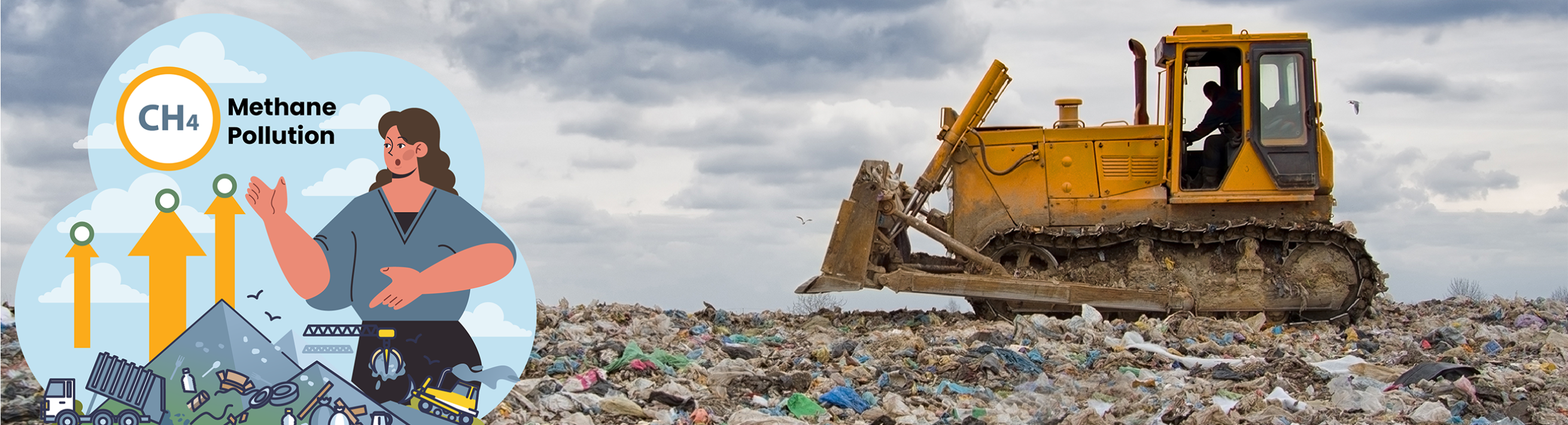
When food scraps, yard waste, and paper break down in landfill conditions (without oxygen), they release methane, a greenhouse gas more than 80 times more potent than carbon dioxide.
Michigan landfills that capture methane and convert it to energy are rewarded with Renewable Energy Credits. But, many landfills receiving these credits still release significant amounts of methane. Without updated standards, polluting landfills can benefit from “clean energy” subsidies while still spewing dangerous amounts of methane into the atmosphere and the local environment.
Why It Matters
Climate Impacts
Michigan is the sixth largest emitter of landfill methane in the country, emitting an estimated 11 million metric tons of CO₂ equivalent in 2023. This equals about 2.6 million gasoline-powered vehicles driven for one year, according to EPA’s Greenhouse Gas Equivalencies Calculator.
Health Impacts
Methane contributes to ground-level ozone, which can worsen breathing problems, heart disease, cancer and strokes. Nearly one in four Michigan residents lives within five miles of a municipal solid waste landfill. And landfills are often built in low-income communities and communities of color that are already burdened with pollution. Methane from landfills can contribute to cumulative health impacts in community members. This happens when pollution from multiple sources interacts, builds up, and causes health problems.
Best Practices
A 2023 state law requires landfills receiving Renewable Energy Credits to follow “best practices” as defined by Michigan’s Department of Environment, Great Lakes, and Energy (EGLE). EGLE, however, has yet to define what “best practices” include. Five practical solutions can dramatically cut landfill methane emissions. We suggest:
- Better Gas Collection: Requiring automated wellhead tuning systems that continuously monitor press and gas quality to reduce methane leaks in real time.
- Stronger Pollution Controls: Ensuring all flares and treatment systems are enclosed and destroy 99% of methane. Require regular performance testing and monitoring of flow rates to track effectiveness.
- Better Landfill Covers: Limit the size of active dumping areas and require timely cover installation to reduce emissions. Require methane-oxidizing biocovers for long-term unused areas.
- Modern Methane Monitoring: Adopt satellite, drone, and continuous monitoring techniques to monitor the landfill and help guide repairs. These tools are cheaper, safer, and more effective than old-fashioned walking surveys that miss or ignore large areas.
- Public Transparency: Require landfills to provide public, accessible reporting of all monitoring data and corrective actions so communities know what’s happening.
(more on the 5 best practices on our landfill methane page)
Michigan is Not Alone
Other states like California, Colorado, and Washington have already taken action to pass state-level landfill standards that rely on the latest science and technology. These state standards go beyond outdated and weak federal landfill regulations set by the U.S. EPA.
What’s at Stake
EGLE will soon define “Best Practices” for landfills that capture methane. Now is the time to make sure the State of Michigan has effective rules for landfills to follow.
What Can You Do
Attend EGLE’s July 9th Webinar on Michigan Landfill Gas Management Best Practices. REGISTER HERE