


By Molly Burger, Clean Transportation Policy Coordinator
If you’re a resident of one of Michigan’s rural counties, you may be curious about the idea of owning an EV, but question, “Would an EV be right for me?” Many rural drivers interested in EVs ask themselves this. In fact, a University of Michigan study finds that residents of rural areas, in particular, need greater certainty about public charging, at-home charging, and EV costs before deciding to switch to an EV. So, if you are a rural driver, could an EV be right for you?
Public Charging
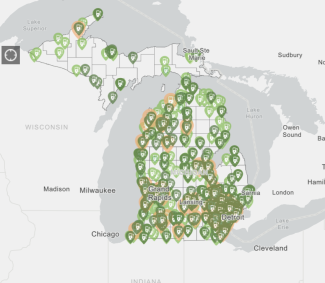
As of 2026, Michigan has over 3,700 public chargers installed across the state.1 While public chargers are more abundant in urban areas, they are increasingly being installed in rural counties as well. The map below, created by Michigan’s Office of Future Mobility and SEMCOG2, shows the locations of public EV chargers across the state. On their website, you can type in your address and locate the nearest chargers (there are many useful tools on their webpage, but for the locator tool, scroll partway down the page. You’ll find it to the right of this map).3
If you find that the nearest charger isn’t as close to your work or home as you’d like, this could change soon. In fact, Michigan is adding more chargers using state and utility funding, as well as another 60 fast charging stations from federal grants. Many of these chargers are also located on highways alongside gas stations, which makes taking a road trip with an EV a similar experience to taking a gas car.
Many public chargers, sometimes called “level 3 chargers,” are fast chargers that can fully charge a car in about 30 minutes. A full charge for an average EV manufactured in 2025 is nearly 300 miles, but this can vary significantly based on the model, with top-range EVs boasting around 500 miles of range. It’s worth noting that cold weather reduces EV range, as demonstrated in this Consumer Reports article, but these impacts are getting smaller as EV engineering improves4. While public charging is popular amongst EV drivers, many choose to charge their vehicles at home. This is a great option for those looking to ‘charge while they sleep.’
At Home Charging
Most at-home charging involves either a “level 1” or “level 2” charger. Both can be a great choice depending on your preferences. Level 1 chargers are the slower of the two, but are still the charger of choice for many EV drivers with standard daily commute distances. This is because charging your car overnight while you sleep using a level 1 charger, which uses a standard electrical outlet, results in around 30-40 miles of charge (about 3-5 miles of charge per hour)5, which is enough for most commuters to make it to and from work and run a couple of errands. Level 2 chargers are faster, offering about 25 to 40 miles of charge per hour.6 These chargers are becoming more popular due to decreasing prices and the convenience of delivering a full charge more quickly.
This guide by the EPA can help new EV owners through the home charger installation process. The costs of installation can vary from a few hundred dollars to a few thousand, depending on a few factors, and should be taken into account by new EV owners. Fortunately, utility rebates can help lower the installation cost, and both DTE and Consumers Energy offer rebates to qualifying customers.
Often, EV drivers install a level 1 or level 2 charger at home, and when traveling, use fast chargers, which are commonly located along highways at rest stations.
Cost of an EV
The cost of EVs is another concern amongst rural drivers; however, EVs can actually save money in the long term, depending on the model and other factors like gas prices, which are currently at a high point.
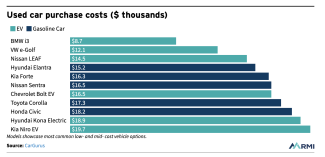
The notoriously high price tags from the past now generally apply only to luxury EVs, with many new EVs now on the market in the $30k to $40k range. Popular models around the 30k mark include the Chevrolet Bolt, Chevrolet Equinox, Nissan Leaf, and the Hyundai Kona, among others. The Ford Mustang Mach-E is also a top-selling model and only slightly more expensive than its gasoline equivalent, starting around $38k. With the average price of a new car (gas or electric) in 2026 at $49k7, many electric models still come in well below that. Used EVs are an even better deal, with some listed below $10k. The graph below illustrates these savings, with used EVs (in light blue) on par with gasoline cars (dark blue). A few of the EV models are even significantly less expensive.8
If you’re looking to save money, a new EV will be more expensive than the same car in a gas model, but that gap is closing.
You can find used EVs near your zip code for your desired price using this resource by Electric for All, a nonprofit focused on EV education. They also have this handy “EV Savings Calculator” that you can use to calculate a rough estimate of how much an EV could save you annually, by plugging in factors like how much you drive, the cost of gas where you live, and what type of EV you would buy. There are also several other useful resources covering how to charge an EV, locating a charger near you, and finding rebates to lower the cost of purchasing an EV.
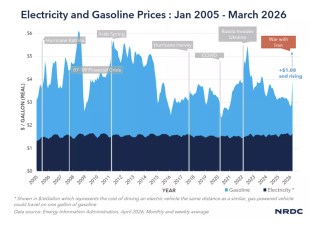
Of course, the cost of electricity can be a concern, but gas has always been considerably more expensive on a per-mile or “e-gallon” basis. The graph below shows the prices of gas (light blue) versus electricity (dark blue) between 2001 and 2025, with electricity always coming out as the clear winner for our wallets.9
Maintenance costs are also lower for EVs, and according to NRDC, “EV maintenance and repair costs run about 40 percent lower than comparable gas vehicles.”
To summarize, here are a few key points on EVs and cost:
- Used EV drivers see the biggest savings compared to both gasoline drivers and drivers of new EVs.
- Both new and used EVs have lower fuel and maintenance costs than gasoline cars.
- New EVs may cost less than gas cars over total lifetime ownership, despite higher upfront costs.
Deciding on your next vehicle is no small task; however, considering an EV could end up saving you thousands of dollars.
Sources
https://www.cleanfuelsmichigan.org/2025/02/mi-keeps-ev-charging-plans-on-track-despite-federal-cuts/
SEMCOG is a planning partnership between several MI counties
https://www.epa.gov/greenvehicles/getting-started-horound-tripLevelme-ev-charging
https://www.epa.gov/greenvehicles/getting-started-home-ev-charging
https://rmi.org/tired-of-gasoline-prices-heres-a-surprising-way-to-save-money/
https://www.nrdc.org/stories/electric-vs-gas-cars-it-cheaper-drive-ev#gas