


Besides the few that have taken on a zero waste lifestyle, all of us produce trash on a daily basis. Much of the trash we produce ends up in landfills in and outside of our state. In an ideal world, we would not need landfills, as everything would be repurposed, reused, recycled, or composted. Unfortunately, we currently rely on landfills as the final resting place for most of the trash we produce individually and industrially. The methane gas created by the organic materials (food scraps, yard clippings, and paper) that end up in landfills is the third largest source of industrial methane emissions after oil, gas, and livestock sectors. It accounted for 14% of U.S. methane emissions in 2022.
However, methane gas emissions are often underreported, under-addressed, and underregulated. In many cases, methane is placed low on the priority list for policy makers, despite the fact that reducing emissions can make a major impact on slowing down the climate crisis and protecting human health. Mike Garfield, Ecology Center Director, stressed that unlike many issues that frequently require major federal levers to make significant dents, “methane emissions can be and needs to be addressed locally. There are many local opportunities to make a significant impact.” This is because trash collection and waste management is a state and local matter. Garfield also stated that now is the time to take on these state and local level opportunities to address this issue.
“[A] small action can directly improve lives locally and globally.” - Melissa Cooper Sargent, Ecology Center Environmental Health Advocate
Melissa Cooper Sargent, Ecology Center Environmental Health Advocate, also described the landfill methane issue as a “low hanging fruit we’ve been ignoring.” “There are many easy things individuals can do that are no cost or low cost that would make a real difference in the climate change issue. It is an issue where an individual’s small action can directly improve lives locally and globally. It can be a ‘feel good’ type of thing that actually has real reverberating effects.”
Ecology Center is leading the local fight against landfill methane emissions in Michigan. We are working on bringing awareness to it by sharing crucial information about the current state of the problem, advocating for stronger protections, and encouraging community involvement through collective and individual actions. Unless they live next to a landfill, most people are unfamiliar with how they impact our environment and health. This is why we want to create conversation about landfills and our trash!
Landfill Methane: An Odorless and Colorless Super-Pollutant
Methane gas is an odorless and colorless super pollutant. It comes from: 1. The breakdown of organic matter in places like swamps and landfills. 2. The formation of fossil fuels deep underground over time.
Methane is approximately 80 times more potent than carbon dioxide in the short term and a major contributor to the acceleration of global warming. The gas has dangerous explosion risks, but it is difficult to monitor without special sensors. It also contributes to ground-level ozone, which can worsen breathing problems, heart disease, cancer and strokes. Worse still, methane is released alongside a host of other toxic air pollutants. All this combined gives it its super-polluter status.
EPA Regulations Are Not Enough
One of the major issues with landfill methane is that many landfills are often in violation of federal regulations. Industrious Labs, an environmental nonprofit, concluded that EPA’s regulations are not enough to prevent landfills from emitting methane at rates that accelerate climate change. In many cases, landfills are releasing higher amounts than facilities report to the government. According to the EPA’s ECHO Database, in 2023, 90 landfills were operating in violation. Similarly to Industrious Lab’s conclusion, the Environmental Defense Fund’s (EDF) satellite analysis showed that total US emissions were double what the EPA reported. While the EPA reported 3.7 million metric tons of methane released from landfills in 2021, EDF estimates over 6 million metric tons of methane were released into the environment.
Landfills are often created in low-income and underprotected communities of color — we do not see landfills in the richest neighborhoods right next to billionaires’ homes. This means landfills harm poor communities the most through their odors, toxic chemicals, and other factors. If landfills cannot meet the current EPA regulations and emissions are frequently underreported, the actual scale of health impacts are hidden and being ignored under a convenient “out of sight, out of mind” thinking. Though the poorest communities are impacted the most, the negative repercussions of landfills impact all of us whether we smell it or not.
Masking Methane as “Green Energy”
Methane gas is often “green-washed” as renewable energy. Landfills with energy facilities sell it to local utilities companies, but methane converted gas (RNG) cannot replace our current natural gas consumption rates. Furthermore, it releases greenhouse gases that are more harmful, and RNG is more expensive than other renewable energy sources available.
Cooper Sargent points out that this is causing a disincentive and limiting investment and promotion of waste reduction (especially food waste.) There is no need for companies to care about where the waste comes from or what ends up in landfills as long as they can collect enough methane to benefit from it. Waste import is one way these companies wreak financial benefits while they offload the health harms onto local residents.
Additionally, food waste methane is difficult to collect (2023 EPA Report). There is data that show for every 1,000 tons of food waste, landfills emitted 34 metric tons of methane that was not captured by the gas collection system. Methane as “green energy” is being conveniently used by companies to prioritize their profit and convenience over people and the planet.
Michigan: The Land of Landfills and Food Waste
Many people think of Michigan as the Great Lakes and beautiful landscapes. This breathtaking imagery leaves out an uglier fact — Michigan has the highest number of landfill waste per resident in the nation.
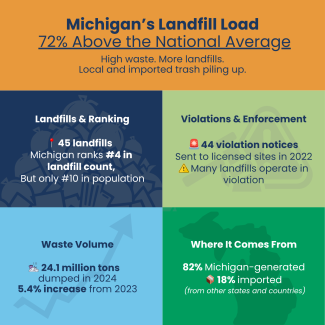
Currently, Michigan’s fees paid to landfills to dump trash are the lowest in the Midwest at 36 cents per ton, which attracts a lot of trash imports (for context, Ohio’s tipping fee is $4.75 and Wisconsin’s is $13.) Because of this, Michigan residents are bearing the negative impacts caused by other states’ trash. In April 2025, Democratic lawmakers reintroduced legislation to increase the landfill fee to $5 per ton, which could help to significantly reduce out-of-state waste.
Michigan’s high number of landfills has led to it being the sixth largest emitter of landfill methane in the country. In the state, Wayne and Oakland counties have a high concentration of landfills, with Wayne County having the three of the top five landfills emitting methane. High methane emissions means high concentrations of organic materials. Michigan also ranks 8th in the nation for landfilled food waste from “pre-consumer” industrial food producers (restaurants, grocery stores, agricultural) as well as residential food waste. 19% of landfilled waste in Michigan is food waste that could be composted instead, a 13.5% increase from 2016, meaning that our food system is inefficient, leading to an increasing amount of waste and economic loss.
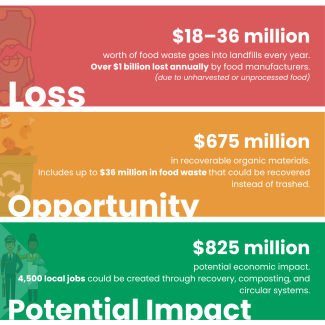
Improving our food waste diversion system can lead to less waste, less methane, and more money. Without a more efficient food waste diversion system, we are dumping money right into the landfills to rot. Michigan urgently needs infrastructural and policy updates to tackle this issue.
Michigan would significantly benefit from a statewide commercial food waste diversion policy that would require and help food producers (e.g. farms, grocery stores, restaurants) prioritize recycling and composting unsold or unused organic materials. Only a limited number of registered composting sites accept food scraps, leaving many commercial businesses and local residents without composting options. Local farms and organizations are working to address this, but in cities like Detroit, compost is restricted under outdated rules that limit compost to gardening, making grassroots operations difficult. But that is not stopping people from finding a path. For example, Sanctuary Farms is working to build Detroit’s composting system through a local network of small farms and organizations banding together.
(Check out the Waste Dashboard for Michigan for more information)
Calling For Stronger “Best Practices”
“If landfills are benefiting financially by selling the energy, they should be required by law to prioritize human health and safety.” - Mike Garfield
The Ecology Center and our partners are pushing the state to put in place a requirement for “best practices” for landfill operations and management. We are advocating for the following 5 key best practices:
- Better Gas Collection: Requiring automated wellhead tuning systems that continuously monitor press and gas quality to reduce methane leaks in real time.
- Stronger Pollution Controls: Ensuring all flares and treatment systems are enclosed and destroy 99% of methane. Require regular performance testing and monitoring of flow rates to track effectiveness.
- Better Landfill Covers: Limit the size of active dumping areas and require timely cover installation to reduce emissions. Require methane-oxidizing biocovers for long-term unused areas.
- Modern Methane Monitoring: Adopt satellite, drone, and continuous monitoring techniques to monitor the landfill and help guide repairs. These tools are cheaper, safer, and more effective than old-fashioned walking surveys that miss or ignore large areas.
- Public Transparency: Require landfills to provide public, accessible reporting of all monitoring data and corrective actions so communities know what’s happening.
(more on the 5 best practices on our landfill methane page)
Best practices are easy to implement and necessary to hold landfills to an operational standard that prohibits poisoning our bodies and land. Garfield stressed that, “if landfills are benefiting financially by selling the energy, they should be required by law to prioritize human health and safety.” Companies should not be allowed to profit on a business model that is contingent on harming people and the planet. The call for landfill best practices that protect community health is a low baseline to set. And yet, these simple requests are considered highly demanding restrictions that cannot be achieved without establishing strong laws and regulations because companies habitually prioritize profits over people.
In Michigan, all counties are currently required to update their materials management process (MMP) every 5 to 10 years. To ensure that the updated MMP effectively prioritizes the best practices for landfill operations and includes a robust food waste diversion system, Ecology Center is working with people who are involved with the MMP planning meetings in various municipalities. We talk to local leaders about the data and why the best practices are necessary. Trash is not a glamorous topic, but it cannot be overlooked, so we work to bring light to it so that informed discussions contribute to the MMP updates.
Our Privilege to Protect Michigan’s Exquisite Views
We create trash every day, but we hide it away in disgust as if it never existed. Looking away does not make landfills that exist just outside of our selective framing disappear. The landfills are already part of Michigan’s landscape whether we like it or not, but there is still time to act so that Michigan does not turn into a giant mitten-shaped landfill.
The Ecology Center is committed to approaching this issue head on. We are encouraging our local community to be involved. This is not an issue that we can offload to someone else to deal with. We must face the reality of our trash problem because destroying Michigan’s beautiful landscapes is not a right we have as state residents. We are in fact gifted with the privilege to protect it. Let’s work together to save what makes living in this state so divine.
This Planet Detroit Article has some useful tips on where you can start.