

As more and more data centers are proposed and built, communities are scrambling to understand their impacts on local water, energy, and air. The Ecology Center is watchdogging Data Center projects and their impacts on our land, water, air, and energy systems. We are working across our network of community partners to help inform the community, raise community voices, and push for protective policies.
What are Data Centers?
Simply put, data centers are warehouses full of rows and rows of servers. These servers are the basis of internet infrastructure, hosting websites and saving materials hosted via cloud computing. Data centers are thus not brand new — as we now know them, they are as old as the internet itself.
Why are there so many of them now?
Increasingly, the purpose of data centers is to provide the computation necessary for artificial intelligence. Since the explosion of investment in AI technology in the early 2020s, corporations have massively increased their investments in data center construction to provide the massive computing capacity required for the widespread use of modern AI digital tools.
In addition to building more of them to handle the AI boom, data centers are getting larger. Firms like Meta, Google, and OpenAI are increasingly investing in massive data center projects as part of a practice called hyperscale computing: combining large amounts of computer infrastructure in order to benefit from economies of scale. Since 2022, the average size of land acquisitions for new data centers has increased by over 140%.1
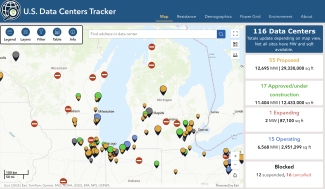
Artificial intelligence is currently a hot sector for private investment, and as a result, new data center projects are being announced constantly, though local opposition or problems with funding are leading to many project cancellations.2 Check out this interactive map of proposed, cancelled, and approved data center projects near you.
Is this a Michigan problem?
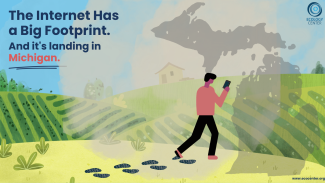
As the data center boom continues to play out, the industry is spreading to new states and regions. Great Lakes states like Michigan, Wisconsin, and Minnesota are in the crosshairs of AI companies. The surplus of flat agricultural land makes data centers relatively easy to build, while the Midwest’s temperate climate makes it a desirable alternative to southern states, where cooling costs are higher. The state of Michigan has attempted to court the building of data centers by offering tax breaks.3 As of right now, there are over one dozen data center projects at various stages in Michigan.4
Problems Posed by Data Centers
Land Usage
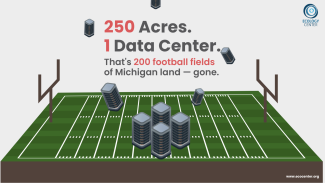
The recent buildout of data centers by AI hyperscaling firms is increasing not only their number, but also their size. Since 2022, the average size of data center construction projects has more than doubled in size to 224 acres. The Oracle/OpenAI data center project under construction in Saline, Michigan, is emblematic, with the $56 billion center planned to take up 250 acres of land.5
Fossil Fuel Emissions
According to the International Energy Agency, data centers and data transmission networks combined account for 3% of global carbon emissions, a number expected to rise as the AI industry rapidly expands. Although some data centers use renewable energy, the growing demand puts major pressure on the world’s energy supply and makes the shift to cleaner energy more difficult.
When they cannot rely on local energy utilities, data centers often invest in their own fossil fuel infrastructure. Data centers have become a massive boon to the natural gas turbine industry, with one leading company seeing a 72% surge in demand in late 2025.6
PFAS Contamination
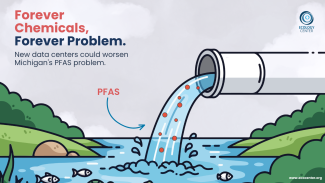
Data centers require incredible amounts of industrial coolants to remain in order. Trifluoroacetic Acid [TFA] is an integral part of the cooling infrastructure of many cutting-edge data centers.7 TFA is increasingly suspected of causing reproductive complications in humans. If disposed of in landfills or incinerated, TFA does not simply go away — it bioaccumulates and spreads astonishingly quickly in water supplies due to its high solubility.
Michigan currently has over 300 sites recognized by the government as contaminated by PFAS, the legacy of decades of industrial malfeasance.8 The current boom in data center construction threatens to replicate this pollution crisis if not taken seriously.

Energy Costs and Reliability
Data centers are hungry neighbors, demanding high levels of electricity 24 hours a day. As these sites expand in numbers and size, the American power grid is under pressure to keep up with the demand. A recent analysis by Bloomberg shows that 75% of “highly distorted” power readings across the United States occur within a 50-mile radius of significant data center activity.9
In 2023, data centers accounted for 3% of American electricity consumption. That number is expected to reach 12% by 2029 based on the current rate of data center expansion. This would be the equivalent of adding eight New York Cities to the U.S. electrical demand and threatens to place massive strain on the US energy grid, accompanied by a massive increase in energy costs.10 In recent years, U.S. home energy prices have considerably outstripped data center energy spending.11 This is not the result of data centers following best practices, but rather the power they have as large-scale consumers.12
To make matters worse, while the MPSC regulates utilities' energy use to protect ratepayers, it doesn't necessarily have the power to regulate what data centers do on their own. The tax incentive provisions do require them to meet the MI energy law in order to receive the credits, however.
Water Use
Beyond the strain on the power grid, data centers place significant and often overlooked demands on another finite resource: fresh water. Cooling systems are essential to keeping these high-density, 24/7 operations from overheating, and that cooling comes at a high cost to local water supplies. Depending on technology and climate conditions, data centers can evaporate between 1 and 9 liters of water per kilowatt-hour of server energy used for cooling.13 An analysis by the Alliance for the Great Lakes projects that data centers could withdraw as much as 150 billion gallons of water nationally over the next five years — the equivalent of what 4.6 million households consume.14
The Great Lakes are a vital natural resource that we are responsible for protecting. The Great Lakes region has become a prime destination for data center development, in part because of its abundant freshwater and cooler climate — but that same abundance is now under pressure. The problem has no simple solution — every cooling method trades one resource for another. Less water means more energy; less energy means more water. It becomes a choice between reducing stress on the grid versus reducing stress on the watershed.15 Protecting the Great Lakes means demanding that data centers be transparent about which tradeoff they are making — and held accountable for the consequences either way.
Noise Pollution
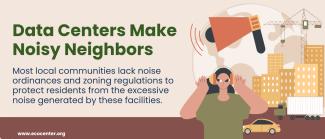
For many residents living near data centers, the noise never stops. Operating 24 hours a day, seven days a week, these facilities generate persistent noise from massive cooling systems, backup diesel generators, and, increasingly, on-site gas-powered power plants. In Virginia, the U.S. hub of data center projects, residents describe a constant industrial hum. The EPA recommends a 24-hour outdoor noise limit of 55 decibels to protect public health, and data centers in residential areas routinely approach or exceed that threshold.
The health consequences of that exposure are not minor: Long-term noise pollution is associated with cardiovascular disease, hypertension, endocrine disruption, and permanent hearing loss. The mental health impacts are equally serious — chronic noise exposure is linked to stress disorders, sleep disruption, and increased anxiety. Children face compounding risks: research consistently shows that kids in chronically noisy environments exhibit lower academic performance, reduced reading comprehension, concentration deficits, and elevated stress.16
What makes the noise problem particularly difficult is that it is cumulative and largely unregulated. A single facility brings cooling systems, monthly generator tests, emergency blackout operations, and up to 50 hours annually of non-emergency diesel generator use — each a separate noise source, all of them adding up. The diesel generators alone can reach 105 decibels, equivalent to a jet flying overhead.17 Most local governments in rural Michigan are simply not equipped with zoning or noise ordinances designed for what is, in practice, a heavy industrial operation dropped into a residential or agricultural landscape.
Take Action
The Ecology Center believes strong action is needed now to prevent data center construction from disrupting communities and locking our planet into further man-made climate change. The Ecology Center supports a range of proposals focused on civilian environmental protections.
We are calling on the State of Michigan to implement a 12-month moratorium on data center siting until sensible regulations are in place. We are also working to protect communities from surging electrical prices and power outages that might result from data center construction.
States should pass moratoria on data center construction until these regulations are in place. Data centers are large, expensive pieces of real estate. By the time they are built, much of the damage has already been done. Only by putting these guardrails in place before new data center construction begins can we prevent increased fossil fuel use or local water and energy supply crises.
Unfortunately, many projects are well underway before regulations are in place. Most notably, the Saline hyperscale data center received fast-tracked approval and is currently under construction.
We are calling for the following regulations to protect Michigan communities:
Ratepayer protections
The people of Michigan should not be required to pay for the electricity used by data centers built in their towns. Companies looking to build data centers should be required to invest in the energy capacity necessary to prevent energy spikes.
Disclosure of potential environmental concerns
Michigan should require developers of AI data centers to disclose the use of PFAS and similar environmental contaminants, such as TFA, in the construction or operation of their data centers. They should also be required to disclose their water use and plans for ensuring they won’t affect other water users or raise costs for water systems.
Community participation and benefit plans
Communities that agree to host data centers should have transparent processes for voicing their concerns, which must be addressed, and for reconciliatory community benefit plans to mitigate the impacts of the data centers.
Mandated clean, renewable energy
Michigan should mandate that data centers be powered by renewable energy and that they provide the capital for necessary clean energy infrastructure. Data Center developers must ensure their facilities are powered by renewable energy to help Michigan meet its Clean Energy Law, which calls for 60% renewable energy by 2035. Utilities entering into agreements with Data Center developers must also guarantee renewable energy for new developments, without passing the costs to ratepayers.
Regulations for Noise Pollution
Michigan should enact legislation limiting the use of backup generators to reduce air and noise pollution. Additionally, noise levels should be monitored, and maximum noise levels should be set and enforced.
How to Get Involved
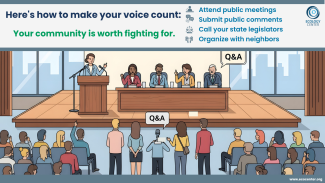
Stay Informed: Closely follow the projects near you; use this interactive map.
Speak Out: Show up for public meetings and submit public comments when allowed.
Take Civic Action: Reach out to your local decision makers and let them know where you stand.
Persist: Use this North Star Data Center Policy toolkit for additional resources.
Sources
International Energy Agency, “Data Centres and Data Transmission Networks.”
Joe Wilkins. “Almost Half of US Data Centers That Were Suposed to Open This Year Slated to Be Canceled or Delayed,” Futurism, April 2, 2026.
Kelly House and Simon D. Schuster. “Michigan lawmakers divided by OK tax breaks to lure data centers.” Bridge Michigan, September 25, 2024.
Lucas Smolcic Larson, “At least 16 sites eyed for data centers in Michigan amid AI boom. Here’s where,” MLive, December 16, 2025.
Paula Gardner, “Saline data center brings out bigwigs. Big day for Michigan or big betrayal?,” Bridge Michigan, June 1, 2026.
Brian Martucci, “GE Vernova Q4 gas turbine orders surge 74%,” Utility Dive, January 30, 2026.
Tom Perkins, “Advocates raise alarm over Pfas pollution from datacenters amid AI boom,” The Guardian
Michigan PFAS Action Response Team, “PFAS Sites and Areas of Interest.”
Leonardo Nicoletti et al, “AI Needs So Much Power, It’s Making Yours Worse,” Bloomberg, December 27, 2024.
Kyle Mason et al, “The Rise of Data Centers in the Grid,” Regional Plan Association, June 30, 2025.
Karin Kirk, “Home electricity bills are skyrocketing. For data centers, not so much,” Yale Climate Connections, January 5, 2026.
Ari Peskoe and Eliza Martin, “Extracting Profits from the Public: How Utility Ratepayers Are Paying for Big Tech’s Power,” March 5, 2025.
Ana Pinheiro Privette et al., “Data Centers Water Footprint: The Need for More Transparency,” AGU Advances, February 27, 2026.
Helena Volzer, “A Finite Resource: Managing the Growing Water Needs of Data Centers, Critical Minerals Mining, and Agriculture in the Great Lakes Region,” Alliance for the Great Lakes, August 2025.
Terry Nguyen, “What Happens When Data Centers Come To Town?” Gerald R. Ford School of Public Policy, July 2025.
Neha Gour et al., “Health implications of the rapid rise of data centers in Virginia: an exploratory assessment,” Frontiers in Climate, February 5, 2026.
"See where diesel-powered data center generators are polluting Virginia,” The Washington Post, May 28, 2026.