

By Yuki Nakayama, Ecology Center Writer
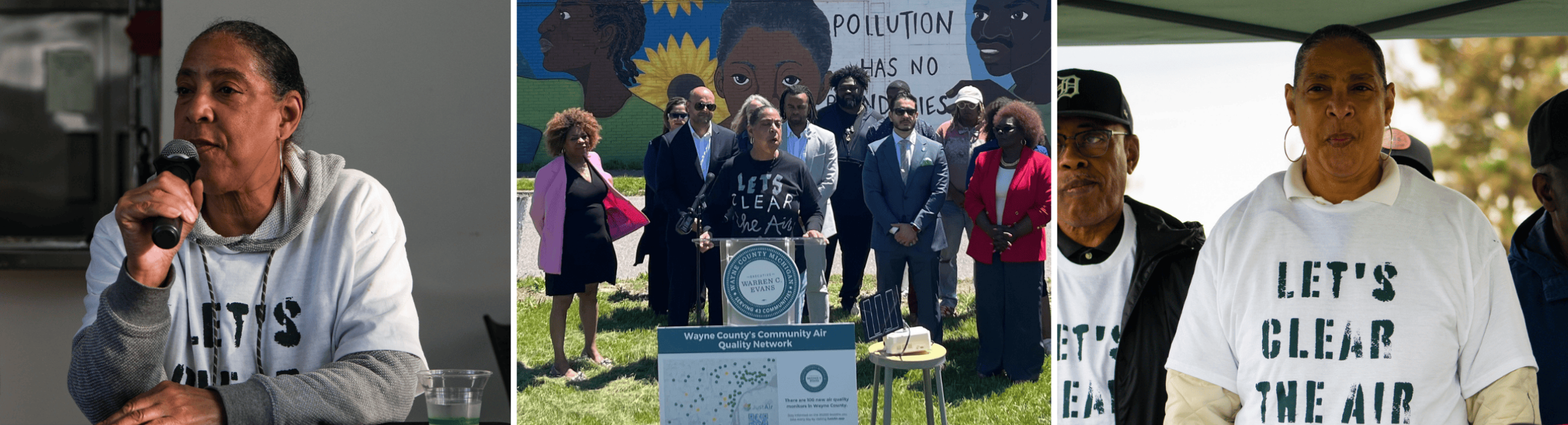
In celebration of Black History Month in February and Women’s History Month in March, the Ecology Center wants to spotlight Theresa Landrum, a crucial figure for environmental justice efforts in Southeast Detroit. Recently, her efforts as a Sierra Club Member led to the historic February 17th federal ruling that ordered DTE and EES Coke to pay a $100 million civil penalty and a $20 million investment for community health projects for violating the Clean Air Act. As a resident of Detroit’s 48217, Landrum describes her entry into environmental justice work as a necessity. “I wasn’t trained or desired to be [an environmental justice advocate]. It was out of necessity," she says.
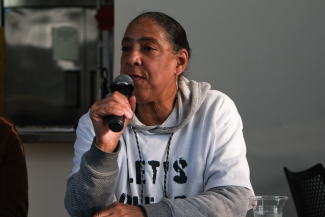
Theresa grew up in Detroit’s 48217, an area known as one of the most polluted zip codes in Michigan. The area always had heavy industry presence that caused grey air, foul smell, ground sinking/cracking, disruptive and damaging levels of noise, and many other visible and tangible consequences. Her parents washed “dust” off their cars every morning before leaving for work.
In her childhood, health conditions — like the prevalence of asthma — were normalized without knowing industrial pollution was the cause. During our conversation, Theresa talked about how many neighbors and family members were diagnosed with cancer — an unmistakable pattern that revealed just how deeply pollution had shaped daily life in her community. Every person she mentioned that dealt with cancer reemphasized how grave the impact of industrial pollution was on her hometown.
The Right To Speak For The Community
There was no singular incident that led her down the path of activism — the everyday reality of living in 48217 motivated her to take action. For example, the community was excluded from the evacuation order during the 2003 Northeast Blackout, despite being closest to the factories that lost power to their pollution control systems. Residents were only able to evacuate because they were able to hear the information secondhand.
When there was a class-action lawsuit against Marathon Oil after the 2003 incident, residents of 48217 only managed to be included because they rushed to the courthouse after a resident happened to read about it at the last minute. The lawsuit ultimately did not serve the residents’ best interests, so instead, the community organized to provide legal support to residents to individually sue the company.
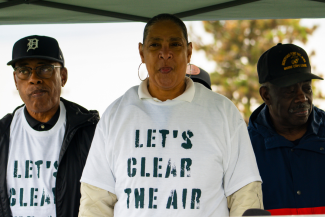
When local authorities tasked with keeping people safe fail to fulfill their duties, impacted communities are forced to take matters into their own hands for their survival. Landrum stressed that advocacy work is crucial because, “We [the residents] have the right to speak for the community,” as they are harmed by the pollution everyday.
She was not alone in noticing the necessity to speak up and speak for the community. Dr. Dolores Leonard and Rhonda Anderson — local residents, long-time members of the Sierra Club, and advocates for environmental protections — were significant collaborators for Landrum since the beginning. Her work in and for the community led her to become the current president of the Original United Citizens of Southeast Detroit and has facilitated many other important developments that paved the way for the recent federal ruling.

Testing Soil For PFAS at the Gordie Howe Bridge Site
We have collaborated with Landrum on many projects, including testing for PFAS in the soil at the Gordie Howe Bridge Construction Site, which we covered in a previous story. It was Landrum who wanted to focus the Ecology Center’s attention on soil testing at the site, going beyond the traditional water testing of the time.
Her concerns for PFAS started in 2017 as more articles about the dangerous levels of PFAS contamination across the globe started to come out. She felt the ubiquity of PFAS and the urgency to address it when “[she] was only able to find one item in her entire home that did not already contain PFAS” while preparing for an environmental justice-themed game for her Christmas party.
At the time, most PFAS discussions and testing focused on water. But her lived experience in 48217 — seeing contaminated dust, debris, soil, and more — told her to test the earth. Construction projects create a lot of dust and particles that spread through the wind. She “felt a strong need to test the soil to show the importance of testing PFAS in various forms” and to see the full picture of contamination.
“Pollution has no borders”
Landrum urges us to act now by stressing that “pollution has no borders.” Pollution does not discriminate: It directly impacts everyone regardless of gender, race, class, age, or location. As corporations continue to pollute, the lines drawn between our neighborhoods are arbitrary.
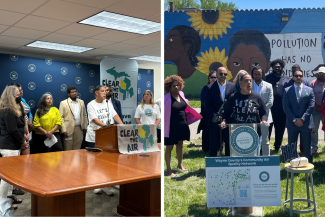
While certain communities are impacted before others, no one is truly safe or protected from pollution unless we all are. As awareness spreads and local testing increases, Landrum says more and more people, even those far away from 48217, are reaching out to her seeking advice. This is why strong prevention measures are necessary along with accelerating clean up efforts.
We must recognize the work by advocates like Landrum who have been forced to be on the frontlines and continue to lead the fight for our collective future. We cannot forget the enormous sacrifices these activists have made to dedicate themselves to environmental justice.
Thank you, Theresa Landrum, for your decades of advocacy work. Your dedication and generosity continues to inspire us and teach us the power of community care.