

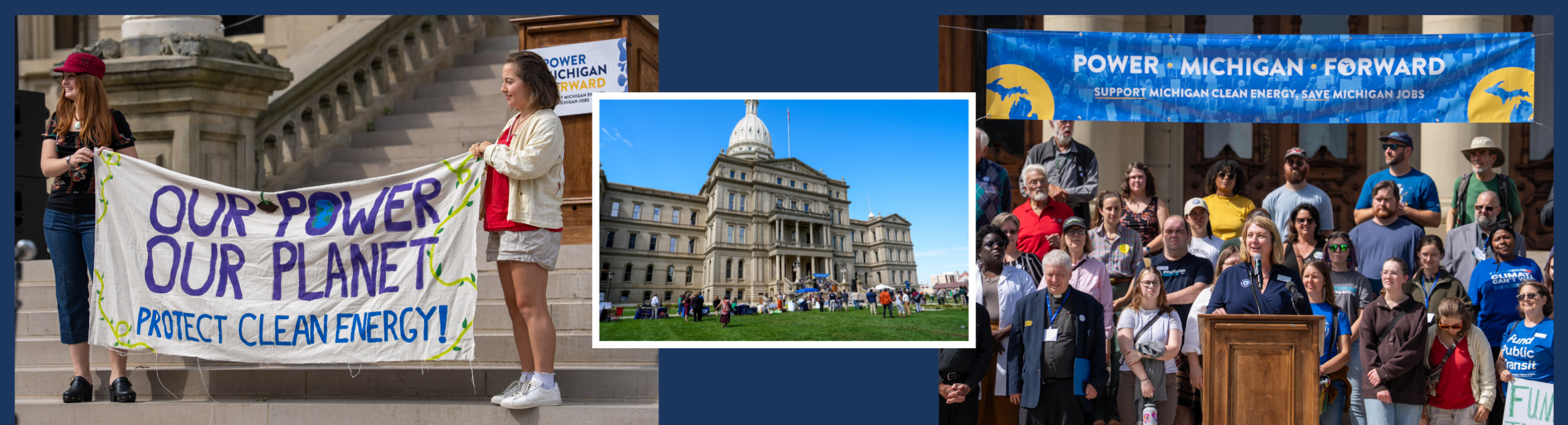
A Day of Action at the Capitol
On September 10, members of the Ecology Center joined partners from the Michigan Energy, Michigan Jobs (MEMJ) coalition at the State Capitol in Lansing.
Our Capitol Day of Action brought together advocates, community members, and experts for face-to-face meetings with legislators. Ecology Center staff and coalition partners spoke directly about the challenges Michigan households face: rising energy bills, unreliable power, children’s daily exposure to diesel exhaust, and the lack of dependable transit options that connect people to jobs and services.
One of the central issues raised in these conversations was the need for clear budget priorities. Coalition members stressed that Michigan’s budget must reflect the needs of its people rather than the interests of polluters. Their remarks underscored that this debate is not simply about line items or allocations, but about the state’s long-term direction. The presence of the MEMJ coalition at the Capitol made clear that communities are watching closely and expect Lansing to invest in solutions that make a tangible difference.
What We Are Calling For
The Ecology Center and our partners in the MEMJ coalition are urging legislators to invest in Michigan’s healthy climate future. That means expanding home weatherization and electrification programs, especially for rural households that still rely on expensive delivered fuels. It means restoring and expanding funding for public transit so that buses and trains across the state are modern, affordable, and reliable. It means supporting job training and workforce development programs that prepare Michigan workers for the clean energy jobs of tomorrow. It also requires protecting public health by continuing to fund lead service line replacements, water affordability programs, and the monitoring of air quality so that families can breathe safely.
We also call on lawmakers not to penalize electric vehicles and fuel-efficient cars in efforts to raise new revenues for road repairs. As our recent analysis shows, such penalties would undermine Michigan’s clean energy transition and discourage consumers from making climate-smart choices.
The Senate and Governor’s budget proposals include many of these priorities, and the task ahead is to ensure that the final budget sustains investments in community health, clean energy and workforce development rather than impose severe cuts or prohibitions.
Why This Matters Now
Michigan already experiences some of the most frequent and prolonged power outages in the Midwest, while households here pay among the region’s higher electric rates. Air pollution from fossil fuels costs the state billions of dollars every year in health impacts. More than six hundred thousand Michigan students ride diesel school buses each day, breathing in exhaust that worsens asthma and other respiratory illnesses. Michigan children continue to be exposed to lead causing lifelong damage. If Michigan fails to invest in community health, electrification, workforce development, and transit, we risk falling behind and undermining our long-term competitiveness.
Investing in community health, clean energy, electrification, and public transit is not a luxury. It is a necessity for safe, affordable, and thriving communities across Michigan.
The House Proposal: Roads First, Communities Left Behind
Just days before our Capitol Day, the Michigan House released its version of the state budget. The plan pours billions of dollars into road funding while making sweeping cuts to health, workforce, and environmental protections. In its current form, the House proposal eliminates key workforce and clean energy programs such as Going PRO and the Office of Future Mobility and Electrification, reduces support for lead service line replacement and air quality monitoring, and strips away contaminated site cleanup funding.
Additionally, the House version of the budget will make egregious cuts to the Michigan Department of Health and Human Services Lead Division. The proposed 30 million dollar reduction will cut 40 important jobs, eliminating the nurse case management program which serves over 5,800 lead-poisoned kids yearly. The work of the MDHHS Lead Division has been invaluable in protecting Michigan children from lead exposure and helping families when lead exposure has occurred. Michiganders deserve a budget that serves the people. Not one that saves money by taking away community resources and harming community health.
Transit funding also falls short. While the House budget maintains baseline bus operating support and creates a new pool of money tied to “efficiency” requirements, it cuts support for critical regional transit services, including the Regional Transit Authority in Southeast Michigan. Most troubling, the House plan prohibits the purchase or lease of electric vehicles for the state fleet — a move that directly undermines Michigan’s role as a national leader in advanced mobility. These choices create a false tradeoff: better roads at the expense of healthy communities. Michigan can and must do both.
Your Voice Matters
Our Capitol Day of Action was a powerful reminder that legislators listen when communities show up. But this is only the beginning. With negotiations between the House, Senate, and Governor still underway, there is time to shape the outcome. Every call, every story, and every letter matters in ensuring that Michigan’s budget reflects the needs of its people.
We encourage members to contact their legislators, to share experiences of power outages or high bills, and to speak about the importance of clean energy, reliable transit, and clean air in their daily lives. The voices raised at the Capitol on September 10 can be amplified if more Michiganders join in calling for a budget that puts communities first.
Michigan faces a choice: a budget that leaves families and workers behind, or a balanced approach that delivers affordable energy, clean air, reliable transit, and good jobs. With your help, we can ensure our state chooses the future we deserve — a future that is healthy and resilient.
Further Information
- Detroit Free Press. GOP state budget includes billions in cuts. Here’s what would get axed. (2025)
- Ecology Center. Prioritizing Clean Energy & Transportation for Thriving Michigan Communities. (2025)
- Power Michigan Forward. Handout on clean energy and transportation priorities. (2025)
- Ecology Center. Road Funding analysis: EVs and Hybrids Are Not To Blame for Road Funding Losses. (2025)