Founded in 1970, the Ecology Center serves one purpose: protecting healthy people and a healthy planet. We believe that the central question of our time is how human beings are going to thrive in the world without destroying the earth's ability to sustain us. This can only be achieved as a strong movement. Sign up to receive emails about ways you can get involved, take actions and learn about important updates from the Ecology Center.
Non-toxic camp tents? Such will be the case in Michigan by February, thanks to a new bill signed into law last November, removing an outdated fire standard requiring manufacturers to treat tent material with toxic flame retardants.
The new law will remove one of the last remaining roadblocks to assuring all tents in the US are produced without flame retardants. Michigan was one of six states (California, Louisiana, Michigan, Minnesota, New Jersey, and New York) with antiquated 1970s-era standards still on the books. In 2023, Michigan joined California in successfully reforming these laws to pave the way for non-toxic tents to be available nationally.
The previous standard was a holdover from when tents were made of wax- or oil-coated cotton. Decades later, tents are now made of much different material. Studies have shown flame retardants do little to reduce flammability but produce toxic fumes when burned.
The Ecology Center has been working to remove unnecessary flame retardants from stuff and the material economy for many decades. Most flame retardants are not strongly bound to the material they are applied to, so they easily migrate out and become airborne via dust. Flame retardants bioaccumulate within the body and can disrupt hormone function and cause cancer.
Michigan State Senator Jeff Irwin (D-Ann Arbor) introduced the policy change in early 2023.
"We know that the [previous] requirements don't make lightweight tents significantly more fire resistant, and we know that the chemicals used to meet the old standard are harmful to people and wildlife," said Sen. Irwin in a press release in May 2023. "You should be able to go camping in Pure Michigan without being exposed to persistent, bioaccumulative poisons."
The Ecology Center applauds this important step in protecting Michiganders from unnecessary exposures to hazardous flame retardants, though there are still many sources of these chemicals in commonly-used products. Still, this bill marks an important achievement in removing toxic chemicals from the products we use.
Above: Bunyan Bryant receiving the Ecology Center’s annual award for environmental activism, 2008, presented by staffers Jeff Gearhart, Tracey Easthope, Charles Griffith, and Mike Garfield, all former students of Dr. Bryant.
“Looking back, I can see that my story was an unpredictable one. Yet I also know that I am far from unique. There are millions of Black youngsters who come from humble backgrounds who need to be nurtured and mentored as I was. Like them, I suffered from a lack of opportunities and the persistent impact of racism. I made it onto the right path with the help of some good fortune…Along the way, I was encouraged by both Blacks and whites who wanted me to succeed.”
– Bunyan Bryant, Jr.
Last year, Bunyan Bryant, Jr. published, “Educator and Activist: My Life and Times in the Quest for Environmental Justice,” a vivid narrative of his life journey from growing up in a poor neighborhood in Arkansas to becoming a world-renowned pioneer in environmental justice. As a former board member, professor to many staff, and a founder of the national environmental justice movement, Bunyan was a spark that helped ignite the Ecology Center’s 53-year legacy in environmental activism. To celebrate the release of his most recent book and his impact on our organization, we wanted to reflect on the remarkable ways in which he influenced our work, and the world.
As a professor at the University of Michigan, Bunyan participated in the very first Teach-In on the Environment in March 1970, which led to the national teach-in we now recognize as Earth Day and the formation of the Ecology Center.
He served as a board member during the early 1970s, soon after the Ecology Center’s formation. But more profoundly, Bunyan’s influence is deeply embedded in the fabric of the Ecology Center through his role as mentor, teacher, and collaborator with most of the long-term staff at the Ecology Center. Current and former staff members working to address environmental justice, air pollution, climate change, and toxics in consumer goods and the environment were students of Bunyan, or worked on projects with Bunyan.
Bunyan believes in empowerment education – that students can and should direct their own learning, follow their interests and passions, and see themselves as full actors in the world, with the ability and agency to both see what is around them and change things for the better. That thinking helped shape the Ecology Center’s approach to environmental advocacy and justice. Communities should be full participants in the decisions that affect them. As an organization fighting for change, the Ecology Center believes we must fight alongside those most impacted, guided by their agenda and their needs.
Bunyan Bryant, colleagues, and students at the Michigan Conference on Race and Incidence of Environmental Hazards: A Time for Discourse, the first academic conference of mainly Black scholars to discuss the disproportionate effects of environmental hazards on marginalized populations.
Photo from Educator and Activist: My Life and Times in the Quest for Environmental Justice by Bunyan Bryant Jr. Published 2022 by Rivertowns Books. Courtesy of the publisher.
Bunyan’s influence on our organization dates back to the first executive director of the Ecology Center, Mike Schechtman.
Mike recalled Bunyan’s outstanding first impression. As part of the hiring process to become faculty for the U-M School of Natural Resources and Environment (then called the School of Natural Resources [SNR], now called the School for Environment and Sustainability [SEAS]), Bunyan delivered a lecture, “The Myth of Value Free Research.”
Noted Mike:
“Bunyan’s lecture was hugely attended – especially by SNR faculty members who prided themselves on the caliber of their research methodologies and publications. Bunyan highlighted how everyone brings their worldview to their research, the lens of their own race, class, and ethnicity that frames how issues are identified and defined. This influences choices regarding data to be gathered, audiences to be engaged, voices to be heard, and literature to be reviewed. It was a mind-blowing lecture with people talking intensively in the following days.
Needless to say, Bunyan received the faculty appointment, and that summer, Bunyan and Jim Crowfoot began the development of SNR’s Environmental Advocacy Program.”
By his own admission, in his memoir, “Educator and Activist: My Life and Times in the Quest for Environmental Justice,” Bunyan had not been interested in the environment. Writes Bunyan, “I knew nothing about natural resources or the environment, nor was I interested in these topics.” However, his transition to this new environmental advocacy program at the University of Michigan fundamentally shifted the environmental movement and greatly impacted the Ecology Center’s work and legacy.
Bunyan was educated as a social worker and started his career as a youth counselor at the Fresh Air Camp, a treatment and research program for severely traumatized children. He later worked as a social worker at Michigan Children’s Institute. He quickly noticed the discrepancies in treatment between white and Black children and took action to address these differences.
After experiencing housing discrimination, he helped advocate for a fair housing ordinance in Ann Arbor, Michigan, one of the first such ordinances in the state. He later became an advocate with the Congress of Racial Equity (CORE), a racial justice organization that emerged from his work on fair housing. He also participated in the Guild House Campus Ministry, an ecumenical Christian organization at U-M that provided space for students, faculty, and staff to raise questions about discriminatory policies.
In 1970, Bunyan participated in the Teach-In on the Environment, a vanguard event in environmental activism that precipitated a national movement of ecological stewardship along with a sweeping set of federal policy laws passed to better preserve the environment. The teach-in also caused a prompt increase in student interest in environmentalism, particularly around the intersection of environment and social justice.
The high demand for education led to the formation of U-M’s Environmental Advocacy Program, and in 1972, the university asked Bunyan if he would join the new school’s faculty. He accepted and, alongside Jim Crowfoot, Bill Stapp, and Peter Sandman, built the Environmental Advocacy Program program that continues today, renamed the Environmental Justice Program in 1990. Unbeknownst to him then, he would also help inspire a global movement, hundreds of U-M students, local, state, federal, and national governments, resident activists, grassroots movements, non-profit organizations, and the Ecology Center staff.
The first and, for a time, only Black professor at the School of Natural Resources, Bunyan found himself marginalized. There, though poorly resourced, the school left him alone, and he found himself able to do what he liked and shape the program as he thought necessary to teach students how to organize communities around environmental issues.
And shape it, he did. Bunyan taught creatively, bringing his students on mini-retreats, environmental justice tours, and field trips, practicing role-playing and small discussions in his classrooms, and empowering students to apply their unique worldviews to problem-solving and critical thinking. With his long-time collaborator Paul Mohai, he hosted the Michigan Conference on Race and Incidence of Environmental Hazards: A Time for Discourse, the first academic conference of mainly Black scholars to discuss the disproportionate effects of environmental hazards on marginalized populations, from which a seminal book of the same name was published, featuring the work of the conference presenters. The group’s work encouraged the EPA to address environmental justice and form the Environmental Equity Work Group in 1992.
A portrait of Bunyan Bryant. Photo from Educator and Activist: My Life and Times in the Quest for Environmental Justice by Bunyan Bryant Jr. Published 2022 by Rivertowns Books. Courtesy of the publisher.
Tracey Easthope, the Ecology Center’s senior strategist, attended one of the program’s first events which introduced the idea of environmental justice.
“As an academic, he was a spark. But at the center of it, he emanated this beautiful, accepting, calming, loving spirit,” said Tracey. “He was so welcoming, so generous to everyone and so nonjudgmental. He really believed in students, and you could feel it. He respected students immensely, and believed in their power and agency and idealism - and he supported us in real world projects to address injustice. He believed young people could change the world, so we believed it too.”
The Ecology Center’s Director, Mike Garfield, recalled, “I was Bunyan’s student in the early 1980s. He was unlike any teacher or professor I’d ever had and left an indelible impression. He found remarkable ways to prepare us to take on powerful economic and political forces, and make real change in the world. He inspired his students to stand proudly and humbly in the struggle for justice.”
Bunyan Bryant was indeed a light illuminating the path of countless activists, communities, and movements, both here in Michigan and across the globe, toward a brighter, more equitable future. The creativity and inventiveness that he applied in his pedagogy inspired his students to believe they could change the world and he equipped them with the tools to do so. An example of this is the inspiration he had on the Ecology Center. His work touches everything we have done and everything we do. His impact is a testament to the divinity of bringing your whole self to your work, including the parts society may have marginalized you for, and knowing these qualities are an asset, not a detriment.
Bunyan explains it best in his 2022 memoir on his life of activism and the legacy he has given to so many of us:
“I didn’t choose this. It chose me… I believe those eloquent words speak for most of us in the environmental justice movement. As I look back on my life and work, I can see that I didn’t become an environmental advocate, researcher, educator, activist, and mentor because of some well-thought-out career path… It happened because of the challenges I faced as a Black male in a society that puts barriers in the path of Black males – barriers that made me ask tough questions about my place in the world, and drove me to work harder than I otherwise might have to overcome the roadblocks in the way.”
We are endlessly grateful for Bunyan’s work and impact on our organization. Thank you, Bunyan, for your lifelong dedication to environmental justice and your steadfast commitment to always being a teacher, reminding each of us of our own power to make the world more just, and of the importance of lifting others up to be their own advocates for justice.
Michigan Public Service Commission approves business as usual on spending and return on equity, but orders the Company to broaden consideration of energy justice in its business process, and expands innovative electric bus procurement model and low-income EV rebates
Lansing, MI– On Friday, December 1, 2023, the Michigan Public Service Commission (MPSC) released its final order in utility giant DTE Electric Company’s 2023 rate case. In its order, the Michigan Public Service Commission approved a rate increase of $368 million, a little more than half of DTE’s requested $619 million.
The Clean Energy Organizations (CEOs) – the Ecology Center, Environmental Law & Policy Center, Vote Solar, and Union of Concerned Scientists – are disappointed that the Commission authorized such a significant rate increase for DTE which will raise residential rates by roughly 6.38% while also holding one of the highest return on equities in the Midwest at 9.9%. The Commission sent the message to the Company that bottom quartile performance was worthy of a continued rich reward through its return on equity.
Despite the CEO disappointment regarding some of the top line issues in the cases, there were at least three notable positives that came out of the Commission order that related directly to the important advocacy work of the Clean Energy Organizations.
First, the Commission ordered the Company to perform important energy justice and reliability analyses in future rate cases as recommended by the CEO and MPSC staff. Among these important additions to future rate cases are: more detailed environmental justice analysis on community vulnerability, better data on customer interruptions, better availability of GIS data, and climate resiliency planning in future distribution grid plans.
James Gignac, Midwest Senior Policy Manager at Union of Concerned Scientists, said:
“Under today’s order, DTE will be required to provide important information going forward on how its grid planning affects environmental justice communities. Based on expert testimony and recommendations of MPSC Staff, DTE will now need to be more transparent and better assess how vulnerable customers experience the costs and benefits of DTE’s electricity system.”
Second, and relatedly, the Commission ordered the Company to use a robust method for understanding the differential reliability experience of customers in environmental justice communities in future grid plans. This recommendation was spurred by the excellent testimony of Vote Solar’s Boratha Tan, Midwest Regulatory Manager, and Will Kenworthy, who demonstrated the important relationship between duration of outages and race, income, and population density.
Will Kenworthy, Midwest Regulatory Director at Vote Solar, said:
“In our testimony, the CEOs demonstrated that there are clear and meaningful differences in reliability experiences of customers in environmental justice communities. The Commission adopted many of our recommendations to understand existing disparities and to address them through improved, more transparent, and robust planning processes. We were particularly pleased that the Commission singled out our innovative approach to using regression analysis to more accurately understand the relationship between equity and reliability.”
Third, the Commission approved the expansion of the Company’s eFleet battery pilot into a permanent program. This program allows the utility to finance the upfront costs of electric batteries for buses for school districts and transit authorities who may not be able to afford these high costs. This will benefit all Michiganders by spurring electrification and taking dirty diesel engines off the road.
Charles Griffith, Climate and Energy Program Director at the Ecology Center, said:
“We’re pleased the Commission’s Order approved the Company’s eFleet battery program as well as low-income EV purchase rebates. However, it could have gone further to approve other pilots that would provide more equitable access to charging infrastructure, such as the proposed Community Chargers program. While a rebate program will help low-income households afford the purchase of an EV, without a place to charge them, EVs will remain unattainable for many.”
The Commission also acknowledged the need to improve transparency in the Company’s distribution system planning process, including more thorough, robust, and transparent application of the Company’s Global Prioritization model. While it declined to require contested cases in the distribution grid plans, the Commission admonished DTE to lend serious consideration to incorporating Staff and stakeholder feedback into its distribution plan process.
Going forward, the CEO will continue to engage across the many dockets which these issues of equity and justice in electrical regulation are considered. While we are heartened by the positive steps taken by the Commission today, we remain committed to achieving grid equity and creating a just and equitable clean energy transition.
New laws will bring accountability for big utilities, help lower costs for ratepayers
DETROIT, Mich. – A nonpartisan coalition of organizations committed to tackling the climate crisis in Michigan today praised Gov. Gretchen Whitmer for signing bills to hold utilities accountable to achieving a 100% clean energy standard.
Michigan is positioned to lead nationally when it comes to advancing clean energy and energy efficiency with Whitmer signing the Clean Energy Future bill package (Senate Bills 271, 273 and 502) and bills to streamline the permitting process for renewable energy, like wind and solar, for farmers and local communities (House Bills 5120-5121).
“Up until today, Michigan’s big utilities have been prolonging the state’s dependence on dirty coal and gas,” said Dr. Denise Keele, Executive Director, Michigan Climate Action Network. “As we approach the climate boundaries of habitable life for humans, Gov. Whitmer’s bill signing represents a historic shift for Michigan in building out wind and solar across the state, and holding big utilities accountable to curtail dangerous pollution by achieving 60% renewable energy by 2035. I commend the lawmakers who championed the explicit inclusion of climate, health, equity, and affordability in utilities long-range plans for the first time.”
The new laws boost energy independence by creating a tenfold increase in access to rooftop solar and giving Michigan farmers greater ability to lease their land out for clean energy by cutting red tape to build out projects across Michigan, creating local jobs and generating tax revenue for local communities. The new laws also create some of the most robust energy efficiency standards in the country, helping to address affordability, health and safety for many low-income Michigan households.
“Michigan’s new laws will help improve public health by reducing dangerous pollution in our air and water,” said Dr. Elizabeth (Lisa) Del Buono, Executive Director, Michigan Clinicians for Climate Action. “Increasing our use of clean renewable energy also protects the Great Lakes. I want to thank the legislators who voted in favor of these bills and to Governor Gretchen Whitmer for her leadership.”
“This legislative package is not just about the environment and climate, there are major economic benefits for Michigan as well,” said Dr. Martin Kushler, Senior Fellow with the American Council for an Energy Efficient Economy. “Michigan is almost entirely dependent upon imports from other states and countries for all of the fossil fuels we consume, which drains over $18 billion a year from the state economy. By increasing energy efficiency and Michigan-based renewable energy, this package of bills will reduce that financial drain and help keep those dollars here in Michigan.”
“These bills translate into better air, water, and health for everyone,” said Derrell Slaughter, Michigan Clean Energy Advocate at NRDC (Natural Resources Defense Council). “The pathbreaking standards for the Midwest industrial heartland will see the state move to 100% clean energy by 2040 and put more resources toward energy efficiency. Michigan has seized the opportunity to demonstrate our commitment to combating climate change and ensure a sustainable, just, and prosperous future for our state.”
"Michigan’s new energy laws will bring more clean, renewable solar and wind power to our communities than any other state in the Midwest, promoting cleaner air and water for all Michiganders," said Charles Griffith, Ecology Center Climate and Energy Director. "Not only will Michiganders breathe cleaner air and drink cleaner water, but workers building these new renewable resources will be protected by the highest labor standards of any climate legislation in the country, ensuring prevailing wages, project labor agreements, and explicit hiring and training requirements in underserved communities."
“The signing of the Clean Energy Future Package into law is a major win for birds and wildlife across the state. Two-thirds of North American bird species are at-risk of extinction from climate change and Michigan species like the Black Tern are hanging on by a thread,” said Marnie Urso, Senior Policy Director for Audubon Great Lakes. “Taking action, like Michigan did today, is the momentum we need to reach net-zero carbon emissions to protect birds and communities.”
The following groups also expressed support for the governor signing the bills: Evergreen Action, Asthma & Allergy Foundation of America - Michigan Chapter, Ceres, Great Lakes Renewable Energy Association (GLREA), Sierra Club, National Wildlife Federation and League of Women Voters of Michigan.
The Ecology Center's Healthy Stuff Lab partnered with TV stations at Cox Media Group, Inc. to test 245 receipts from businesses in eight U.S. cities (Orlando, Jacksonville, Atlanta, Charlotte, Boston, Pittsburgh, Dayton, and Seattle.) This 2023 study is a follow-up to our earlier study of 571 receipts from two dozen states nationwide. In both studies, the businesses sampled included national chains and smaller local and regional stores.
Receipts, nearly all of which are made of a specially coated paper called thermal paper, were mailed to the Ecology Center and tested with FTIR. This test identified the primary color developer chemical used in each receipt.
Bisphenol developers, specifically bisphenol S (BPS) and bisphenol A (BPA), are known health hazards. In contrast, the various alternative developers in use are, in some cases, environmental hazards and need more evaluation.
Key Findings
4 out of 5 receipts tested had toxic BPS
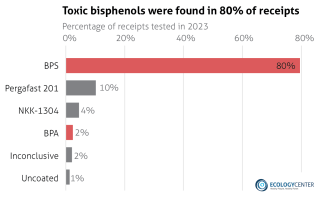
As shown in Figure 1, 80% of the tested receipts were coated with BPS, 10% with Pergafast 201, 4% with NKK-1304, 2% with BPA, 2% with an unidentified developer, and 1% were uncoated, plain paper. Pergafast 201 and NKK-1304 are non-bisphenol alternatives.
The results are similar to the 2022 study, which found 85% BPS, 12% Pergafast 201, and roughly 3% other alternative developers, including NKK-1304. The use of NKK-1304 has slightly increased in 2023, but more sampling is needed to determine if this is a consistent trend.
As we saw in 2022, smaller businesses with a local or regional reach (those with stores in up to 10 states) were more likely to use receipts coated with bisphenols. Large national chains still had the majority of BPS but were more likely than smaller businesses to have switched to alternatives.
Join us in asking Kroger to protect shoppers and workers from toxic receipts by offering e-receipts and safer printed receipts.
In a new study, the Ecology Center Healthy Stuff Lab found that 80% of receipts tested positive for toxic bisphenols such as BPS.
Nationwide news reports are helping to alert the public to the harmful chemicals coating the receipts most commonly handed out from retailers.
As a hormone-disrupting chemical, BPS is linked to fetal development issues, reproductive impairment, type 2 diabetes, thyroid conditions, and other health concerns. It can pass from the receipt through the skin and into the bloodstream. Exposure to BPS is particularly problematic for cashiers who handle receipts all day and for pregnant women who are at greater risk of adverse health outcomes from BPS exposure.
Today the Michigan House passed the Clean Energy Future Package (Senate Bills 271, 273, 502, & 519). This legislation culminates years of work and months of grueling negotiations by a broad coalition. It is Michigan's most substantial effort to address climate change, improve air quality, and promote equity to date– putting it on the national stage with other leading progressive states. The legislation is estimated to reduce greenhouse gas emissions by approximately 82% from Michigan’s electricity sector and cumulatively avoid 364 million metric tons of carbon dioxide emissions by 2040 compared to the status quo.
The passage of the Clean Energy Future Package is a significant step forward, moving us toward a cleaner, more equitable energy system and actualizing the Governor's MI Healthy Climate Plan. The bills increase the state's renewable energy standard from 15% to 50% by 2030, and to 100% clean energy by 2040. The bills increase the cap on distributed generation, giving more Michiganders the ability to invest in rooftop solar and storage. And these bills provide Michigan the ability to leverage billions of federal dollars through the Inflation Reduction Act.
The package strengthens energy waste reduction standards for gas and electric utilities and, for the first time, requires a minimum spending amount for low-income households. The legislation clears the way for some investments in building electrification and moving health and safety measures that prepare homes for weatherization and efficiency measures into full program offerings. Additionally, there are incentives for utilities to invest a significant portion of their residential energy waste reduction on building shell improvements such as air sealing and insulation, moving away from just replacing equipment.
Additionally, this legislation would also allow the Michigan Public Service Commission to consider health, equity, affordability, environmental justice, and climate in utility integrated resource plans, giving real weight to arguments that we have been making at the Commission for years. Finally, the legislation would create an Office of Just Transition to assist communities and workers potentially impacted by the energy transition. A group of companion bills (House Bills 5120-5121) also passed. These bills would streamline the permitting process for renewable energy, like wind and solar.
All of these provisions were hard-fought and worth celebrating. But more than one thing can be true at the same time. We still have a long way to go. The final versions of these bills are not as strong as we hoped and fought for; but they were the best we could achieve in this legislative session, given pressure from utilities and big industry, who still hold far too much influence over the legislature. We have a lot more work to do to hold utilities accountable and to achieve a truly clean and equitable energy future.
There were some disappointing losses in the bill package. We were not able to get provisions to expand community solar, and further legislation is needed to specifically address that issue. One particularly disappointing loss was the failure to strike the inclusion of the Grand Rapids trash incinerator from its current category as a renewable energy resource. The Ecology Center has been a leader in the fight against trash incineration as a waste management strategy and stands with its Environmental Justice partners in declaring that burning trash is not equitable, clean energy. Additionally, the broad definition of clean energy opens the door to unproven and expensive technologies that do not adequately address the environmental harms that burden our environmental justice communities.
The Ecology Center is committed to continuing this fight, both in the legislature and at the Michigan Public Service Commission (MPSC), to improve upon the legislation's shortcomings and to ensure that its implementation prevents some of the problematic provisions from coming to fruition.
We thank you for your support and ask that you thank your legislators who voted in favor of this critical legislation. We will keep fighting to support equitable, affordable, clean energy for all Michiganders.
Lead levels are harmful in many schools and childcare centers. With 'Filter First', they soon won't be
Thousands of Michigan children are at risk of lead poisoning. They’ll soon be protected at the places where they spend much of their days.
Last week, Gov. Gretchen Whitmer signed into law “Filter First” legislation, three bills that will require the installation of lead water filters in all schools and childcare centers. Costs will be offset by $50 million dollars set aside (so far) in the state budget.
Schools and daycares should be places where children are safe from dangerous neurotoxins, like lead," said Meli Garcia, regional environmental health organizer for the Ecology Center. “Lead impairs children’s brain development and can trigger serious and irreversible learning, and behavioral problems. Now water that has been sitting for extended periods in school pipes will be filtered before children and staff take a drink.
“Michigan lawmakers have just enacted the nation’s strongest measures protecting kids from lead in school and childcare centers,” said Cyndi Roper, Michigan senior policy advocate for NRDC. “These bills implement a solution that actually gets lead out of drinking water while also realizing dramatic cost savings.”
The legislation’s passage comes after a nationwide Environment America report gave Michigan an F grade for its efforts to remove lead from school drinking water. With “Filter First” legislation becoming law, the ranking would be boosted to an A.
Research by Elin Betanzo of Safe Water EngineeringLLC revealed that 89% of the 114 schools and childcare facilities that voluntarily submitted water samples to the state had dangerous amounts of lead in their water.
Lead stunts mental, physical, and social development. Young children, whose minds and bodies are growing most, are especially at risk. No amount of lead is safe.
The filters will prevent lead found in fountains and taps from leaching into the water that children and staff drink. Lead leaching is possible in water fixtures new and old and is especially prevalent in those left unused for long periods of time. That makes schools and childcare centers, with their many breaks and weekend closures, especially prone to lead contamination.
“We have monitored hydration stations in older school buildings in Michigan and have hundreds of data points,” said Nancy Love, a distinguished university professor at the University of Michigan. “Bottom line: Lead exists in buildings without lead service lines, and hydration stations with properly maintained filters work to remove lead below detection. The Filter First legislation is a game changer for Michigan’s children.”
“There has not been a bigger moment in the lead poisoning fight since lead paint was banned 45 years ago,” said Charlotte Jameson, chief policy officer for the Michigan Environmental Council. “Momentum is on our side. We can make lead poisoning history, not current reality.”
The policy within the legislation, dubbed “Filter First,” is more effective than replacing water infrastructure outright because even new plumbing contains lead. It is also hundreds of millions of dollars cheaper and much faster to implement, according to an analysis prepared by NRDC for the Filter First Coalition, a 40-member group that has advocated for such policies for over five years.
The legislation’s passage comes as other transformational lead prevention efforts are realized. Gov. Whitmer also approved the widely bipartisan effort to get all toddlers routinely tested for lead poisoning, and legislation to get more homes tested and treated for lead contamination is moving through the political process.
“Michigan has recently passed two important pieces of legislation to move the needle on lead poisoning of Michigan children,” said Mary Sue Schottenfels, staff member with Wayne State University’s Detroit Lead Parent Advocacy Group. “Filter First assures safe drinking water in Michigan schools and Universal Lead Testing makes sure that ALL Michigan children will be tested for lead poisoning at ages 1 and 2. Although we need to do more to eradicate lead poisoning in our State, this is real and meaningful progress.”
The Ecology Center voiced support for legislation introduced today to hold polluters accountable for cleaning up contamination. The seven-bill package, led by Sen. Jeff Irwin and Rep. Jason Morgan, would increase transparency for contaminated site cleanup and put in place accountability measures so corporations that pollute our land and water are responsible for paying to clean it up, not taxpayers.
“Corporate polluters must pay for the burden they place on communities' health,” said Michael Garfield, director of the Ecology Center. “Too often, communities living near polluting industries face higher rates of cancers, asthma, and other diseases. This package of bills will make it easier for those harmed by pollution to seek justice and holds polluters accountable to cleaning up their mess."
Michigan has more than 24,000 known contaminated sites. The corporate polluters who caused the damage have evaded responsibility for cleanup costs at about half of those sites, putting the financial burden of “orphaned” sites on the state and, ultimately, taxpayers. Even at sites with a “responsible party,” current law allows polluters to leave contamination in place if they limit access. The Polluter Pay legislation will set more stringent cleanup standards, increase transparency, prevent sites from becoming orphaned, and make it easier for those harmed by pollution to seek justice.
From 1990 to 1995, Michigan was a national leader in holding corporate polluters accountable thanks to strong “Polluter Pay” laws. During that five-year period, Michigan taxpayers saved more than $100 million because corporate polluters were better held accountable for paying for their mess. In 1995, those laws were stripped away, and the number of contaminated sites has increased.
The Electric Vehicle Transition Should Be a Just Transition for Workers
We believe you cannot have a healthy planet without healthy people – and healthy people need safe working conditions, fair, family-sustaining wages, and good benefits. That’s why the Ecology Center stands with the United Auto Workers (UAW) in support of their strike demands for a fair share of the auto industry’s profits and full partnership as the industry makes the transition to electric vehicles.
We joined with 100+ organizations in signing on to Labor Network for Sustainability’s open letter to the CEOs of General Motors, Ford, and Stellantis urging them to do right by the workers by preserving and strengthening good union jobs as they transition to clean transportation. The full letter can be read here.
The Ecology Center’s Director, Mike Garfield, said the following,
“Former UAW President Walter Reuther was a keynote speaker at Michigan’s first Earth Day in 1970, the event that led to the founding of the Ecology Center. Soon after, the Ecology Center and UAW organized one of the first labor-environment conferences at the UAW’s Black Lake retreat center.
Over the decades, we have worked alongside autoworkers to address environmental health issues both inside and outside the auto industry’s factory walls. The Ecology Center’s staff have been union members since 1991. As UAW auto workers stand up on the strike line, we stand in solidarity with them.
The United States must transition to electric vehicles, and Michigan is poised to lead this transition. However, it cannot come at the expense of autoworkers’ health and well-being. We must prioritize individual and community health above profits. We can build a nation with unionized, well-paying green jobs to support our transition to a cleaner, more sustainable future.”
ANN ARBOR, MI — The Ecology Center announces the receipt of $25,000 to support work with the City of Lansing to take innovative and equitable steps to improve children’s health. Three city projects were given awards totaling $75,000 to be split between the municipalities working to reduce neurotoxic exposures for expectant families and young children while also addressing climate change.
“Sadly, at birth, babies have already been exposed to hundreds of toxic chemicals from a wide range of sources, including consumer products, industrial pollution, and pesticide applications,” said Tracey Easthope, Senior Strategist from the Ecology Center. “This funding will help us use the power of purchasing to reduce harmful chemicals in products, thereby limiting one source of chemical exposure.”
With the funding, the City of Lansing, MI,will implement an adopted sustainable procurement policy and create practical deliverables that other municipalities can use to foster sustainable procurement in their communities. The Ecology Center will provide technical assistance and support.
“The partnership with the Ecology Center is critical to provide important technical support for our work to implement our city’s Sustainable Procurement Policy to better protect our residents and employees, to address the changing climate, and to protect the environment,” said Lori Welch, Sustainability Manager for the City of Lansing – Public Service Department.
The City of Lansing has been an active participant in the Great Lakes Climate Adaptation Network (GLCAN) Procurement Workgroup, formed by the Ecology Center to support regional sustainability and procurement professionals as they work towards more socially- and environmentally-conscious purchasing practices. Through the workgroup, cities, counties, and universities across the region collaborate to build robust, sustainable purchasing programs and implement progressive criteria.
Though 35 of the 50 largest US cities have adopted local climate action plans, just a fraction of cities have integrated specific strategies to reduce ubiquitous toxic exposures within their climate, sustainability, or resilience plan. To help reduce this gap, Healthy Babies Bright Futures awarded three $25,000 grants for cities to plan a locally appropriate action that reduces neurotoxic exposures with a climate, resilience, and/or sustainability co-benefit. Cities in Michigan, Colorado, and North Carolina were selected as recipients of this funding.
In addition to the work in Lansing, the City of Boulder, CO, will develop and implement a sharable communication campaign to leverage community environmental toxic chemical exposure studies so residents better understand the impact of lawn chemicals on prenatal and early childhood exposure and healthier alternatives. The City of Hendersonville, NC, partnered with community-based organizations on a community garden revitalization project, including growing food using organic methods, conducting cooking classes, and providing hands-on educational experiences in the garden for neighborhood children.
“It’s exciting to see individual municipal actions being integrated into a city’s day-to-day work,” said Kyra Naumoff Shields, PhD, Bright Cities Program Director. “We are thrilled to work collaboratively with talented staff in Boulder, Hendersonville, and Lansing and with their technical advisors to support local work and share it broadly to help build brighter futures for the kids in all of our lives.”
About the Ecology Center
The Ecology Center is a non-profit environmental advocacy organization established in 1970 in Ann Arbor, Michigan. The Ecology Center develops innovative solutions for healthy people and a healthy planet in four primary areas: environmental health, environmental education, energy & climate change, and zero waste. This work is accomplished through educating consumers to help keep their families healthy and safe, pushing corporations to use clean energy, make safe products, and provide healthy food, and working with policymakers to establish laws that protect communities and the environment. For more information, visit www.ecocenter.org and follow @Ecology_Center.
About the City of Lansing
Lansing, Michigan, is a city that has a rich and diverse history. Michigan’s capital since 1848, the City of Lansing was incorporated in 1859 and is currently home to approximately 113,000 residents. The City of Lansing formally adopted its Sustainability Action Plan in 2022, demonstrating its commitment to cultivating a more vibrant, resilient, and sustainable city.
About HBBF: Healthy Babies Bright Futures is a nonprofit organization that measurably reduces the largest sources of babies’ exposures to neurotoxic chemicals that harm brain development. We use original research, city governments, and strategic partnerships to empower parents, build resilient communities, and pressure decision-makers to keep babies' brains safe from neurotoxic exposures.
The Bright Cities program provides grants and tailored best practices to city governments to equitably reduce community exposures to neurotoxic chemicals. Forty-four cities have designed and completed projects that reduced harmful exposures to neurotoxic chemicals. Our three main areas of focus are: healthier air and environments; nontoxic and environmentally-preferable purchasing; and increasing access to organic and healthy food. View the RFP for this award.