
Film Series Highlights the Need for Equitable Transportation and Electrification

The State of Michigan spends over $6 billion a year on transportation. But are those dollars well spent? Do they really serve the needs of Michigan communities?

A new short-film series from Michigan Toward Equitable Electric Mobility (TEEM) urges elected officials to allocate more money in the state’s budget to the electric vehicle transition and to alternative means of transportation. The Ecology Center is a member of TEEM, a coalition of environmental and grass roots organizations working toward equitable transportation and electrification. 

We reached out to our supporters to give testimony as part of the film series, including our communications work-study from the University of Michigan, Jenna Weihs, and friends of the Ecology Center, Cathy Reischl and Linda Teaman. Excitingly, the film featuring Cathy, who explains why she uses an e-bike for transportation, was submitted to a national Environmental Protection Agency (EPA) competition. The winners will be announced soon, stay tuned.   

Jenna Weihs 

Jennifer Weihs (TEEM) from Marcus Thomas on Vimeo.

Cathy Reischl

Cathy Reisch (TEEM) (EPA Video Challenge) from Marcus Thomas on Vimeo.

Linda Team

Linda Teaman (TEEM) from Marcus Thomas on Vimeo.

Complete Video Compilation

TEEM Compilation Video from Marcus Thomas on Vimeo.

About TEEM

TEEM has developed a Values Framework and Platform to evaluate Michigan’s transportation, electrification, and related investments to hold Michigan’s elected officials accountable for putting their words into budget actions. 

Budgets demonstrate our values. The State of Michigan’s investments on and related to transportation and electrification need to meet these values:  

  • Affordable Access for All: Everyone in Michigan should be able to get where they need to go, affordably and reliably. Yet Michigan families spend nearly 1/4 of their entire household budget on their cars and many still struggle to get to work and school. Michigan transportation investments must provide reliable options for people that don't require driving and improve affordability of sustainable mobility.
  • Equity & Justice: The state and federal governments have committed that 40 percent of the benefits of climate and water investments should flow to communities that are marginalized, underserved, and overburdened by pollution. As a climate mitigation strategy, transportation investments should be prioritized similarly, with a focus on engaging local voices to communicate local needs. 
  • Sustainability: Michigan has committed to be carbon neutral by 2050 including 52% reductions by 2030. Michigan transportation investments must explicitly cut climate pollution by including both electrifying vehicles and providing attractive alternatives to driving. Both are necessary.
  • Health & Safety: Our transportation system should not be killing us. Transportation investments, including road design, multimodality, and manufacturing subsidies, need to substantively and rapidly decrease harm from car crashes and air pollution, especially for kids, elderly, and other vulnerable populations. 
  • Accountability & Responsibility: Our state has a moral and fiscal responsibility to workers, communities and taxpayers to require that state investments and subsidies are allocated through a transparent, accountable and fiscally responsible process and to ensure they are creating or retraining good-paying, family-sustaining jobs and addressing historic racial, environmental and economic inequities whenever possible.

Complete Video Series


Donald Stuckey II (TEEM) from Marcus Thomas on Vimeo.

Ken Miguel-Cipriano (TEEM) from Marcus Thomas on Vimeo.

Bella Mazzarese (TEEM) from Marcus Thomas on Vimeo.

Claire Steigelman (TEEM) from Marcus Thomas on Vimeo.

Patty Fedewa (TEEM) from Marcus Thomas on Vimeo.

Craig Washington (TEEM) from Marcus Thomas on Vimeo.

Juan Shannon (TEEM) from Marcus Thomas on Vimeo.

Lukas Lasecki (TEEM) from Marcus Thomas on Vimeo.

Shelton Rodriguez (TEEM) from Marcus Thomas on Vimeo.

Cynthia Bailey (TEEM) from Marcus Thomas on Vimeo.
Groups Advocate for Clean Energy Investments in State Budget on Earth Day

Non-partisan groups ask lawmakers to prioritize funding for clean transportation, whole home retrofits, clean energy law implementation

LANSING, Mich. – Today, on Earth Day, a coalition of non-partisan Michigan groups asked lawmakers to harness the state budget to make critical investments to protect our air, land and water for the future of our state. 

The coalition highlighted priority investments for more affordable energy, clean buildings, clean mobility and transportation, along with implementing the state’s historic 100% clean energy standard. 

“We must improve the quality, safety and affordability of existing attainable and low-income housing so it is free of pollutants, residents are staying warm through the winters and homes are resilient to the effects we’re experiencing here in Michigan due to climate change,” said Carlee Knott, Energy and Climate Policy Coordinator for the Michigan Environmental Council. “Weatherization and energy efficiency puts money back into people’s pockets, saving on monthly utility bills. With high inflation, this is a golden opportunity to lower costs for families and protect our air, land and water.”

“Converting state and municipal fleet vehicles to cleaner fuels, along with upgrading our infrastructure to support them, is critically important to reducing the emissions from the transportation sector in our communities,” said Jane McCurry, Executive Director for Clean Fuels Michigan. “With the global shift toward clean and advanced mobility, Michigan must continue to lead in this pivotal moment.”

"The historic clean energy legislation that passed last year must be matched with investments in the state budget," said Derrell Slaughter, Michigan Policy Director, Climate and Energy at NRDC. “The funding will empower the public service commission to efficiently and equitably transition to renewable and other clean energy sources, ensuring all Michiganders fully benefit.”

“It is critical to maintain and improve local buses in communities across Michigan – because let’s face it – not everyone can drive or afford a car, and we all need reliable ways of getting to work, doctor’s appointments, school and more,” said Megan Owens, Executive Director for Transportation Riders United. “This investment will make it easier for more Michiganders to use clean, healthy, affordable alternatives to driving, as both the MI Healthy Climate Plan and the Growing Michigan Together Council said we need.” 

“The Michigan budget is a reflection of how we view our state and what we prioritize,” said Chris Semrinec, State Government Affairs Manager for Michigan League of Conservation Voters. “That is why it’s so critical for Michigan lawmakers to support Gov. Gretchen Whitmer’s budget recommendations in these areas and the additional priorities we’ve laid out here today.”

“Transportation is now higher than any other sector driving climate change and is a leading source of pollution causing asthma and other health impacts,” said Charles Griffith, Director of Climate and Energy Program for the Ecology Center. “A Michigan Vehicle Rebate Program that incentivizes zero-emission vehicles for those who need it most would go a long way toward making EVs more accessible to all Michiganders.”  

The comprehensive budget asks included: 

Michigan’s 100% clean energy standard

  • $6 million to hire 30 full-time employees to the Michigan Public Service Commission

Clean Buildings

  • $100 million in whole home retrofits to cover needed investments in low-income housing for weatherization, minor home repair, safety upgrades, toxin remediation, adding energy efficient electric appliances, installation of roof-top solar and residential battery back-up systems
  • Optimize the 15% Low Income Home Energy Assistance Program allocation to the Weatherization Assistance Program
  • Support and expand energy efficiency and building electrification workforce development across the state with $30 million in state and federal funds

Clean mobility and transportation

  • $50 million to provide grants to municipalities, transit authorities and ports to replace medium and heavy-duty fleet vehicles with emission-free alternatives such as EVs
  • $2 million for the state of Michigan to transition to electric vehicles
  • $65 million in funding to build out the state’s EV charging infrastructure in under-invested locations
  • $120 million in the budget for the Michigan Department of Transportation
    • $60 million for Local Bus Operating 
    • $30 million for rail operations and infrastructure 
    • $30 million for the Transportation Alternatives Program
  • $8 million in funding for electric bikes

### 

City of Ann Arbor in Partnership With Local Non-Profit Launch More Life, Less Stuff Campaign To Inspire the Community To Use Less Stuff and Connect With the World Around Us.

Ann Arbor, MI - April 22, 2024,  This Earth Day, April 22, 2024, the City of Ann Arbor, in partnership with the Ecology Center, is proud to launch the 'More Life, Less Stuff' Campaign. The campaign aims to inspire the community to break free from the burden of stuff and connect with the world around them. 

To engage the community through storytelling and idea sharing about community efforts to make a difference by using less stuff and connecting with the world around us, the City of Ann Arbor and the Ecology Center are asking for story leads and ideas at  A2morelife.com. Community ideas will be developed into stories and shared with the Ann Arbor area. 

The More Life, Less Stuff campaign arose from a year-long community engagement initiative where the Ecology Center and the City of Ann Arbor met with a diverse group of interested Ann Arbor community members and discussed motivations and barriers to waste reduction activities like reuse, recycling, and composting. Through this effort, the central theme of all the conversations was that community members wanted to see reducing waste lifted up as a shared community value. They wanted to spur an ongoing discussion about waste and how to minimize it while bettering our lives and strengthening our connections to each other rather than acquiring more stuff. 

More Life, Less Stuff is about connecting and inspiring us to make a difference for the benefit of individuals and the community.  

The first story will be published in May and is about reducing food waste. It features Food Gatherers, an organization that redistributes food that would have been wasted to community members experiencing food insecurity. It is a powerful example of how food waste reduction can make a positive impact on people's lives by connecting them; this story connects people experiencing hunger, to people volunteering to alleviate hunger, to people looking to donate food instead of wasting it, to people whose jobs are dedicated to both food rescue and fighting hunger. 

For more information, visit our website at A2morelife.com. Or contact Erica Bertram at [email protected]

Community Science Monitoring on Lake Huron Shows Widespread Prevalence of Toxic Chemicals

A new report from the Ecology Center and partners points to the urgency of increased public awareness and education on Oscoda’s beaches

With twenty miles of sandy beaches, thousands of acres of wetlands and wildlife reserves, and renowned trout fishing on the Au Sable River, Oscoda, Michigan, is a beloved destination for summer vacationers. But within this watery haven lies a tragic, toxic secret: PFAS contamination. 

For beach lovers, the news is even more grim. The shores of Oscoda can be full of lake foam, and some of this foam may be toxic. Surface water foam can contain up to  5,000 times greater concentrations of PFAS than the surrounding water. And without ample monitoring or public advisories to avoid the Lake Huron foam, people may be unwittingly exposed to toxic PFAS. 

To address this urgent concern, Need Our Water (NOW), the Ecology Center, and the National Wildlife Federation Great Lakes Regional Center developed a community-based monitoring project. Oscoda community members collected lakeshore foam for analysis to better understand the scale of the contamination and use the data to advocate for stronger state regulations and awareness. 

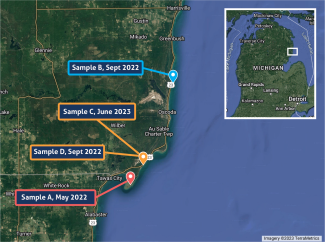
Between 2022 and 2023 , NOW volunteers collected foam samples in four different areas along Lake Huron near Oscoda. All four samples contained PFAS, though Tawas Point State Park had the highest concentrations at 7,900 ppt. PFOS and PFUnA were found in every sample, among others.

PFAS Foam map

Based on the results, the community and environmental partners developed two recommendations to protect the health of residents and visitors. First, the group is asking Michigan’s Department of Environment, Great Lakes, and Energy (EGLE) and Michigan Department of Health and Human Services (MDHHS) to develop health-protective policies for Lake Huron foam. These include publicly available test data, foam advisories on Lake Huron, and increased public education. They are also asking for permanent signage on Lake Huron’s high-use beaches and shorelines to educate the public on visual indications of PFAS foam and alert them about the dangers of touching it.

"Since 2017 we've noticed significant foam events on Lake Huron. Repeatedly we asked EGLE to test the foam for PFAS and they repeatedly refused. We felt gaslighted when they told us the foam was a “natural” type of foam, so we tested the foam ourselves. We found there is nothing natural about the PFAS foam in Lake Huron." - Cathy Wusterbarth, NOW Co-Leader and member of Great Lakes PFAS Action Network 

The full report can be reviewed here. 

PFAS Pollution in Oscoda 

Per- and polyfluoroalkyl substances (PFAS) are a class of thousands of chemicals widely used in manufacturing and consumer products. PFOS and PFOA were phased out but continue to pollute our environment, along with newer PFAS. 

EGLE first detected PFAS in the groundwater and water bodies in Oscoda in 2010. They issued “Do Not Eat” advisories for fish and wildlife, and warned residents not to touch the shaving cream-like foam oozing up on the shores of Van Etten Lake, which borders the contaminated Wurtsmith Air Force Base. However, EGLE declined to conduct more extensive testing or monitoring of foam on Lake Huron, noting the state has no standard for surface water foam. 

The community grew increasingly frustrated with the lack of state action being taken to monitor and address PFAS pollution on Lake Huron. In 2017, Oscoda residents formed the grassroots group Need Our Water (NOW) to engage residents in fighting for clean water and protecting wildlife and human health. In 2021, NOW joined the Ecology Center, the National Wildlife Federation, and the Michigan League of Conservation Voters to form the Great Lakes PFAS Action Network (GLPAN). This community-driven coalition has developed community-based science monitoring projects for PFAS and a series of policy recommendations for elected officials to turn off the tap on PFAS pollution. 

Community members and fellow advocates concerned about PFAS pollution can get involved with the GLPAN. View the website to learn about our policy recommendations, and sign up for the newsletter to learn about upcoming events and ways to get involved.

Graphic of pfas accumulating in surface water foam

Consumers Rate Case Spotlights Grid Equity and Environmental Justice

Michigan PSC Approves Rate Increase, Calls for Measurable Improvements on Grid Equity

Lansing, MI – On Friday, March 1st, 2024, the Michigan Public Service Commission (MPSC) released its final decision in the Consumers Energy 2024 rate case. In its decision, the MPSC approved a rate increase of just over $92 million, less than half of Consumers Energy’s originally requested $216 million. The MPSC approved a return on equity of 9.9% and rate of return of 5.86%.  

The Clean Energy Organizations (CEOs), consisting of the Environmental Law and Policy Center, the Ecology Center, Vote Solar, and Union of Concerned Scientists commend the Commission’s mandate for measurable grid equity assessments, and summaries of environmental justice and equity considerations in future rate cases. However, the CEOs advocate for further addressing affordability by shifting focus to return on equity, which remains at 9.9%, one of the highest return on equities in the Midwest. 

One of the key decisions of the case is the Commission’s directive for the Company to perform innovative energy justice and reliability analyses in future rate cases as recommended by the CEO and MPSC staff. These analyses, similarly required by the MPSC’s decision in DTE’s 2023 rate case, offer an improved approach to understanding grid equity within the utilities’ service territory. The methods include the use of  regression analysis, a tool used in social science that can aid understanding and assessment of how utility reliability performance affects customers differently.  

The Commission also directed the Company to file a comprehensive transportation electrification plan later this year as part of its ongoing electric vehicle programs, in addition to other analyses of EV charging loads to evaluate whether current rate structures are appropriate for different types of charging infrastructure.  The transportation electrification plan will need to evaluate the costs and benefits to the Company of increased EV adoption, which will help to determine how much spending on infrastructure might be warranted to help facilitate a transition to EVs.   

Other important additions to future rate cases include more detailed environmental justice analyses on community vulnerability, facilitating access to GIS system data, and mandating engagement with local communities and stakeholders in distribution grid planning. These measures will allow the MPSC, stakeholders, and the public to better evaluate utility proposals in future rate cases on critical topics such as environmental justice, grid equity, and reliability.  

Will Kenworthy, Midwest Regulatory Director at Vote Solar, said: 

“All customers, regardless of where they live, deserve safe, reliable, and affordable electric service. The Commission’s action today adopts important recommendations regarding the advancement of grid equity. The analysis of reliability in environmental justice communities requires an apples-to-apples comparison that takes into account differences around the type of grid that serves each community. This analysis will help Consumers Energy to plan their investments and operations in a way that ensures that grid modernization and reliability improvements serve all customers equitably.” 

Daniel Abrams, Associate Attorney at the Environmental Law & Policy Center, said:  

“CEO applauds the steps the Commission took today to advance environmental justice and grid equity in Michigan. In particular, we welcome the Commision’s directive to track the impact of spending on low-income customers.” 

James Gignac, Midwest Senior Policy Manager at Union of Concerned Scientists, said: 

“Under today’s order, the MPSC is demonstrating its ongoing commitment to require utilities to better integrate data and analysis of how their electric grid plans and investment proposals can serve customers more equitably. Based on the expert testimony in this case, the Commission ordered a robust set of measures aimed at improving the safety, reliability, and security of electric service for all customers, including lower-income households and medically vulnerable customers.” 

Charles Griffith, Climate and Energy Program Director at the Ecology Center, said: 

“With transportation now a leading source of emissions in the state and country, it is imperative that our utilities engage in planning to ensure our grid is prepared for the EV transition, and that their investments help to speed up that transition rather than slow it down.  We applaud the Commission for ordering a comprehensive transportation electrification plan be completed early this summer, along with additional analyses of consumer EV charging use to ensure the Company has the right programs and rate structures in place to encourage a transition to clean, electric transportation.”

More Life, Less Stuff

Are You Living a More Life, Less Stuff Lifestyle? 

Help Shape Ann Arbor Waste Reduction Efforts - Participate in Our Survey! It takes less than 5 minutes to take.

As part of our ongoing efforts to enhance community outreach and education on reducing waste, we invite you to participate in an important survey titled “Are You Living a More Life, Less Stuff Lifestyle?” Your responses will play a crucial role in shaping initiatives to promote sustainable living and reduce waste in our community.

Survey Overview:

The survey focuses on understanding our community's attitudes and behaviors toward using less stuff and the importance of mindful consumption. Your insights will help us identify motivations, barriers, and create resources that can encourage a more sustainable lifestyle for everyone.

Why Your Input Matters:

The results of this survey will guide us in developing impactful programs and resources that truly resonate with our community’s needs. Together, we can contribute to a healthier environment and a stronger sense of community.

Please take a moment to complete the survey by clicking the link below:

Take the Survey

Women resting on tree enjoying outdoors

Ann Arbor's campaign to inspire the community to use less stuff and connect with the world around us.  

On Earth Day 2024, the City of Ann Arbor and the Ecology Center launch the More Life, Less Stuff Campaign.

The More Life, Less Stuff campaign arose from a year-long community engagement initiative where the Ecology Center and the City of Ann Arbor met with a diverse group of Ann Arbor community members and discussed motivations and barriers to waste reduction activities like reuse, recycling, and composting. In all of our conversations, we heard two central themes: community members wanted to see reducing waste lifted up as a shared community value, and they wanted to spur an ongoing discussion about how to reduce waste while bettering our lives and strengthening our connections to each other rather than acquiring more stuff. The More Life, Less Stuff campaign hopes to do both. 

Fugitive Dust Found to be Associated with Scrap Metal Processing

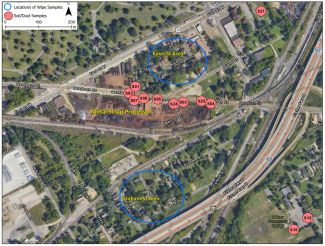
Ecology Center Environmental Health Advocate Melissa Cooper Sargent and Research Director Jeff Gearhart worked with our Detroit partners and U-M School of Public Health to complete a study of the impacts of a scrap metal processor in southwest Detroit. These types of facilities, which generate fugitive dust (and the truck traffic associated with them), significantly impact the quality of life and health of nearby neighborhoods.

The study found iron in road dust and sediment samples at levels above national public health guidelines near the Fort Iron and Metal scrap yard, as well as other metals and contaminants.  

Read the full study here.

fugitive dust neighborhood from above

Elevating Equity with Cumulative Impact Policies in Michigan

A new video series uplifts community leaders calling for better processes to protect human health and the environment

“When Michigan’s regulators monitor pollution right now, they look at industries separately. They monitor pollution from Ford separately from the steel mill, separately from the slag company,” said Samra’a Luqman, Concerned Residents for South Dearborn, in the From Air Pollution to Solutions video series. “But that’s not how our families experience it. We get exposed to all the stuff, all together, all at once. And that’s how regulators should measure the harm that is being done to us.” 

In a new video series uplifting impacted community members' voices, Samra’a calls on elected officials to implement a cumulative impact policy, a proposed regulatory shift to better protect the health of people living in communities overburdened by pollution. The policy, which can be implemented on the municipal or state level, requires environmental regulators to assess all sources of pollution, as well as factors that make a community more vulnerable to pollution, when determining pollution impact or siting a new facility. These policies can help prevent additional pollution burdens from harming a community and reverse the disproportionate impacts of legacy pollution on disadvantaged communities. 

Recent studies have shown Black Americans are exposed to more pollution from every type of source, including industry, agriculture, and transportation, than white Americans. Detroiters and other southeast Michiganders suffer more from poor air quality and higher rates of asthma than other Michigan communities. Residents are exposed to elevated levels of pollutants from many sources, including a wide range of industrial facilities and vehicular traffic.

In response, for more than a decade, environmental justice leaders in Michigan have been advocating for cumulative impact policies to halt the harm. The Ecology Center supports these efforts and our partner organizations who lead the charge on these vital policies.  

Hear community voices on the proposed policies by viewing the series

Video screenshot
Community Voices on Cumulative Impact Policies
Produced by Clear the Air, a coalition of organizations working for clean air in Detroit and Wayne County. Rooted in the conviction that breathing healthy air is a basic human right, Clear the Air partners are working together to advance policies that protect that right.

Gov. Whitmer’s Budget Outlines Clean Energy Priorities

MPSC clean energy implementation, weatherization, clean mobility amongst highlights

Lansing, Mich. – As Gov. Gretchen Whitmer laid out her state budget priorities today, a diverse coalition of nonprofit organizations advocated for the inclusion of funding for the Michigan Public Service Commission (MPSC) to implement the 100% clean energy standard by 2040, along with investments in home energy efficiency and clean vehicle fleets and urged the Legislature to support them.

As Michigan is now a national leader in clean energy, the groups said funding for the MPSC  is key in implementing the new laws.

“The Michigan Public Service Commission is positioned to advance energy justice and affordability by holding the utilities accountable in reaching the 100% clean energy standard,” said John Freeman, executive director of the Great Lakes Renewable Energy Association. “Fully funding the commission will ensure Michigan retains its position as a national leader while helping to address the reliability of our grid so Michigan families and small businesses are finally free from paying the highest electric rates in the Midwest for poor service. We appreciate Gov. Whitmer for including this funding in her budget proposal.”

The governor’s budget also lays out ways Michigan can take full advantage of federal funding available for energy efficiency and renewable energy through the Inflation Reduction Act (IRA) and Infrastructure Investment and Jobs Act (IIJA). 

This includes $1.4 billion to build or rehabilitate almost 10,000 homes across Michigan so there is more affordable and energy efficient housing available. 

“The majority of Michigan’s housing lacks energy efficient upgrades and insulation that would truly help residents save money every month,” said Alexis Bizman, legislative and policy director for the Ecology Center. “Investing in whole-home retrofits will improve our housing stock and allow people to live in safer and more comfortable homes. The governor’s inclusion of $1.4 billion for this type of work is vital to our state.”   

In her budget presentation, the governor called on the Legislature to provide support for a number of Clean Mobility initiatives, including those for electric vehicles and EV charging infrastructure. 

“Gov. Whitmer has been a strong supporter of our Clean Mobility sector, and her proposed vehicle purchase rebates, Clean Fleet, and EV charging infrastructure programs would continue to benefit Michigan’s economy, environment and our residents health in the transition to electric vehicles and cleaner transportation,” said Jane McCurry, executive director of Clean Fuels Michigan. “Clean mobility is critical to the future of Michigan, which is why it’s great to see more than $100 million included in this year’s budget proposal. We urge lawmakers to support these provisions as they finalize the budget in the coming months, and look forward to further refining the proposals to ensure they maximize environmental benefits and help those most in need.”

The groups plan to work with legislators and policymakers and ask them to provide more robust funding for local public transit, which the governor’s budget did not include. 

“The Growing Michigan Together report and MI Healthy Climate Plan both said expanding transit is essential. We’re disappointed that the Governor’s budget doesn’t provide the increased transit investments Michigan needs,” said Megan Owens, executive director of Transportation Riders United. “We are working with the newly-formed Transit Legislative Caucus and other lawmakers to ensure local public transit gets the support it deserves so all Michiganders can get to work, doctors, grocery stores, and elsewhere, even if they don’t drive.”

###

Cleaning Up the Government's Shopping Bags

How the Ecology Center's work on sustainable, accountable government procurement policies reduces toxic chemicals from entering the environment, supports communities, and addresses climate change.


When the government goes shopping, the shopping bags are big. And when governments purchase clean products that have been responsibly sourced and do not contain harmful chemicals, they can play a major role in reducing GHG emissions and toxic waste, thus protecting our health, our communities, and the environment. 

You might do this already: Choose local apples over those that have traveled thousands of miles. Buy things with reusable or recyclable packaging. Or even invest your retirement account in environmentally or socially responsible funds. Collectively, responsible spending makes a big difference. For example, a recent study from Harvard University found that after safer furniture was purchased, levels of toxic chemicals in interior dust decreased, reducing occupants' exposure.

We understand the impact purchasing can have on social change, which is why the Ecology Center and our partners have targeted some of the biggest purchasers of all – governments – as an intervention point. In Fiscal Year 2022, agencies of the United States federal government spent $259 billion buying products.  State and local governments spend a great deal on procurement, too–about $1.3 trillion each year. On the shopping list are pens, staplers, computers, cleaning supplies, pesticides, construction materials, furnishings, vehicles, medical devices, playground equipment, carpet and flooring, and more. 

In the last few years, our hard work on sustainable procurement has been paying off. 

Our first win was in the Ecology Center’s hometown of Ann Arbor. In 2019, we worked with the City to create a sustainable procurement policy explicitly listing PFAS and other hazardous chemicals to avoid in city purchasing. This policy has been a model for other small- and mid-sized cities looking to create non-toxic purchasing policies. 

Though our focus has been helping Great Lakes communities transition to sustainable purchasing, we share our lessons learned with any interested municipality. That’s how we helped Anchorage, AK, and Providence, RI, pass resolutions to move their sustainable procurement policies forward in 2020. We continue working with cities across the region, including the cities of Dayton and Toledo, OH, and Toronto, Canada to help implement sustainable purchasing practices. 

We formalized our work with cities regionally through the Great Lakes Climate Adaptation Network (GLCAN) procurement group, an information-sharing peer network for sustainable purchasing. Through the network, municipal employees, university faculty and staff, and environmental health experts share knowledge and support each other as they work to implement sustainable purchasing in their communities.

For example, in 2022, we helped the City of Lansing create a model equitable, non-toxic, and climate-friendly procurement policy. The policy bans purchasing products containing PFAS, phthalates, and single-use plastics, and outlines climate-friendly and equitable purchasing guidelines. In addition, the policy encourages seeking out minority-owned, locally-owned, small businesses, and unionized vendors, as well as those using fair labor practices.

"The Ecology Center and GLCAN provide much-needed information and resources that helped Lansing adopt an effective green purchasing policy," said Lori Welch, Sustainability Manager for the City of Lansing – Public Service Department. "Their continued support is helping to ensure City employees are prepared to procure goods and services that are safer and more sustainable."

At the state level, we worked with Great Lakes PFAS Action Network, a community-driven advocacy group, to successfully advocate for Michigan to sign the first PFAS-free procurement policy in the nation. This groundbreaking executive directive, signed into law in October 2021, directed state purchasers to avoid all products containing every type of PFAS. Many other states are following suit, including Maine, New York, and Colorado. 

Also, in 2021, the Biden Administration released an improved framework for assessing the environmental performance standards for federal purchasing. In addition to outlining an ambitious path to achieving net-zero emissions from federal procurement, the plan also advises avoiding products containing PFAS. For example, furniture, cutlery, dishware, containers, insulation, paint, carpet and flooring, adhesives, cleaning solutions, dishwasher detergents, soaps, and many other products contain the compounds. Due to the policy, the government will no longer purchase any of this stuff if they’re laced with PFAS. Not only will that reduce individual exposure to hazardous chemicals, but it will also encourage manufacturers to stop using PFAS altogether if they want to sell to the government. 

The Ecology Center helped advocate for the executive order. We also worked with national partners and PFAS-impacted community members to provide comments and resources on how the government should implement the order. Additionally, we have provided guidance, tools, and suggestions to analysts helping the Department of Defense figure out how to comply with their new PFAS-free procurement mandates. 

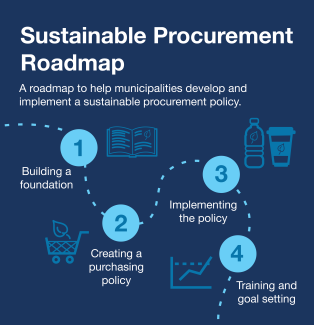
Procurement roadmap

We also helped craft a model sustainable purchasing policy and continue to provide curated resources for municipalities and organizations interested in implementing sustainable purchasing practices. These resources include general factsheets about PFAS-free purchasing, third-party certifications and eco-labels, how sustainable purchasing saves money, and less toxic purchasing

Most recently, we developed a modular powerpoint presentation to help sustainability and purchasing staff make the case for sustainable purchasing to decision-makers (such as mayors, councils, and administrators), created a sustainable purchasing training program for municipal staff, and developed a series of fact sheets covering high volume product categories for municipal purchasers. We are currently developing guidance to embed sustainable purchasing in Zero Waste and Climate plans. 

If you are interested in helping your local government adopt a sustainable purchasing policy, the Ecology Center and our partners have many resources available on the Ecology Center website. We welcome municipalities and institutions to join us as we continue to advance sustainable procurement efforts across the Great Lakes and the country.