
More Life, Less Plastics

By Crystal Zanders

This Plastic Free July, Ann Arbor’s More Life, Less Stuff campaign is raising awareness about how our clothing habits and consumption contribute to plastic pollution in our local waterways – a literal river of microplastics making its way into our wildlife and bodies. The More Life, Less Stuff campaign is a partnership of the City of Ann Arbor and the Ecology Center. Learn more at a2morelife.com.

A few summers ago, my friends and I went tubing in the Huron River. It was my first time tubing, and to say I was concerned would be an understatement. I was terrified. I worried that the current would take me away because I am not a strong swimmer. I imagined an elaborate helicopter rescue saving me from careening over a waterfall. I knew there were fish in the water, and I imagined accidentally ingesting some fish poop and being infected by a rare fish-poop virus. I was sure that my friends were leading me into near-certain death, but courageously, as I mentally planned my funeral, I put on my big-girl bathing suit and a life jacket and spent an idyllic afternoon floating down the river. Looking back, I thought I understood the dangers of the Huron River, when I never even saw the danger floating beside me.

Crystal Zanders by waterway
Crystal Zanders, she/hers Doctoral Candidate in English and Education at the University of Michigan and freelance writer for the More Life, Less Stuff campaign

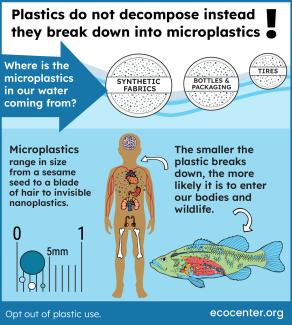
The Huron River — and every other river — is filled with plastic. Most bacteria don't eat plastic the way they eat natural materials to break them down. So, plastic doesn't decompose the way other materials do.  It just breaks down into smaller and smaller pieces over time, the smallest of which are called microplastics and nanoplastics. Because so much of our world is composed of plastic, microplastics and nanoplastics are everywhere. They are in the water, the air, and our bodies.

To learn more, I sat down with Ecology Center Senior Scientist Gillian Miller, Ph.D and asked some questions about this invisible threat flowing freely through our waterways.

How do microplastics get in the water?

One of the most significant contributors of microplastics to waterways is laundry.  Remember the bathing suit from my tubing adventure? According to the tag, it is 82% nylon and 18% spandex. Both materials are different kinds of plastic. Many of our clothes are made of plastic.  Each time we wash clothes, they break down a little bit. Fibers from those clothes are washed into the water.  

Dr. Miller explained what happens next: "Everything that goes down the drain in our homes gets treated at the wastewater treatment plant, and the liquid portion is discharged to rivers and waterways. The treatment doesn't remove all microplastics, so some get discharged that way directly into our waterways." With each load, a small amount of plastic goes into the water system and makes its way into larger bodies of water, including the Huron River.  

Why are microplastics a problem for our health? 

Microplastics have been found in nearly every organ and part of the body and in bodily fluids like blood, urine, and breast milk. Although we are just beginning to understand their effects, evidence already suggests harm.

Patients who had micro or nanoplastics in the plaques in their arteries were more likely to have a heart attack or stroke or die from any cause over a three-year follow-up period. These tiny plastic particles can also carry other hazardous chemicals with them, exacerbating harmful effects. They can harm the brain because the smallest particles can pass the blood-brain barrier, possibly increasing the risk of developing Parkinsons or Alzheimer's. In the lungs and other parts of the body, they can also cause inflammation. 

Microplastics are also dangerous to animals. According to Dr. Miller, microplastics "look like food to a lot of wild animals, including birds, turtles, and all kinds of fish." If they eat enough plastic instead of food, they could die. 

How can we help keep microplastics out of our waterways?

As individuals, the first thing we could do is buy less clothing. The more plastic clothes we buy, the more plastic clothes are produced. The more plastic clothes are produced, the more they break down into our air and waterways and eventually end up in landfills. The longer you can wear the clothes you have, the better for the environment.

If you need some clothing you don't already have, consider buying from thrift stores or other secondhand retailers or joining your local Buy Nothing group*. However, if and when you do buy clothing, Dr. Miller suggests you try to buy high-quality clothing that lasts a long time. When asked about materials, she said, "Natural materials in general are going to be better: wool and hemp and cotton," encouraging us to buy organic if that is within our budget. The issues around pesticide use in non-organic cotton production could warrant its own dedicated story. 

Also, we can do less laundry. For example, I wash my bathing suit every time I wear it, but I don't have to wash my jeans with the same frequency. The less often we wash our clothes, the less plastic we put into the water system. Also, the longer the clothes last. It has the added benefit of saving time and money. Win-win.

The longer you wear your clothes, the more value you get from them. That bathing suit was about $25 in 2014. If I have used it once per year for the last ten years, then I have used it ten times, making my cost per use $2.50. If I can keep it for another five years, that would bring my cost per use down to $1.66. The longer we use items, the more bang we get for our bucks. Higher quality clothes tend to last longer, often making them cheaper per use than cheap clothes that you may only be able to wear a few times before they become damaged. 

When clothes wear out, we can repurpose them. Growing up, we dusted using single socks, saving money by using what we already had rather than buying expensive dusters. My brother used to clean his car with soft, old t-shirts to ensure he wouldn't scratch the paint. These creative uses for our old items helped save money while protecting the environment and keeping our old clothing out of landfills.

We're ready to take the No New Clothes challenge. Are you?

Video 3 (Micro Plastics & Clothes) from Marcus Thomas on Vimeo.

And Don’t Forget to Vote!

According to Dr. Miller, the most important thing we can do is vote. She said, "Individual people cannot shop their way out of the microplastics problem. There have to be political solutions at the government level to these pollution and environmental destruction issues." Dr. Miller encourages us to let our representatives know that we care about environmental policy and that protecting our families and our world from microplastics is essential to us. 

As I think back to that day tubing on the river, I remember being awed by how beautiful it was to watch the water sparkle in the sunshine and feel connected to the community and the wildlife it sustains. Water is life, and keeping our waterways healthy is our responsibility.

*Stay tuned for our next story for the More Life, Less Stuff campaign about our local Sharing Economy and Buy Nothing groups!

Groups urge lawmakers to prioritize more funding for clean energy investments

Non-partisan groups thank lawmakers for including clean energy law implementation, funding for clean transportation, energy efficiency in state budget

LANSING, Mich. – A coalition of nonpartisan Michigan groups is thanking the Michigan Legislature for making critical investments to protect our air, land and water for the future of our state by passing the 2025 state budget, while urging them to provide more funding in these areas.

The state budget includes funding for the implementation of the state’s historic 100% clean energy standard, affordable energy and energy efficiency projects, clean mobility and transportation — but those investments are still only a fraction of what’s needed to protect Michiganders from rising costs while reducing pollution.

“The funding allocated for pre-weatherization, housing stock and homeowner affordability will help us make improvements to the quality, safety and affordability of Michigan’s existing attainable and low-income housing,” said Carlee Knott, energy and climate policy coordinator for the Michigan Environmental Council. “Much more funding is needed through a comprehensive whole-home approach so we can help ensure that our homes are free of pollutants, residents are staying cool in the summer and warm through the winter and homes are resilient to the effects of climate change. Energy efficient homes help save people money on utility bills and protect our air, land and water for generations to come.”

“With the transportation sector now the leading source of climate-changing emissions, Michigan’s 2025 budget makes some critical commitments to cleaner transportation options that will help us meet our state’s climate and pollution reduction goals and increase access to clean mobility for all Michiganders,” said Charles Griffith, climate and energy program director at the Ecology Center. “We’ve still got work to do if we want to be leaders in clean mobility, however, which will require consideration of new policy initiatives that set targets for clean vehicles and transportation emission reductions, and that raise new revenues to help support this critical transition.”

“We applaud the Michigan Legislature for their transformative investments in clean mobility,” said Jane McCurry, executive director of Clean Fuels Michigan. “These investments will not only advance the state’s transportation goals but also bolster Michigan’s position as a national leader in the clean mobility transition by developing our infrastructure, encouraging the deployment of cleaner vehicles and creating jobs in a rapidly growing sector.”

“We’re thrilled that Michigan is getting a statewide e-bike incentive program and so grateful to all the people who helped make it happen. E-bikes are the future. They’re a transformative, extremely popular form of affordable transportation with benefits for public health, climate goals and cleaner air. With this program, Michigan will join 10 other states that recognize their potential to make our streets less crowded and our commutes more joyful," said Matt Penniman, communications and advocacy director for the League of Michigan Bicyclists.

“While we appreciate the Legislature’s increased attention to transit this year, this budget falls far short of the transit operating funds Michigan needs,” said Megan Owens, executive director of Transportation Riders United. “Even as the Governor’s MI Healthy Climate Plan and Growing Michigan Together Council have called for significant investments in transit, these budget levels may result in cuts in transit service, especially in fragile rural communities. Our state must do better.”

“We applaud the Michigan Legislature for taking critical steps to further the state’s development of a thriving clean energy economy,” said Courtney Bourgoin, senior Midwest policy and advocacy manager at Evergreen Action. “These investments not only support the implementation of the state’s clean energy and energy efficiency goals, but will also create good-paying jobs, enhance the workforce with essential trainings and attract significant additional investment to Michigan. We must continue building on this progress to ensure that everyone in Michigan benefits from clean air, clean water, and affordable energy."

The coalition highlights the following allocations in the state budget:

Michigan’s 100% clean energy standard

  • $156.2 million in federal Inflation Reduction Act funding for Solar for All, which supports solar programs for low-income households to increase residential solar installation, increase pollution abatement and improve grid reliability
  • $7 million for implementation of the 2023 Clean Energy Jobs Act at the Michigan Public Service Commission
  • $5 million for grants to businesses, nonprofit organizations and units of local and state government for planning, developing, designing, acquiring or constructing renewable energy and electrification infrastructure projects
  • $5 million for Michigan’s nonprofit green bank (Michigan Saves)

Clean Buildings

  • $33.4 million for housing stock and homeowner affordability, which can be used to build new construction, renovate current homes and complete energy efficiency improvements
  • About $22 million for weatherization assistance with an additional $40 million in funds through the federal Infrastructure Investment and Jobs Act
  • $5 million for pre-weatherization projects, which will help protect our homes against the effects of climate change

Clean mobility and transportation

  • $30 million to add EV charging stations and hydrogen fueling facilities around Michigan
  • $1m for state fleet electric vehicle transition
  • Increase of $30 million for local bus operating for a total of $247 million
  • Increase of $14.5 million for rail operations and oversight for a total of $152 million
  • $2.95 million for E-bike purchase incentives
  • $2.5 million for the Economic and Worker Transition Office to aid Michiganders with the transition to electric vehicles and clean energy

###

Diverse coalition encourages passage of bipartisan community solar legislation

Groups say legislation would help lower energy costs while helping state transition to clean energy 

LANSING, Mich. — A diverse coalition of organizations is encouraging lawmakers to pass bipartisan-sponsored legislation that will enable and scale community solar across Michigan.

The Environmental Protection Agency (EPA) recently awarded a $156 million federal grant to Michigan for programs aimed at expanding solar access in low-income and disadvantaged communities. Michigan’s Department of Environment, Great Lakes, and Energy (EGLE) is responsible for utilizing the funding to finalize and implement programs that maximize benefits for low-income households and communities.

“We have a tremendous opportunity for EGLE to help ensure residents in underserved areas gain access to the economic and environmental benefits of solar power,” said Sergio Cira-Reyes, Climate Justice Catalyst, at the Urban Core Collective. “To do that we need a state policy framework that encourages the creation of third-party community solar projects, which ultimately will help provide cleaner air to breathe and water to drink for all Michigan residents. This important legislation would help improve public health, save lives and create equitable access to clean energy.”

Currently, Michigan does not allow independently owned community solar programs that local residents can subscribe to. Community solar projects in Senate Bills 152 and 153 would expand solar energy access to individuals who are limited due to income, rent a home that does not permit rooftop installation or who face other obstacles, such as the placement of their home or trees shading their home. 

Community solar programs are currently not allowed in the state despite the work of community organizations preparing to lead community solar development for more than a decade. They need access to the utility billing system so community members can receive credits on their bills from their community solar subscriptions. Additionally, these solar energy projects need to be connected to a utility company’s grid. 

Studies of community solar development show that local ownership expands financial benefits to households and local economies while generating more jobs, more engagement and more stability for the solar industry. 
“It is time for the Michigan Legislature to move community solar legislation forward so that we can expand access to clean solar energy to more Michiganders,” said Carlo Cavallaro, Midwest regional director of the Coalition for Community Solar Access. “Without Senate Bills 152 and 153, Michigan will miss out on the ability to tap into the hundreds of millions of dollars from third-party community solar developers’ investments into Michigan’s utility grid at no cost or risk to Michigan ratepayers. We have a tremendous opportunity to capitalize on EPA grant funding to help more families save money and take control of where their energy comes from. We can create a cleaner, brighter and more sustainable future for all Michigan residents with community solar.”

“Our Legislature and Gov. Gretchen Whitmer should enable community solar in our state’s transition to 100% clean energy,” said Nick Occhipinti, government affairs director at The Michigan League of Conservation Voters. “Community solar allows those who can’t install rooftop solar to take part in Michigan’s clean energy future, while lowering their monthly energy bills and reducing pollution in our air and water. This bipartisan legislation will pave the way for community-led solar projects and we urge lawmakers to unleash this opportunity giving Michiganders more access to affordable solar energy.”

“Community organizations in Michigan have been trying to create community solar programs for more than a decade — they’ve developed models, negotiated settlements, and advocated to regulators to no avail,” said Dr. Denise Keele, Executive Director at Michigan Climate Action Network. “Twenty-two other states already enable community solar, and advancing this bi-partisan legislation would finally allow all Michiganders to embrace and benefit from the fastest growing segment of the U.S. solar market.”  

“Community solar legislation is necessary for Michigan to gain the greatest number of benefits of Solar For All,” said John Delurey, senior midwest director at Vote Solar. “Michigan received $156 million through the Solar For All program to benefit low- or moderate-income households. EGLE’s proposal projects that more than 90% of the solar deployed will be community solar. That’s more than $100 million of public investment that could be generating benefits for both local and community ownership. Without taking legislative action now, these projects will be dominated by utility interests, and we’ll miss that opportunity.”   

“It is time to pass community solar legislation that includes third-party community solar programs to help achieve 100% clean energy by 2040 under Michigan’s clean energy law,” said Andrea Pierce, Michigan Environmental Justice Coalition (MEJC) policy manager. "We have an important opportunity to use EPA grant funding to assist low-income, black, Indigenous, people of color and families to save money, take control of where their energy comes from and hold big utilities accountable. Doctors say transitioning to clean energy will reduce rates of asthma, heart disease, lung disease and even cancer — especially for children and seniors. Now is the time to create a cleaner and more sustainable future that benefits ALL Michiganders.”

“With the Legislature’s support, community organizations stand ready to make community solar projects with tangible community benefits a reality for everyone in Michigan — regardless of your race, income or if you own a home,” said Alexis Blizman, Ecology Center legislative and policy director. “It’s time to create a transformative policy and start building projects that offer real community benefits.”

“As Michigan continues to emerge as a national climate leader, it’s important to ensure that all Michiganders feel the economic and health benefits of the state’s growing clean energy economy. By passing community solar, Michigan can unlock the door for low-income communities and renters to access the cost-saving benefits of solar energy,” said Courtney Bourgoin, Evergreen Action Midwest senior policy and advocacy manager. “Enacting community solar will lower energy prices, give Michiganders alternative choices beyond monopoly electric utilities, and help ensure that Michigan’s massive $154 million Solar for All award works effectively and equitably across the state. Let’s get it done.”

“Community solar legislation is an opportunity to improve the health and well-being of all Michigan residents, especially those who have suffered the greatest health impacts from fossil fuel pollution,” said Dr. Elizabeth (Lisa) Del Buono MD, founder and president of Michigan Clinicians for Climate Action. Such legislation would not only expedite the build out of healthy, clean solar energy in a more democratic and equitable fashion, but it would also protect health by improving the resilience of the grid. As extreme weather becomes more common in Michigan, dependable and affordable electricity can literally be the difference between life and death for those dependent on electricity to provide oxygen to breathe and for those whose health cannot withstand the increasingly common extreme heat, humidity, and poor air quality.  Let’s seize this opportunity to improve the health of ALL Michigan residents today!”

### 
 

Uncovering PFAS in Rainwater: A Community Study

In recent years, there has been growing concern about the accumulation of PFAS (per- and polyfluoroalkyl substances) in air and its spread through rainwater. Ecology Center collaborated with Great Lakes PFAS Action Network, Original United Citizens of Southwest Detroit, and Environmental Transformation Movement of Flint on a community-driven initiative that involved the collection and testing of rainwater in Detroit, Flint and Dearborn to understand the presence of PFAS in the environment. 

The Community Initiative

Community activists and environmental justice advocates in Detroit, Dearborn, Flint and Ann Arbor joined forces to better understand PFAS accumulation in the air around heavily industrial areas in Southeast Michigan and how it impacts residents. The Ecology Center provided funding and technical support for this project, and worked with community partners to pilot the study. 

Using buckets, rainwater samples were collected in Dearborn, Detroit, and Ann Arbor by community partners and analyzed by the College of Wooster. The analysis utilized the EPA’s method to measure 43 PFAS compounds, including TFA (trifluoroacetic acid), a breakdown product of common refrigerants used in air conditioning.

The results revealed the presence of PFAS in all three rainwater samples. Dearborn and Ann Arbor contained high levels of TFA. Several other PFAS chemicals, including legacy compounds PFOS and PFOA, were also detected. When TFA wasn’t accounted for, Dearborn and Detroit had the highest total PFAS. 

“We’ve long advocated for stronger environmental protections when it comes to the tens of thousands of synthetic chemicals currently used by industry. Until our society commits to regulating harmful substances as chemical classes, rather than one by one, this story of chemical bad guys and disillusioned communities will continue to repeat.” - Gillian Miller, Senior Scientist at Ecology Center 

Implications and Action Needed

The presence of multiple PFAS chemicals in rainwater, many at relatively high concentrations, emphasizes the urgent need for stronger regulations and environmental safeguards. The findings highlight the failures of the existing laws to protect human health and wildlife from the harmful effects of PFAS contamination. It is imperative to shift towards a precautionary approach in regulating new and emerging chemicals, prioritizing regulations on chemicals that accumulate and persist in the environment and lead to widespread, long-lasting, and increasing contamination. Current regulations are driven only by risk analysis, which has allowed dangerous and persistent chemicals to infect our environment, water, air, and products, putting our and our world’s health at risk. 

Key Takeaways

  • Rainwater collected in Ann Arbor, Detroit, and Dearborn was tested for PFAS and significant levels of TFA were found in Dearborn and Ann Arbor. 
  • This is a pilot study that collected rainwater on multiple rain events, which could impact PFAS levels in each sample. 
  • This study highlights the urgent need for regulatory action to address the presence of PFAS in rainwater.

The initiative to test rainwater for PFAS in Detroit and Dearborn exemplifies the power of community-driven environmental action, a cause the Ecology Center is dedicated to. The discovery of abundant PFAS in rainwater underscores the importance of collaborative efforts in addressing environmental challenges and advocating for stronger federal and state regulations to safeguard public and environmental health.

To read the full Healthy Stuff Lab study, click here.


June 26 Update

Local non-profit news organization Planet Detroit recently released an article series about Living with PFAS in Metro Detroit. Click Here to read more!

Microplastics in Our Water

Art and community science project puts the focus on plastics and microplastics in our watersheds 

On a blustery April morning, the Ecology Center Healthy Stuff team gathered with Sidewalk Detroit and about 60 people in Detroit’s Eliza Howell Park to collect garbage from the Rouge River. Some in the group donned waders and ventured into the water, while others formed a bucket brigade to carry the trash to a third group waiting with garbage bags to sort into piles of plastic, metal, rubber and styrofoam. 

Detroit-based artist Halima Afi Cassells stood between multiple trash cans calling out directions for where each material should go. The groups collected and sorted for hours and by the end of the afternoon the fish and other aquatic wildlife in that part of the Rouge were likely a little happier and a little less encumbered by all that trash. 

But while cleaning up the river was a worthy project, it wasn’t the only purpose of gathering that day. 

Plastic trash from river

Much of the trash pulled from the river was plastic. All kinds of plastic bottles, lighters, styrofoam cups, and even a giant yellow exercise ball. And because plastic does not decompose like natural material, it likely wasn’t going anywhere for a very very long time. In fact, less than 10% of all plastic is recycled. Most plastic just breaks down into tiny particles called microplastics and nanoplastics. Those microplastics can enter the bodies of fish and even humans, and research has shown that microplastics may be linked to endocrine disruption, increase the risk of cardiovascular diseases and contribute to other health problems. Many of the chemicals used to make plastic are toxic to humans and the environment. 

Microplastics get into our bodies

The cleanup day was part of a larger project bridging art and citizen science to raise public awareness about the dangers of plastic in our watersheds and throughout the entire plastic lifecycle. In partnership with Sidewalk Detroit and Halima Cassells, the Ecology Center organized a series of hands-on workshops after the cleanup day. These workshops gave Detroit youth and adults opportunities to help Halima create a semi-permanent art installation made from upcycled plastic found in the river. 

Kids testing water for microplastics

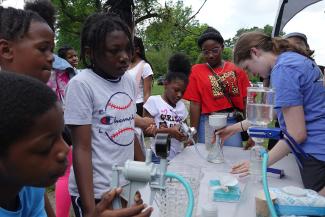
The workshops mixed scientific and creative inquiry about the plastic problem and solutions. While Halima worked with workshop participants to create pieces for the installation, the Ecology Center staff and summer interns busted out our water filters and microscopes. Our team worked with youth participants to pump water through a paper filter that trapped microplastics - too tiny to see with the naked eye. Once the paper filter was placed under the microscope tiny colorful plastic threads appeared on the paper. 

These tiny threads that accumulate in our river water are a result of plastic’s toxic lifecycle. Microplastics largely come from deteriorating products such as synthetic fabrics, tires and bottles and packaging. Just one fleece jacket sheds up to 250,000 microfibers during a single wash. “Fast fashion” depends on polyester which does not easily degrade and releases synthetic microfibers when washed. Most washing machines don’t catch these synthetic microfibers before the water flows to the wastewater treatment plant and flow into our local watersheds. 

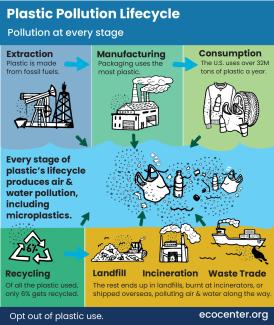
Our Great Lakes see 22 million pounds of plastic every year, and at every stage of plastic’s lifecycle - from manufacturing, to use, to disposal - microplastics are created. The smaller the plastic breaks down the more likely it will leach into our bodies and wildlife. 

To address the plastic crisis we need bold commitments and the resources to make change at the institutional, municipal, state, and national levels. You can support policies that reduce plastic pollution, like banning plastic bags and holding producers responsible to clean up pollution.

The Ecology Center recommends a set of actions for the Michigan Legislature.

These include: 

  • Rejecting false solutions to plastic pollution (like chemical recycling) 
  • Restricting single-use plastic 
  • Phasing out the most dangerous plastics 
  • Updating our state’s Bottle Bill 
  • Creating an Extended Producer Responsibility (EPR) law  

The Ecology Center is advocating for Michigan policies that will address microplastics in several important areas. These policies would ban microbeads into waters, regulate pre-production plastic pellets, test and develop comprehensive plans for microplastics, and require all new washing machines to contain synthetic fiber filter systems. 

When the workshop participants peered into the microscope they saw the microplastic threads. Our Ecology Center Healthy Stuff team guided youth and adult participants to think about where these plastics come from, and why they might be in the Rouge river. We even gave them lint rollers to use on their clothes, then put the lint under the microscope. We showed them plastic water bottles and face wash that contained plastic microbeads. 

Almost four months after we collected trash from the Rouge River, a semi-permanent structure made from plastic bottles and other plastic materials arched over the trail down to the river. Ironically, the archway was beautiful as colorful plastic pieces shaped into flowers intertwined with tree branches. But was it beautiful? Halima had used the structure to raise critical questions about how plastic pollution can impact our natural world. The solution has to be more than just cleaning up the river; it’s about understanding the true environmental and human health costs of producing, using and disposing of plastic.

ECO art Sidewalk Detroit

The choices you make are also part of the solution. Here’s some tips to get you started:  

  • Find reusable alternatives to single-use plastics like plastic bags, straws, plastic bottles, cups, and plastic packaging.
  • Choose natural fabrics over synthetics, and think about how much your clothes need to be washed 
  • Recycle plastic labeled #1 and #2 and check your local recycling facility to see what other kinds of plastic they may accept

Learn More: 

Plastic Pollution Lifecycle


The Forth Roadmap Conference

Join us for the Forth Empowering Mobility Roadmap Conference!

September 24–26th, 2024

Huntington Place | Detroit, MI

Ecology Center is proud to be a community partner of the Forth Roadmap Conference, the premier electric transportation conference in the US where leaders convene to transform how people and goods move.

The Roadmap Conference is where the future of transportation is created. Join us as we explore emerging trends, share learnings and best practices, and convene industry leaders to chart the future of electric transportation.

As the industry continues to grow, so does the Roadmap Conference. Join us in Detroit, MI, the world’s automotive capital, as we chart the road forward for electric transportation.

Register for the event here!

Fighting Food Waste & Feeding Folks in Our Community

More Life, Less Stuff

In partnership with the Ecology Center and the City of Ann Arbor, the More Life, Less Stuff campaign aims to inspire the community to use less stuff and connect with the world around them.  This story is the first in a series highlighting and supporting people and organizations making things better in our community and our world.  Learn more at a2morelife.com

The Cost of Wasting So Much Food

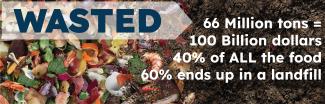
Food Wasted equals 66 million tons, the equivalent of 100 billion dollars and 40% of all the food produced!
EPA's 2019 Wasted Food Report: 66 million tons, 100 billion dollars, 40% of all the food, 60% ending up in landfills!

Every year, Americans throw away a mind-boggling 66 million tons of food. To put it into perspective, this is almost 40% of the food we produce, and a staggering 60% of this waste ends up in landfills.

Changes, even small ones, can dramatically reduce the amount of food we waste, reducing the impact on the environment and making resources available to organizations that help feed people in need.

More life, less food waste. 

Every stage of our current food system creates waste, and the environmental impact is huge—from growing and grazing to production and manufacturing, from packaging to transportation, and from retailers to individuals.

Growing, producing, and transporting food is energy-, chemical-, and land-intensive. Conventional food production requires large amounts of fresh water and massive amounts of pesticides and fertilizers, which pollute and overburden the environment. Agriculture consumes half of the world's habitable land. The entire agricultural supply chain has GHG emissions associated with it. Agriculture is responsible for about one-quarter of the world's greenhouse gas emissions.  

It's more than just the production and transport of food that has such a huge environmental footprint. Food waste storage and disposal uses lots of energy, some of which comes from fossil fuels, which release more toxic chemicals into the environment. This wasted food fills up landfills. As it rots, it gives off methane, a greenhouse gas (GHG), that is more than 80 times more potent than carbon dioxide. Methane is the second largest contributor to climate warming. Food waste, along with food packaging, makes up almost half of household, retail, and commercial waste.    

All these GHG emissions from the agricultural supply chain and disposal of waste food are helping to drive climate change, a main cause of the extreme weather events like hurricanes and droughts. 

Food Waste is a Preventable Problem - So is Food Insecurity. 

Food waste presents both a problem and an opportunity. In our current linear system–the take-make-waste economy where we use natural resources to produce stuff that we don't need and eventually throw away–food waste is inevitable. A circular system focuses on reducing food waste by creating and purchasing only what we need and ensuring that extra food is shared with others (who may be experiencing food insecurity) or goes back into use by creating animal feed and compost. In a circular system, the majority of food waste is preventable.

Through supporting charitable organizations, such as Food Gatherers, we can fight food waste and make sure everyone in our community has food to eat.  

Our Neighbors Struggle with Food Insecurity

According to Feeding America, in 2018, the average meal in Washtenaw County cost $3.39. By 2021, that same meal cost $4.05. At that time, almost 10% of Washtenaw County residents – more than 39,000 people – experienced food insecurity.  

Because of the high cost of living, many people in Washtenaw County experiencing food insecurity don't meet the federal poverty guidelines and, therefore, don't qualify for the Supplemental Nutrition Assistance Program (SNAP) or other government assistance programs. SNAP benefits have returned to pre-COVID levels for those who do qualify, although prices have remained high. Food Gatherers and other food rescue programs work to fill the holes in the social safety net and ensure that every resident has access to healthy and nutritious food. 

The Story of Food Gatherers 

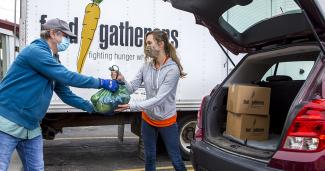
Thirty-six years ago, the founders of Food Gatherers were frustrated. They saw how much usable food was being thrown away and wasted, food they knew could feed hungry people. So, they decided to do something about it. They borrowed a van, filled it with surplus food from restaurants and grocery stores, and then delivered it to hot meal programs in Ann Arbor and Ypsilanti. This was the beginning of Food Gatherers, Michigan's first food rescue organization.

Today, Food Gatherers distributes the equivalent of 18,000 meals daily to 140 community partners. They aim to "alleviate hunger and eliminate its causes in our community." Along with their partners, they build community, fight food insecurity, and reduce food waste.  Therefore, Food Gatherers is the first organization profiled in and celebrated by the More Life, Less Stuff campaign. We interviewed volunteers Frank and Lindsay Bateman as well as Markell Miller, director of community food programs, to learn more about their work in rescuing food and feeding those in need in their community. 

Food Gatherers

Food Gatherers Rescues Food and Fights Food Insecurity

It works like this: Food Gatherers collects food donations from consumers, grocery stores, restaurants, and farms—food that would have otherwise been wasted—and redistributes it to people experiencing food insecurity. They also use government programs and individual financial donations to purchase food. This food goes to food pantries, low-income and assisted living facilities, and shelters for people experiencing homelessness.

Food Gatherers also has and works with programs for children. 12% of Washtenaw County's children struggle with food insecurity. One of their goals is to ensure that the meals that they serve and the food they provide contain balanced nutrition for their clients within the community. Food Gatherers works with organizations that introduce new fruits and vegetables to kids whose families may not be able to afford the risk of investing in food their children may or may not like. They also distribute food through schools and during summer break. When school gets out, students who qualify for free breakfast and lunch lose access to both meals. Food Gatherers steps in and fills the gap, making sure that these kids and teens are fed. 

Through serving the community, Food Gatherers also builds community.  Frank Bateman, a long-time volunteer, told me, "It's a close-knit organization.  If you come into it, you're adopted; you're one of us. We have new friends because of our work there. Some of those are staff, and some of them are volunteers." Lindsay Bateman, another volunteer, said that through Food Gatherers, they "got to meet a lot of new and interesting people" and felt "like we were giving back to the community, not just writing a check." Food Gatherers's impact goes beyond saving the environment and feeding the community - it also improves lives. 

Food Gatherers

How to Find Food

Food Gatherers makes it easy to get food.  When asked about the process, Frank Bateman said, "If you're picking up food or getting dinner or lunch, nobody asks for your name or ID. You don't have to say a certain prayer. You just come in, you get in line, and you eat. That's all there is to it."  Because Food Gatherers partners with various community organizations and distributes to pantries throughout the area, odds are you aren't far from a free meal or bag of groceries. Find a location close to you here: https://www.foodgatherers.org/foodresources/

We Can All Help Reduce Food Waste

The first step in reducing food waste is to be more intentional about food purchases. Small changes like meal planning and bringing a list to the grocery store can go a long way toward avoiding buying food you don't need and spending money unnecessarily. You could also designate an "Eat First" section of your refrigerator for foods that must be eaten soon to prevent spoiling. 

If you find yourself with extra food, you can donate it to Food Gatherers, one of their partner pantries, or another program that provides food to folks in need.  Food Gatherers is funded primarily through individual donations. More than 90% of every donation goes directly to food programs and every little bit counts.

Food Gatherers also relies heavily on its volunteers, who do everything from collecting food from restaurants and grocery stores to cooking and serving meals at the Food Gatherers’ Community Kitchen, located in the Delonis Center, which provides hot, nutritious meals for shelter residents. According to  Lindsay Bateman, getting started volunteering is pretty simple: "It's easy to go to the website and see all the volunteer effort opportunities right there."  

When asked how community members with less time or money could contribute, Markell Miller, director of community food programs at Food Gatherers, said, "We also love to encourage people to do word-of-mouth outreach, making sure people know that there are resources for them." Anyone who needs help should know where to go to find either a hot meal or free groceries. You can also follow them on social media by searching Food Gatherers on Facebook or @foodgatherers Instagram or X (formerly known as Twitter) to learn more about their programs.  

A big thank you to Frank and Lindsay Bateman, and Markell Miller. 

Food Gatherers


K-12 Students Work Together to Stop Food Waste

The students at Dicken Elementary have been working hard to eliminate food waste in their cafeteria. Led by Abby Rosenbaum — a parent volunteer — along with third-grade teacher Caitlin Concannon, these kids are volunteering their free time to help their classmates sort compostable food and recyclables into bins, making sure that the items are ready for pickup by the compost and recycling collectors and keeping those items out of the landfill.

These students, who are part of Dicken Elementary's Green Team, inspire us. Together, they are creating a more sustainable school and a healthier planet. The Green Team students (under the supervision of teachers and parents) work to educate their school community about composting and recycling by designing and posting informational signs throughout the building. Throughout Ann Arbor schools, there are similarly inspiring projects and other Green Teams that also fight food waste and support sustainability within our community. For example, earlier this year, the Green Team at Pioneer High School held a food waste challenge at their school — the next community-wide Food Waste Challenge Week starts on June 9th. 

These young folks remind us that protecting the planet is a collective responsibility. We all, young and old, must work together to create a healthier world. Their valiant efforts demonstrate that empowered communities can tackle challenging problems — like school cafeteria waste — and make a difference. 

 My Mom saw how much food was going into the landfill and thought it was wrong. And that she could do something about it. And, she could. - Mabel, 4th Grade, Dicken Elementary 

Watch their story: 

More Life Less Stuff - Dicken Elementary from Marcus Thomas on Vimeo.

We want to thank the parents, students, principal, and teachers at Dicken Elementary for helping us share their story. We hope it brightens your day. 

This video is part of a story series for the More Life, Less Stuff Campaign, which aims to inspire the community to use less stuff and connect with the world around them. Stories that show us how our world can be better and infuse us with hope connect us. Use this form to let us know if you have an idea for a story. 

Join the A2ZERO Food Waste Challenge starting June 9th

Food Wasted equals 66 million tons, the equivalent of 100 billion dollars and 40% of all the food produced!

Join the A2ZERO Food Waste Challenge from June 9th - June 15th and learn how simple changes to how you shop, prepare, consume, and dispose of food can help you significantly reduce your carbon footprint and save you money on your groceries. During the challenge, you'll get daily emails with tips and local resources on reducing your food waste. Plus, just by signing up, you're eligible to win prizes from local businesses like a $100 gift card to Zingerman's, a $25 gift card to Argus Farms, a Roos Roast reusable Fellow mug, and more!

Lead Education Days 2024

Michigan lawmakers opened their doors (and their Zoom links) to meet with Ecology Center staff and lead poisoning prevention advocates last week on May 7th and 8th. Organizations and individuals working together under the banner of the Michigan Alliance for Lead Safe Homes (MIALSH) spoke to state representatives, senators, and their staff both virtually and in Lansing. Ecology Center's Lead Policy Priorities

The significance of MIALSH's mission cannot be overstated: to prevent childhood lead poisoning. A pivotal part of our strategy is the annual Lead Education Day, a crucial platform that empowers lead-impacted families, health professionals, and concerned citizens to directly address lawmakers and shape legislative action around lead prevention.

This past fall, Michigan took big steps forward to detect and prevent childhood lead poisoning by passing Universal Lead Testing and Filter First. Years of advocacy helped educate lawmakers about the importance of testing all 1—and 2-year-olds in Michigan for lead and the need to provide hydration stations with water filters in all schools and daycare centers.

Building on the momentum of our past achievements, we spoke to lawmakers about three new bills, each with the potential to significantly advance our lead poisoning prevention efforts: 

  1. Renovation, Repair and Painting Act (RRP): The EPA Renovation, Repair and Painting Rule is a current federal regulation requiring contractors to follow lead-safe practices when working on old houses (built before 1978). Fixing old houses can disturb lead paint, create lead-laden dust, and expose families and workers. HB 4532 calls for the adoption of RRP as state law, giving Michigan oversight of the program and enabling Michigan to expand RRP, ensuring that contractors working on old homes are certified, and tailoring RRP to the needs of Michigan communities.  
  2. HB 5368: This bill drops the 'level of concern' for lead-poisoned kids from 5 to 3.5 ug/DL to align with the Centers for Disease Control's level of concern.
  3. HB 5369 automatically qualifies lead-poisoned children for Early On, Michigan’s system of health care services for infants and toddlers with developmental delays. This automatic referral will be a vital companion to Universal Testing. Once more children are tested, more lead poisoning will be identified. Families and health care providers will need an easy pathway to support services.

Lead Education Days not only provide a platform for dialogue with lawmakers, but also foster a sense of community among advocates, facilitating mutual learning and support. The Ecology Center extends its heartfelt gratitude to all those who shared their knowledge and experiences. These advocacy days serve as a powerful reminder that everyday citizens are integral to the legislative process. In every office and Zoom meeting, lawmakers and their staff appreciated the input from concerned Michiganders. Together, we send a powerful message.

Next time, will you join us?

lead education day
Sen. John Cherry and Lead Education Day 2024 participants
Healthy Homes Coalition at the Capitol

What is More Life, Less Stuff About?

Every day, an inundation of advertisements pressures us to buy more. These advertisements are well-devised. They play on our need to fit in, feel good about ourselves, not miss out, make life easier, and enjoy life's finer things. However, all this stuff comes with hidden costs that, in the end, might not be worth it. 

Everything we buy impacts people and the environment because of the labor, energy, chemicals, and resources used to make and deliver it. Manufacturing uses a long list of resources to produce every item, from materials extracted from the Earth to energy used in production and all the pollution emitted and energy used along the way. 

Every step of producing our stuff leads to waste, and eventually, our stuff itself becomes waste, causing additional costs. Not everything can be safely recycled and composted. Instead, it ends up buried in the ground or, worse, burnt and released into the air, or sent to countries without an infrastructure to manage waste. Then, the people who live around landfills, waste dumps, or incinerators are disproportionately burdened by our stuff - through air and water pollution. 

Every purchase also sends a message about our values. Do we value the people and places where the raw materials are grown or mined, or the places where the products are manufactured? Do we value the communities that host disposal facilities where the waste is buried or burned? 

We all share a responsibility to right-size our consumption and minimize harm to the world and the life it sustains. It's not just about our individual choices but our collective commitment to a healthy future. 

Our current economy thrives on consuming more and more stuff, leaving us with the question, "How do we use less stuff and not tank the economy?" Maybe the question should be, "How can we have an economy that supports health and life?" rather than one that requires mindless consumption. We should ask ourselves, "Is all the stuff worth it?" And the answer is no—it's often not worth it, especially when it's single-use, fast-fashion, or excess.  

We can also use less and not tank the economy. Part of circularity is to shop locally whenever possible. Local artisans and businesses are vital to a sustainable economy that uses less while thriving locally. Shopping locally, especially for locally made items, reduces the transportation miles the food or items travel to get to you. Reducing the miles stuff has to travel helps reduce both pollution and resource use from transportation.   

In a linear system, the premise is take, take, take until there is no more to take. But we have the power to change this. A circular system is about keeping and saving instead of only taking. It's about values-based spending, where our resources, money, and time are used in ways that enhance our community and our lives for the better. By transitioning to a true circular economy, where we design things to be non-toxic and reusable, we can keep finite resources in use as long as possible, ensuring a sustainable future for all. A circular system is a path toward a better, more balanced world, and it's within our reach. 

We also know that stuff - once we have met basic needs and have provided important security - doesn't make us happier.  Over the past five years, studies have shown that we live longer and happier lives when we connect to our communities. Time spent together and time spent in nature strengthen our mental health and recovery. When we connect with our family and friends, we are happier and healthier. 

This contradiction between what advertisers tell us we need to buy to be happy and what science tells us will make us happier and healthier has spurred the More Life, Less Stuff campaign. In an affirming way, the More Life, Less Stuff campaign helps shift our focus away from all the stuff and toward all the life experiences. We can inspire one another to seek out experiences instead of seeking stuff. We can foster community connection and break free from our stuff. 

Throughout the past year, we reached out to the Ann Arbor community to hear what others thought about waste, consumption, and alternatives to all the stuff we accumulate. People had a lot of ideas, but threaded through those ideas was the desire to seed reducing waste as a community value and a subject of mindful conversation and to watch it grow around us into a movement that betters our lives and strengthens our connections. More Life, Less Stuff is about connecting and inspiring us to make a difference.