
Perpetual PFAS: Forever Chemicals In Our Blood

The Ecology Center's community-based PFAS research has found “forever chemicals” in the fish in our SE MI rivers, the foam on our Great Lakes, and even the blood running through our veins. The Centers for Disease Control's (CDC) PFAS biomonitoring studies have found that over 97% of people in the U.S. have PFAS in their blood. Though this is an alarming percentage, certain PFAS, such as PFOS and PFOA, have declined in blood since 2002 thanks to the voluntary U.S. phaseout orchestrated by the EPA and nonprofit advocates. This being said, thousands of types of PFAS chemicals exist and the vast majority of these are not monitored for in blood. 

“Evidence shows that reducing PFAS throughout our economy and consumer goods can lower the amount of PFAS in our bodies over time,” Erica Bloom, Toxics Campaign director, says. “Policies that ban PFAS in products and encourage safer chemistries lead to healthier people and wildlife.”

PFAS exposure is linked to numerous adverse health outcomes, particularly for vulnerable populations such as pregnant women, children, and individuals with pre-existing conditions. These include reproductive effects such as decreased fertility, developmental delays in children, increased risk of prostate, kidney, and testicular cancers, and increased cholesterol levels and risk of obesity. Some PFAS chemicals also interfere with the body's natural hormones and weaken immune systems.  

While reducing PFAS in our bodies is essential, avoiding exposure is increasingly difficult in our modern built environments. These synthetic “forever” chemicals, so called because they do not break down easily and accumulate in the environment and food chain, are used widely for their resistance to heat, oil, and water. Certain professions, including construction, manufacturing, and firefighting, are particularly vulnerable to PFAS exposure. However, PFAS blood tests are expensive and only measure a minimal number of PFAS chemicals. For example, a worker exposed to fluorotelomers used in metal plating and firefighting foam would not learn about that exposure from current blood tests. 

After Ecology Center staff tested their blood for PFAS, utilizing home testing kits and local lab services, they distributed test kits by EmpowerDX to six community members across Michigan. Among these were a mother and her adult daughter - Denise Trabbic-Pointer and her daughter Jennifer Snyder.  Study participants also include a Detroit firefighter, a former firefighter diagnosed with cancer, a woman exposed to PFAS in her drinking water in Northern Michigan, and an environmental activist who has been a vegetarian for decades.

The chart below details their test results. 
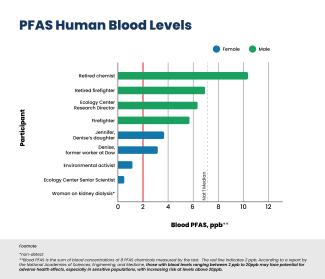
PFAS in blood levels

Denise & Jennifer's Story 

Denise's workplace in the late 1970s utilized PFAS, and she calculated her blood levels during that time using published half-lives for PFOA and PFOS. Even the most conservative estimates revealed that her combined levels would have been above 20 ppb, a level associated with a higher risk for adverse health effects*. Had she known them, her levels would've been especially alarming since she was pregnant with Jennifer then. 

“I was exposed in the workplace primarily to PFOA while pregnant and working in the Teflon area of the Toledo DuPont site. We wanted to know the PFAS levels in our blood these many years later. Thanks to the Ecology Center, we were able to test our blood. Both of my daughters and I have chronic health issues now that are known health risks associated with exposure to PFAS. My anger has led me to use my career-long knowledge of chemicals and health impacts to do what I can to tell my story, and to help workers and communities assess their exposures.”  - Denise Trabbic-Pointer 
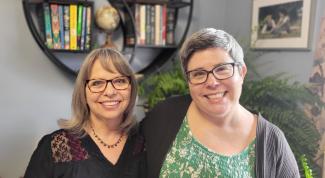
Mother and daughter who are concerned about PFAS in their bloodstream
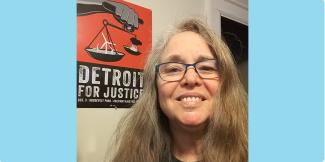
Denise Trabbic-Pointer and her daughter, Jennifer Synder

The Ecology Center collaborates with impacted communities, health professionals, scientists, legislators, and environmental advocates to protect individuals like Denise and Jennifer from further PFAS exposure. Through our leadership within the Great Lakes PFAS Action Network (GLPAN), we've successfully worked alongside impacted community members, like Denise, to implement stronger federal drinking water standards, push for sustainable government purchasing practices, and advocate for more robust regulations to keep PFAS out of everyday consumer goods. 

The Ecology Center supports enacting legislation to ensure that insurance covers PFAS testing costs, which cost anywhere from $400-$800, making it unaffordable for most Michiganders. Individuals like Denise and Jennifer deserve to know their PFAS levels. The National Academies of Science, Engineering, Medicine via the Committee on the Guidance on PFAS Testing and Health Outcomes has indicated a widespread desire for accessible testing, particularly in communities impacted by PFAS pollution. In addition to the need for accessible testing, the current PFAS testing kits need to test for more PFAS compounds. Current tests only measure 8 PFAS compounds out of thousands. Given these limitations, a blood test could provide false reassurance to individuals exposed to forms of PFAS that are not currently monitored in blood tests.  

Get Involved

Contact your state representatives and let them know that Michiganders need protective actions taken immediately to prevent further PFAS contamination. 

PFAS should be banned in everyday products whenever possible. Michigan legislators can take real action to protect communities from PFAS exposure by adopting the recently introduced Hazardous Products Act HB 5657. The Hazardous Products Act would ban PFAS in apparel, carpets, cleaning products, cookware, cosmetics, dental floss, fabric repellent, children's products, menstrual products, home textiles, ski wax, and upholstered furniture. Non-PFAS alternatives are available and worthwhile, given the enduring health and environmental costs of PFAS. Join us in calling on legislators to protect our communities from PFAS. 

Let your representatives know that Michiganders shouldn't bear the cost of PFAS exposure testing, especially those at greater risk. Consider testing yourself if the following applies to you:

  • You are an active or retired firefighter
  • You work or worked at a chemical manufacturing facility
  • You live or lived near a military installation
  • You  work or worked in the carpeting or cleaning industry
  • You eat carry-out or fast food often
  • You use or used nonstick cookware
  • You wear water or stain-resistant clothing, uniforms, or shoes
  • You work or worked in construction or food packaging
  • You live in a community at risk for PFAS contamination

Or

  • You wax or have waxed ski and sporting equipment

If you take a PFAS blood test, the PFAS Exchange  “What's My Exposure” can help you interpret your results and what you can do next. 

With community support and advocacy pushing for policy change, we can help end the problem of PFAS and protect Michigander's health for future generations. 
The Fight for Environmental Health and Justice Goes On

We will fight on, because we all know what’s coming next.  

We saw what the first Trump Administration meant for environmental health and justice.  It took hundreds of actions that threatened vulnerable communities, worsened the climate crisis, and, had they not been blocked, would have undone many of the country’s most important protections for clean air, safe water, and environmental justice.

But please remember the response to the challenge then, and please remember the role the Ecology Center played.

We joined with progressive advocates in Michigan and across the country, and our collective efforts helped blunt most of the rollbacks and attacks of the first Trump Presidency.  It’s widely believed that Trump 2.0 will be better organized than the last version, but so will we.

The next Administration will have fewer federal guardrails to constrain the MAGA anti-environment, anti-health, anti-justice agenda. Still, there are powerful countervailing forces that will rise again to challenge it. The Ecology Center plays a critical role – in Michigan and beyond – in several of them.

One countervailing force is the power of state and local governments, where much of the United States’ regulatory authority resides, and where the country’s most progressive laws were first adopted.  The Ecology Center is a leader in the work for strong environmental health and justice protections at the state and local level. In 2025, we’ll be working to see, among other priorities, that Michigan’s ambitious new climate and lead poisoning prevention laws get rolled out equitably, unimpeded by federal intervention.

Second is the power of consumers and market forces, which are moving the private sector toward sustainability, whether or not the federal government requires it.  The Ecology Center has been a long-time leader in campaigns to push companies and industries to make cleaner products in safer ways; in recent years, nowhere more notably than in the transportation sector, where the industry’s biggest players have invested heavily in moving away from fossil fuels.
 
Finally, we collaborate with dozens of nonprofit advocates, whistleblowers, and community activists, using science and people power to block threats to already overburdened communities – whether they’re dealing with air pollution, PFAS contamination, lead poisoning, or other issues. During the past four years, some meaningful steps have been taken at the federal level – like the Justice40 initiative – to address the disproportionate burdens on these communities.  The new Administration will likely move to walk back these steps, but we will fight with Michigan’s frontline communities to build power and work for lasting environmental justice.

Right now, many of us are reeling, angry, despondent, and disturbed about the election. Many of you are probably struggling just to make sense of it all.  We know that some of our colleagues and communities face much more risk and uncertainty in the coming months. It’s important to reach out in your community, to grieve and process it with others.  Please know that you’re not alone.  We need to come together, and when we do, we will rise together.  And that’s how we will eventually build a just and healthy world.

I do not underestimate the threats and challenges we’ll be facing over the next four years, but at this moment, I want to be clear with you about our commitment.  As we have for over 54 years, the Ecology Center will be there.  We will never stop fighting for healthy people, healthy communities, and a healthy planet, in Michigan and beyond.

A Community Shares Through Reuse Programs

Over 70,000 of our community members work or attend school at the University of Michigan. So, it is important to include them in conversations about reducing waste and focusing on connecting with each other rather than stuff, especially since the University of Michigan won first place in the zero waste category of the 2024 Campus Race to Zero Waste, a competition involving over 150 colleges and universities in the US and Canada. We sat down with Alison Richardson from the U-M Office of Campus Sustainability to learn more about the work they are doing to reduce waste and connect communities.

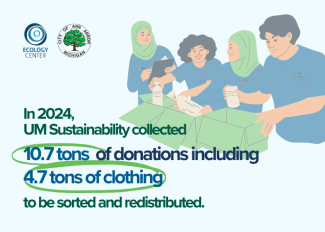
One of the first things that we discussed was the Move-In and Move-Out Donation Program that the University of Michigan has been running for 25 years. According to Alison Richardson, in 2024 U-M Sustainability collected 10.7 tons of donations including 4.7 tons of clothing to be sorted and redistributed.  

2024 U of M Sustainability collected 10.7 tons of donations including 4.7 tons of clothing

U-M Sustainability delivers these items to several organizations. House N2 Home, an organization that collects furniture and household goods that they use to furnish houses and apartments for our neighbors who are transitioning from homelessness. The Ann Arbor PTO Thrift Shop resells donated items to support Ann Arbor Public Schools. The proceeds also go to grants for community organizations that provide emergency assistance to our neighbors. Food donations go to the Maize and Blue Food Pantry, the food pantry that serves the campus community.

When asked what students can do to reduce their environmental and social footprint, Alison  Richardson advised, “Be mindful of your purchasing, before you even come to campus. Coordinate with your roommate to see if some items can be shared. Think about what you would actually need throughout the year – it's not as much as maybe students think that they need.” She also encourages students to look into renting mini-fridges and microwaves as well as other reuse options like the thrift stores listed above. Interested students can also take the Planet Blue Ambassador training which gives student information on the sustainability efforts on campus and some resources to become more involved.

Community Swap Days

The City of Ann Arbor Office of Sustainability and Innovation also hosts Community Swap Days.  A community swap day is like a garage sale, but everything is free. You can bring the items that you no longer want or need and give them to your neighbors who can still use them. You can also “shop” for new-to-you items.

We attended a recent community swap day. Check it out here:

When asked “what does more life, less stuff mean to you?” Alison explained, “I think that you can have lots of experiences and fun things in your life without the stuff that doesn't necessarily add to that. You don't need to accumulate items to have enriching and fulfilling experiences … and a lot of fun.” I think we could also use enriching and fulfilling experiences, and a bit more fun. 

* We interviewed them in part 1 of this story. Check it out here: https://www.ecocenter.org/sharing-stuff-creates-community 

* Learn more about the U-M Move out here: https://ocs.umich.edu/programs/waste-reduction/student-move-in-move-out

Sharing Stuff Creates Community

By Crystal Zanders, More Life, Less Stuff Freelance Writer

Over the summer, I moved into a smaller apartment. My senior pug had been having difficulty with the stairs in my townhouse. So, I downsized. My new apartment is half the size of the old one, so decluttering was a priority.

Crystal Zanders' Dogs

You don’t realize how much stuff you have until it is time to pack it all up and move it. Some items were obviously not going to make the move. I loved my 11 ft blue sofa, but it was too big for my new place. Other things weren’t as simple. I don’t grate cheese. But some part of me knows that the minute I get rid of this cheese grater, some cheese will need grating. Guaranteed.

And there are some things that I held an emotional attachment to. I love my plants. They are part of my household, creating oxygen and promoting peace in my home. I didn’t have space for one of my bigger plants. How could I abandon a member of my plant family?

Share Economy

Crystal Zander More Life Less Stuff
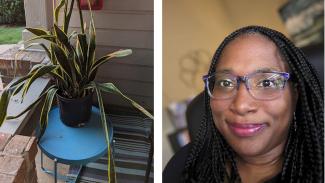
Crystal Zander, More Life, Less Stuff Freelance Writer. And, the plant that went to a new home to continue to grow and bring joy.

Around this time, I began doing research on the share economy and the Buy Nothing Project. The idea is that instead of putting items in a landfill, you offer those items to your neighbors who may need them. When they need something, they don’t have to shop for new stuff—stuff that carries an environmental cost to produce, distribute and sell. In the share economy, items move from home to home when needed, saving money, reducing waste, and connecting neighborhoods with each other. These communities tend to be hyper-local, encouraging connection and minimizing transportation costs.

So, I decided to try it out. I joined my local Buy Nothing group and began posting photos and descriptions of items I no longer needed. Remember my big blue sofa?  I gave it to a college student who was moving into an apartment with several roommates, the perfect place for a big couch. Her family came and picked it up. They were super nice.

I kept the cheese grater, but the plant went to a new home where it joined a new family. I imagine it is happier with more sunshine and space to grow.

Buy No Things Ann Arbor

Daniel Buy No Things Ann Arbor
Daniel Grenzicki, moderator of the Ann Arbor Buy No Things facebook group

To learn more about Buy Nothing groups, I interviewed Daniel Grenzicki, moderator of the Ann Arbor Buy No Things group. He explained the basic concept behind Buy Nothing, “Essentially, it's just a community of people, that, share items. It is a way to kind of connect people with each other through stuff.” He told me that one of the biggest benefits of Buy No Things is the sense of community it provides, “It's really easy to just not know your neighbors at all and live here forever. This group gives you another to way get out in your community and connect with people who live near you.”

Daniel Grenzicki explained that the Buy No Things group is not limited to items. “There are all kinds of little things that people want to donate their time and efforts to. They've had clothing swaps. There's somebody doing a sourdough class; people offer free photography stuff. There's a Pullover Prevention group in Ypsi. They do events in the community where they'll help fix your car up, so you don't get pulled over.”

To join a Buy Nothing group or the Ann Arbor Buy No Things Group, Daniel recommends searching for your local group through Facebook, although they can also be found on some other social media platforms. He also encourages people who are interested in participating in a group but don’t have a local group to start their own. He explained, “It’s low effort, high impact. You can connect somebody with something that's just perfect. It's like lock and key sometimes. It's cool the way it works.”

Ultimately, participating in Buy Nothing groups empowers folks to focus less on stuff and more on community, while minimizing their environmental impact. When asked what more life less, stuff means to him, Daniel replied, “ I'm always trying to declutter and minimize the amount of things I have, because you either own your stuff, or it starts owning you. It's very easy to get over encumbered and forget the things that actually bring you joy-- you don't need anything for them.”

Buy Nothing Year

Kathryn Savoie
Kathryn Savoie, Ecology Center Director of Equity and Environmental Justice

After my move, I committed that I would spend the next year making a conscious effort not to accumulate as much stuff. I don’t want to purchase things that I don’t need or hold on to things I don’t use. For inspiration, I spoke with Dr. Kathryn Savoie, Director of Equity and Environmental Justice at The Ecology Center, to learn about her journey undertaking a 'Buy Nothing' year.

Although I had seen folks talk about taking a 'Buy Nothing' year on social media, it means different things to different people. Dr. Savoie explained how she tailored the idea to her life, “I'm not an absolutist about it. To me, it's a way of being more intentional.  It makes me stop and really think 'do I need this?' So, there are exceptions. I bought socks and underwear. I buy food, toilet paper, and things for the household. But do I need a new set of sheets right now? No, I probably don't.” She told me that the biggest challenge was mental, “Most of the adjustment has been a change in my attitude towards things. I'm not spending money on things that I don't need. I'm not cluttering up my house with things. And I have more time to do the things I enjoy.”

One of the things that I was most curious about was gifts. I love to buy Christmas presents for my niece and nephew who are young enough to see Christmas as magical, to listen for reindeer on the rooftop. Would doing a 'Buy Nothing' year mean that I couldn’t buy them gifts? According to Dr. Savoie, canceling Christmas, as far as gifts are concerned, is not necessary. For her the goal of a 'Buy Nothing' year is to slow down and think before making purchases. She explained, “I do gifts. I am just more thoughtful about what kind of gifts I give people so that I'm not adding to their clutter. I've been much more intentional about buying gifts that are experiences: a gift card for a massage or tickets to a movie, show, play or concert. Sometimes I make canned fruit from my garden and give people homemade jam.”

When asked about what more life, less stuff means to her, Dr. Savoie gave this sincere response, “I think it just means that we try to focus on what's important in life and enjoy this beautiful planet, the people that we love, and the things we love and without getting caught up in all the stuff.” Ultimately,  Dr. Savoie explained, “We can live with so much less and be so much better off.”

I felt inspired by the words of Daniel and Dr. Savoie. It is important to prioritize each other and our experiences and be mindful of the constant pressure to consume. At the end of the day, more life is about connection. Limiting the things that we buy allows us the space to connect to ourselves. Participating in the share economy encourages us to connect with our neighbors.

So, I am encouraging members of this community to join me in participating in the 90 Day No New Clothes Challenge. To do that, I will agree not to purchase any new clothing items for three months. Because I can’t shop at thrift stores, that means I will be committing to wearing past year’s winter clothes. I looked pretty fabulous the last few winters; that shouldn’t be much of a sacrifice.

Despite All the Misinformation, EVs Are Good for Michigan's Economy, Health, and Environment.

You've probably heard one or two myths about EVs. Here are some facts about EVs:

Investing in electric vehicle manufacturing will energize Michigan's economy.

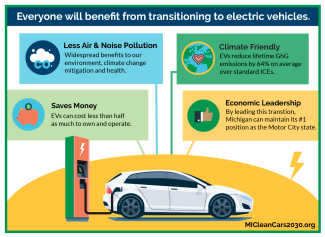
Michigan’s growing EV manufacturing industry is boosting economic growth in communities and local economies throughout the state, while strengthening the state’s automotive workforce. Michigan was named the national leader in the EV battery and clean energy race, fostering $21.3 billion in new projects with 16,600+ jobs created, and 167,000 jobs projected.

With federal tax rebates, EVs are becoming more affordable.

The expanded EV tax credit in the IRA allows car buyers at all income levels to claim up to $7,500 in tax credits for purchasing a new electric vehicle. There are new EVs on the market starting at $28,000, and as EV manufacturing and battery production increases in the United States, EVs will become even more affordable. 

EVs put Michigan in a prime position to continue to lead in global automotive manufacturing.

Michigan workers make great cars, electric and otherwise, and they know Michigan needs to stay competitive in the global race for quality electric vehicles. While we already produce several industry-leading EVs in the auto state, much more is coming, thanks to recent announcements making Michigan the leading state for bringing home federal IRA investments for EV and battery manufacturing.

EVs are NOT mandated.

While there have been some misleading claims in the popular media on this point, the federal government does not mandate the use of EVs. EVs are one of the options that automakers have to help them meet vehicle fuel economy standards, and there are several incentives and other programs available that help make the technology more accessible to American drivers. Federal tax incentives also encourage the purchase of electric vehicles and batteries that are made in the United States. 

EVs are GOOD for the environment. 

EVs are a lower-emissions option than cars with internal combustion engines. A recent Bloomberg report confirms that EV lifecycle emissions can be over 70% lower than gasoline and diesel vehicles. EVs create 3,932 lbs. of CO2 equivalent per year, compared to 11,435 lbs. for gasoline vehicles. Said simply, EVs produce way less pollution. A safer, smoother ride with less maintenance and cleaner air!

EVs are GOOD for consumers, too. 

EVs are significantly cheaper to fuel and maintain than their gasoline counterparts.  The cost of electricity, for example, is much less volatile and at least half the price of gas. With fewer moving parts, they are also cheaper to maintain.  With federal incentives and rebates backed by the Biden-Harris administration, EVs are becoming increasingly more affordable. 

The bottom line: 

There's a lot of damaging misinformation about EVs being spread by the naysayers right now. We hope you consider the source of that information and know that EVs are critical to ending our dependence on fossil fuels, reducing pollution, and improving our health. Investing in a cleaner, more sustainable auto industry now ensures that Michigan is prepared to lead the auto industry in the future. 

EV Benefits

In Vitro Endocrine and Cardiometabolic Toxicity Associated with Artificial Turf Materials

For multiple years, Ecology Center has been testing the impact of artificial turf plastics, revealing some significant findings. Collaborating with national artificial turf campaigners, Chris Kassotis at Wayne State University, and his students (notably Kyle Siegel and Brooklynn Murray), a new study was published providing initial evidence of endocrine disruption and cardiometabolic health impacts from artificial turf plastics. Cardiometabolic diseases include heart attacks, strokes, diabetes, insulin resistance, and non-alcoholic fatty liver disease.

Published in the journal "Science of the Total Environment," the study has broader implications for understanding how plastics behave when exposed to environmental conditions. This extensive research, which spanned several years, underscores the need for further investigation into turf-associated chemical exposures and their potential impacts on human health. Meanwhile, Chris Kassotis's team and other researchers are actively engaged in two additional artificial turf studies, striving to deepen our understanding of these critical issues.

Link to the Artificial Turf Paper

Citation: Kyle R. Siegel, Brooklynn R. Murray, Jeff Gearhart, Christopher D. Kassotis. (2024). "In vitro endocrine and cardiometabolic toxicity associated with artificial turf materials." Environmental Toxicology and Pharmacology, 111https://doi.org/10.1016/j.etap.2024.104562 

How Our Stuff Can Be Reused to Welcome & Build Community

By Crystal Zanders

Our More Life, Less Stuff campaign, a partnership of the City of Ann Arbor and the Ecology Center, is sharing stories about building community, strengthening our connections, and celebrating life, all while using less stuff.   

The More Life, Less Stuff campaign is about rethinking our relationship with stuff and reimagining ways that our stuff, once no longer needed, can serve our community. As our lives and needs change, we don't have to add items in good condition to landfills. We can share those items with our neighbors and use them to serve and support our community members, especially our newest members. We spoke with volunteers from two community organizations, the Washtenaw Refugee Welcome (WRW) and the House By the Side of the Road, to learn about the folks who need help, how to access help, and what we can do to support these organizations that perform the vital services of welcoming our neighbors and ensuring folks have what they need. 

The Washtenaw Refugee Welcome is Empowering Neighbors to Help Neighbors.

Emmeline Weinert
We talked to WRW founding board member Emmeline Weinert to learn more about their program. 

Washtenaw Refugee Welcome works exclusively with refugees and their families.  In Washtenaw County, refugees work with Jewish Family Services, a resettlement agency licensed by the government to help refugees find a place to live and get established.  After three months, much of that government financial support goes away, but refugees often still need help. That is where Washtenaw Refugee Welcome (WRW) comes in.  

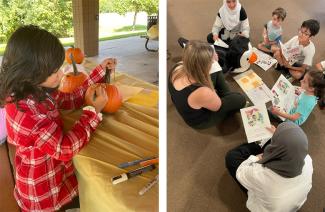
Since 2016, WRW, an all-volunteer non-profit, has supported refugees in our community. According to Emmeline, WRW volunteers "create social opportunities, facilitate getting household items and donations to refugees, act as a familiar face and a helping hand in the community." They do everything from hosting events for pumpkin painting and a Thanksgiving potluck to answering questions about mysterious mail and parental concerns about a child's school.  

Pumpkin Painting Washtenaw Refugee Welcome Event

One of the main things they do is connect refugees with other community organizations that provide support, like Food Gatherers, House By the Side of the Road, and the Hope Clinic food pantry.  

When asked what she is most proud of, Emmeline Weinert responded, "I'm proud of the families who continue to come to our events. Some families resettled years ago and are still at our Thanksgiving Potluck because we were their initial family and support system when they came to the area. And so often, those are our best advocates out in the community. They meet a neighbor who's a refugee or something like that, and then they bring them in." Washtenaw Refugee Welcome makes a difference in the lives of neighbors who, as refugees, by definition, have struggled to get to a place where they and their families can be safe. 

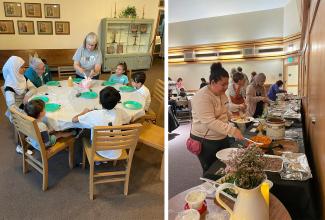
Thanksgiving Event for Washtenaw Refugee Welcome

What can I do to help?

There are many ways that we, as a community, can support the Washtenaw Refugee Welcome. The first is to donate money. Over 60 % of their budget last year came from individual donations. 86% of that budget went directly to supporting refugee families through programming, financial, and other support. 

We can also volunteer. Washtenaw Refugee Welcome is always looking for folks to help. When asked about volunteers, Emmeline encouraged folks to "Sign up to do the craft. Sign up to do the snack at a monthly meetup. Sign up to come to one of our picnics and maybe offer to drive a refugee family." If you are interested in volunteer opportunities, you can find more information here: https://www.washtenawrefugeewelcome.org/volunteer 

In the spirit of More Life, Less Stuff, we can donate goods in good condition. 

I think that's the beauty of when something isn't serving you, we don't hold onto it… we can give it to someone who can use it. Let's let our stuff serve the people we care about and want to care for. – Emmeline Weinert

Washtenaw Refugee Welcome always looks for small appliances such as countertop microwaves, kettles, pressure cookers, and vacuum cleaners. They also frequently need good-quality dishes, pots, pans, and household items. However, some items, such as diapers, soap, feminine pads, and laundry detergent, are not appropriate to reuse. For more information on those items, check out their Amazon wishlist

Emmeline also explained that they are looking for old-fashioned, reel-to-reel push lawnmowers (not electric, not gas) for larger families renting houses requiring lawn care. When they receive these donations, they immediately take them to the families that need them. 

Washtenaw Refugee Welcome Kids Story time and pumpkin painting

As previously stated, one of the main goals of Washtenaw Refugee Welcome is to connect refugees with trusted community organizations and services where they can get help. One such organization is House by the Side of the Road. 

The House By the Side of the Road Has Been Giving Back to the Community Since 1970. 

House By the Side of the Road is another all-volunteer organization that takes gently used goods and distributes them to the community free of charge. Essentially, they operate a thrift shop where folks in the community who need help can "shop" for free. They have a variety of goods, including bedding, clothing (especially winter gear), and shoes for kids and adults. If you need help and live in Washtenaw County, House By the Side of the Road only requires that you bring an ID or other proof or Washtenaw County residency.  Clients do not need to make an appointment or have a referral to stop by and get needed items. They are open for clients Monday through Friday from 10 am to 2 pm. Come by and get stuff. 

They also accept donations of goods they stock for folks who come in and cash, which is used to support the organization's operations. 

We visited House By the Side of the Road to learn more about their program and talk with their volunteers and manager – watch their story here: 


Washtenaw Refugee Welcome and House By the Side of the Road help us show that we care by sharing resources like household goods and clothing and giving money and time when we can. Amazing people throughout our community are working together to ensure our neighbors know they are valued and important and that we, as a community, care about each other. We can come together as a community to welcome our newest members and help provide access to the resources they need to build a life here and thrive.  


How do refugees get from their home countries to Washtenaw County?
Refugees are folks who have been displaced from their homes and cannot return because it is not safe, often due to violence, persecution, or human rights concerns. This applies to millions of people across the globe. Currently, 117.3 million people throughout the world are forcibly displaced.

To become refugees, they must first flee their homes and cross an international border. Then, they apply to the United Nations High Commissioner for Refugees (UNHCR) for refugee status. UNHCR evaluates whether each person qualifies as a refugee. However, qualifying for refugee status doesn't automatically mean they get to move to another country. Each country only allows so many refugees to resettle. The UNHCR prioritizes the folks who are most at risk in their home country and the country they fled to. When selected, the UN refers people to a host country that does its own, often intensive, screening to decide whether or not to accept them. It is a long and arduous process that can take years.

If accepted in the US, they get three months of support through a resettlement agency that works with the State Department. The resettlement agency in Washtenaw County is the Jewish Family Services. This agency is licensed and partially funded by the government to help refugees find a place to live and get established. After three months, much of the government's financial support for refugees has disappeared, but refugees often still need help. That is where Washtenaw Refugee Welcome (WRW) comes in.

“I know that I’m doing my part to bring about change and justice”: An Interview with Salam Beydoun, Environmental Justice Organizer

Salam Beydoun, Environmental Justice Organizer at the Ecology Center, brings a unique perspective to environmental justice and equity, shaped by her heritage and experiences growing up in Dearborn, MI. With roots in Southern Lebanon, Salam’s journey portrays an unwavering commitment to justice, community, and environmental advocacy. Her path, which includes an educational background in Philosophy, Sociology, and Social Work from Wayne State University, led her to focus on environmental justice, particularly in the Detroit and Dearborn areas.

Drawing from personal experiences and daily challenges faced by her community, Salam is passionate about addressing the intersections of injustice. Her work emphasizes air quality advocacy within Southeast Michigan, aiming to connect the dots between air pollution and other critical issues affecting our cities, like affordable housing, food insecurity, and poverty. In her role at Ecology Center, Salam is dedicated to empowering residents and community members to speak out about injustice, ensuring their voices are heard and their needs addressed.

Since joining the Ecology Center in 2023, Salam has been instrumental in coordinating community education initiatives, such as DIY Box Fan Air Filter workshops, to combat poor air quality exacerbated by factors such as industrial pollution and wildfire smoke. She also played a key role in the newly launched Clear the Air coalition, organizing events for Air Quality Awareness Week 2024 and pushing for legislative policies to protect vulnerable and unproportionally-impacted communities.

We had the opportunity to speak with Salam about her journey, her work at the Ecology Center, and her vision for a just and equitable future for all communities.

(This interview has been edited for clarity and length.)


Tell us a little bit about yourself – where are you from? What did you do for fun as a kid? What did you study in school? What specific life experiences, interests, or ambitions led you on that path?

I grew up in Dearborn, MI, both of my grandfathers were immigrants from Southern Lebanon who came in the late 60s/early 70s and worked for Ford. As a kid I loved playing outside, doing somersaults in the front yard of my parents’ home. I grew up playing football with my dad and brother, joined a basketball league when I was eight and a volleyball team when I was ten and continued playing those sports up until high school. Moving my body has always been an essential part of my life and continues even now as I practice and teach yoga.

I went to Wayne State for both my undergraduate and graduate degrees. I studied Philosophy and Sociology in undergrad, with the initial goal of becoming a lawyer. I have always been drawn to helping people, and the profession fits my parents’ approval of acceptable careers. After graduating with my Bachelor of Arts in 2019, I realized that it wasn’t the right avenue for me. This led me down a path of trying to decide what to do with a degree that didn’t mean much to most employers, while still trying to feel that I was doing my part in advocating for justice and vulnerable people. During the George Floyd and BLM protests in combination with the #SaveSheikhJarrah in Palestine campaign during the summer of 2020, I felt drawn to the organizing that went behind these powerful movements. I eventually found myself applying to Wayne State’s School of Social Work after learning that there was a tract designed to train social workers, like myself, to become community leaders and organizers. During the program, my personal focus became environmental justice, especially in Detroit and Dearborn, knowing that it’s a crucial point where almost all injustices meet.

I don’t think any one specific instance led me to this point – rather, a conglomeration of all my experiences and the identities I hold. Being a second-generation Lebanese Muslim woman growing up in Dearborn, I was surrounded by others with a similar background as myself. The majority of my friends and I are from families displaced by war and occupational forces causing instability in our Southern villages, so I grew up hearing stories about discrimination for our religious background and race from those around me. This strengthened my internal pull towards wanting to know more about the systems that perpetuate it. Even in religion, our duties as Muslims are to be advocates for justice when we witness oppression or injustice, as we are meant to be protectors of the environment and one another. “In Islam, love is not just a feeling, but a responsibility; to care for, support, and uplift one another in goodness and righteousness,” @Soul.Guider on Instagram. All of this and more brought me to this point, and while I can’t do it all, I know that I’m doing my part to bring about change and justice, acting in alignment with my value system.

You joined the Ecology Center in 2023 as an ​​Environmental Justice Organizer, a new position at our organization. Can you tell us your hopes for this position and the work you’ll do in this position?

I’m excited to be doing work with the Ecology Center! I feel fortunate to be part of this organization and to do Air Quality advocacy and organizing within Dearborn and Detroit. Through my position, I hope to be able to draw connections to the intersections of injustice many people within Southeast Michigan face. Through air quality, we can see the negative effects on communities also facing a lack of affordable housing, food insecurity, poverty, unreliable public transportation, and so much more. Ultimately, I’d like to have a network of organizers and organizations who are willing to connect our issues and empower residents and community members to be advocates for their own change. Using my social work background, it’s necessary to emphasize the needs of the community first, and I hope we can work together to identify those issues and work towards a more just and equitable future.

In the meantime, much of my work involves community education around air quality issues, especially with regard to the wildfire smoke that impacted us last summer. We only anticipate this to continue and find it necessary to provide affordable and accessible ways to mitigate it. There are plans to host DIY Box Fan Filter workshops throughout the summer to supplement the education and resources. These workshops will be co-hosted with partner organizations throughout Detroit with the intent of showing residents and community members how simple it is to assemble their own indoor air purifier with materials found at any supply store. It’s important and necessary to make this type of health impact easily accessible.

As a native of Dearborn, which has historically experienced poor air quality due to the extensive industrial properties in Dearborn, Melvindale, and Detroit, what does EJ advocacy work mean to you?

Admittedly, I grew up in the better part of Dearborn, not so close to industry (like the Ford Rouge Plant or Cleveland Cliffs Steel Plant) affecting the air quality around me. I did have several family members work for these industries, however, and saw the negative health impact  for those who were exposed to it daily, causing cancers and respiratory issues. Environmental Justice advocacy means understanding my privilege of not having lived in areas that would have negatively impacted my own health AND knowing my responsibility to be an advocate for those who are impacted. The communities living in the shadow of these polluting industries are majority Black, Latinx, and Arab, and so many within these communities are immigrants who may not have access to the language or resources to advocate on behalf of themselves. It’s our duty to tap into these communities and really understand the harms that are being done and ask them what they need in order to live with the right to breathe clean air.

The Clear the Air coalition launched in May during AQ awareness week. What did the week look like? 

Through the new Clear the Air coalition, I coordinated a week of events for Air Quality Awareness Week, which was May 6 –10 this year. The week was in coordination with other members of the coalition and partner organizations. We had film showings about air quality and pollution in Detroit and Dearborn, showing the industries contributing to the harm of residents who live around them. There was also a panel discussion on Tuesday, May 7th hosting coalition members, community leaders, and health researchers talking about the need for cumulative impact policy on a local and state level – the purpose of the coalition is to educate communities about it and push these policies forward. We had a DIY Box Fan Filter workshop with parents in Southwest Detroit, educating them on how to use these in their homes to mitigate poor indoor air quality, especially as the summer and wildfire smoke season approached us. A press conference in Dearborn’s Southend was also held to emphasize the close proximity of the steel plant to the elementary and middle school, impacting the health of everyone who lives and goes to school nearby. The DIY Box Fan Filter workshop and press conference were among a full week of events through SE Michigan. 

Air Quality Awareness Week was educational, allowing residents and community members to learn more about what cumulative impact policies are and what it means for their health. We provided resources for folks to learn about how to mitigate poor air quality days and how poor air impacts our lungs, and who is most susceptible to its impacts. Air Quality Awareness week provided folks with an opportunity to learn about who is in their community and to build relationships in the fight for our right to clean air.

You also teach yoga. How does that teaching inform your work at the Ecology Center?

I have been practicing yoga sporadically over the last 10 years, and more seriously through the last 4 years. Yoga has been a grounding force as I pushed through grad school, helping me maintain a healthy balance between self care and community care. Feeling so grateful to have learned a way to recenter and ground myself, it was only natural that I pursued my yoga teaching certification so that I could share this knowledge with others who might also benefit from the healing nature of the practice. Teaching yoga is a selfless service, the focus always on the student and showing up for themselves. I’m a mere guide on their journey to self-discovery and self-determination.

So many of the tools I have learned through teaching transfers over into my work with the community, with an emphasis on meeting people where they are. Yoga is a practice meant to honor our bodies and to be patient as we learn to tap into the mind-body connection. When working with others and organizing, I have learned to reflect on this principle when considering the life experiences of those I have the privilege of working with by leading my work with openness and curiosity, while leaving assumptions at the door. I’ve learned to apply it to myself as I started this position a year ago. I have had to learn to be patient with myself, giving myself grace to take time to learn the skill sets I need and make the connections necessary to do the work. Above all, yoga encourages me to be intentional and present, encouraging balance on and off the mat. This work can require a lot out of us because there’s always something to do, it’s nice to have that gentle reminder to come back to myself and recenter. As Audre Lorde has said, “Caring for myself is not self-indulgence, it is self-preservation, and that is an act of political warfare.” We must fill our own cups before pouring into others to sustain ourselves in this very demanding work.

Diverse coalition says clean energy laws will help U.P. lower costs, reduce pollution

During MPSC hearing, groups renewed support for state’s clean energy standards

Marquette, Mich. — A diverse coalition of organizations is repeating its support for Michigan’s clean energy laws following a Michigan Public Service Commission (MPSC) hearing on the Upper Peninsula’s (U.P.) implementation of the clean energy standards on Tuesday, July 30.

Last year, Michigan lawmakers passed legislation to transition to 100% clean energy by 2040 from sources such as wind and solar power — giving Michigan the most robust energy efficiency standards in the country, while helping to address energy affordability, health and safety for many low-income households.     

“Michiganders pay the highest rates for electricity for the worst electric utility services in the Midwest,” said Ashley Rudzinski, climate and environment program director for Groundwork Center. “On top of that, many Yoopers pay the highest electric rates in Michigan. It’s time to hold utility companies accountable for rising costs, bad service and pollution in our air and water. The Upper Peninsula can transition to 100% renewable, clean energy by 2040 and help reduce carbon pollution that is disrupting our climate.”

The coalition has pledged to beat back any efforts to undermine the law while asking the MPSC to help move Michigan to cleaner, renewable energy.

“We must protect the Great Lakes we rely on for our economy, drinking water and way of life by implementing the 100% clean energy standard,” said Charles Griffith, Ecology Center climate & energy program director. “New technologies and renewable energy innovations are being developed every day and costs continue to come down, and it would be premature to say the U.P. will not be able to implement the clean energy standard by goals more than a decade away.”

Measuring the cost of different forms of energy, an analysis found that clean, renewable energy sources, like wind and solar, are cheaper than coal and natural gas, even without subsidies.

“Michigan lawmakers passed groundbreaking legislation that will help lower the cost of our utility bills and ensure we have cleaner air to breathe and water to drink by transitioning to clean, renewable energy,” said Carlee Knott, energy and climate policy coordinator for the Michigan Environmental Council. “Our fellow Michiganders in the Upper Peninsula deserve the same opportunities to create new good-paying jobs and reduce pollution by generating clean energy.”

“It’s time for the big utilities — everywhere in our great state — to move toward 100% clean energy by 2040,” said Derrell Slaughter, Michigan policy director, climate and energy, at NRDC. “We owe it to our kids and grandkids in the U.P. to protect them and their futures. Renewable energy will provide cleaner air to breathe and water to drink, improve public health, and save lives.”

“Reliable clean energy is essential to protecting human health”, said Elizabeth Del Buono, MD, president of Michigan Clinicians for Climate Action. “Michigan residents are experiencing the health impacts of fossil fuel pollution today, and it will only worsen as our climate changes. The good news is that transitioning to clean energy saves lives and health care dollars. People living in the Upper Peninsula deserve the opportunity to benefit from Michigan's 100% clean energy standard by 2040 without compromises.”

“U.P. residents have much to gain from the lower electric bills and enhanced reliability that more clean energy and energy efficiency can bring,” said Amy Bandyk, executive director of the Citizens Utility Board of Michigan. “We shouldn’t delay on rate relief for the U.P.”

“The Clean Energy Standard presents a transformative opportunity to secure a future where clean, reliable, and affordable energy is a reality for all U.P. residents,” said Tim Minotas, deputy legislative and political director at the Michigan Sierra Club. “Transitioning to a future powered by clean energy will enable the U.P. to capitalize on the financial support available through the Inflation Reduction Act, ultimately delivering the air and water and cost-saving benefits that clean energy provides.”

The following groups also expressed support for clean energy implementation in the U.P.:

  • Great Lakes Renewable Energy Association (GLREA)
  • Union of Concerned Scientists (UCS)


###

Sustainable Purchasing Guide for Candidates

Sustainable purchasing is fundamental to a healthy, prosperous, and resilient future. Sustainable purchasing can strengthen Michigan communities, support businesses, save money, and protect health and the environment.

The world is experiencing an unprecedented set of environmental and social challenges including a climate crisis, a pollution crisis, and a biodiversity crisis. Plastic pollution is now threatening ecosystems and human health. Residents of the State of Michigan confront these multiple environmental crises that threaten social stability, human and environmental health, and the economic fortunes of the State. All of these crises have roots in the materials we purchase and the energy we use.

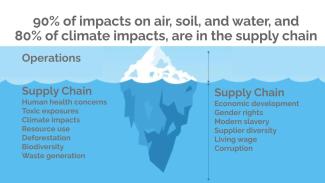
procurement graphic -- 90% of impacts on air, soil, and water, and 80% of climate impacts are in the supply chain

Michigan’s climate plan lays out a pathway for Michigan to reach 100% carbon neutrality by 2050 to avert the worst impacts of the climate crisis, create good-paying jobs, and build a healthier and more prosperous, equitable, and sustainable Michigan for all Michiganders.

Michigan will not reach that climate goal without a focus on sustainable purchasing. On average, 70% of climate emissions are in the products governments purchase every day including making products and transporting, using, and disposing of them. Michigan also can’t reach climate goals without focusing on plastics reduction. Plastics are a large and growing use of fossil fuels, so the State can’t just focus on reducing fossil fuels used to make energy. The State also needs to focus on reducing fossil fuel use to make new plastics. Sustainable purchasing also offers one of the most powerful ways to address the plastics crisis.

By adopting policies to prioritize the purchase of products that protect health and the environment, we can help address some of the most difficult and intractable environmental and social problems. Buying products that reduce energy use, do not contain toxic chemicals, are made under safe, sustainable, and fair conditions, can be reused, and don’t deplete resources and ecosystems helps build a more resilient future for all. Buying local, sustainable, fairly produced goods and services also supports Michigan’s economy and prosperity.

The State has already recognized that the products and services it buys have inherent environmental and economic impacts and that it should make procurement decisions that embody, promote, and encourage the state’s commitment to being environmentally, socially, and fiscally responsible. For example, Michigan was one of the first states in the country to adopt a strong purchasing policy to eliminate PFAS, “Reducing State Purchases of Products Containing Intentionally Added PFAS.” For information on state PFAS policy, please see the SAFER PFAS Guide. The State should extend that commitment and adopt a strong policy to reduce other pollutants and greenhouse gas emissions through sustainable purchasing.

Voters want legislators to take action!

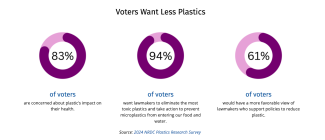
In a national poll taken by NRDC, voters clearly signaled their interest in action on plastics, one of the big product categories purchased by states. In order to address this concern, a strong statewide sustainable purchasing policy is necessary.

voters want less plastic

Cities, institutions, and states are taking action

Cities and states across the country and the world are implementing successful sustainable purchasing policies and commitments that accelerate the purchase of products that are less toxic and less fossil fuel intensive, while still performing equally well and often saving money, particularly when energy and waste disposal requirements are considered. Michigan should join them.

  • Cities like Lansing and Ann Arbor and institutions like the University of Michigan have passed comprehensive sustainable purchasing policies and applied them to major contracts that offer a good roadmap for the state. They demonstrate that sustainable purchasing is not only possible, but necessary to address critical environmental and social issues and save taxpayer dollars.
  • States like New York, Minnesota, Maryland, California, and many others have strong sustainable purchasing policies that have been demonstrated to save money, protect health, and preserve the environment.

Benefits of taking action

In addition to saving money, sustainable purchasing is a powerful tool for all kinds of benefits including:

  • Supporting healthy communities and workforces
  • Ensuring the safety of Michigan's land, air, and water
  • Spurring economic development and creating good-paying jobs
  • Protecting and improving the health of Michiganders
  • Positioning Michigan as a leader in climate action and sustainability
  • Protecting our natural resources and wildlife
  • Addressing environmental injustices
  • Reducing liability and risk
  • Supporting the mission and values of the state
  • Modeling best practices
  • Supporting local businesses
  • Demanding safer products to help drive the market toward more innovation and safer materials for the future

Solutions

Michigan should adopt proposed legislation to use the purchasing power of the State of Michigan to promote health, protect communities, advance equity, localize supply chains, support economic development, save money, address the climate, plastics, chemicals, and biodiversity crises, provide a model for local units of government, and preserve Michigan’s natural resources.

What should the legislation do?

The legislation should put existing Michigan executive actions related to sustainable procurement in statute, and strengthen others to mirror best practice. The legislation should support the State of Michigan’s goal to minimize negative impacts on human health and the environment while supporting a vibrant community and economy. In addition, it should set preferences for desirable sustainability attributes when procuring goods and services. It also should establish policies and procedures for acquiring, developing, maintaining, and using specifications for goods and services that align with the State’s goals. The legislation should provide incentives to communities with sustainable purchasing policies when competing for state grant funds.

The legislation should also:

  • Empower State staff to be innovative and demonstrate leadership by incorporating progressive and best-practice environmental specifications, strategies, and practices in procurement decisions;
  • Encourage vendors and contractors to promote products and services that are most suited to the State’s environmental, social, and fiscally responsible principles and encourage the development of environmentally preferable products and services;
  • Complement existing State ordinances and policies; and
  • Communicate the State’s commitment to sustainable procurement by modeling the best product and service choices to other local units of government, other states, and the private sector.

Anticipated outcomes of sustainable procurement legislation:

  • Reduced occupational health hazards for State staff
  • Reduced exposure of State residents and visitors to toxic chemicals
  • Protected and improved air and water quality for Michigan residents and visitors
  • Reduced greenhouse gas emissions, energy use, and resource consumption, and associated cost savings
  • Reduced landfill waste and associated costs and liabilities
  • Reduced use of toxic chemicals and associated costs and liabilities
  • Alignment of State purchasing and use of materials, products, and services with the State’s fiscal, equity, environmental, climate change, toxics reduction, community, and performance goals

The following directives would be codified:

The policy would also:

  • Create an Office of Sustainable Procurement jointly funded by EGLE, MEDC, and MDHSS; use third party certifications where applicable; and favor products manufactured by companies that take financial and/or physical responsibility for collecting, recycling, reusing, or otherwise safely disposing of their products and packaging at the end of their useful life.
  • Offer potential opportunities for sustainable municipal procurement contracts to be bundled with state contracts.

Environmental factors to be considered in product and service acquisitions include:

  • Pollutant releases and toxicants, especially Persistent Bioaccumulative Toxics (PBTs), other chemicals of concern, air emissions, and water pollution; Transparency and full disclosure of ingredients and product details; Waste generation and minimization; Greenhouse gas emissions; Recyclability and recycled content; Energy consumption, energy and fuel efficiency, and use of renewable energy; Depletion of natural resources; Potential impact on human health and the environment; Impacts on biodiversity; Manufactured locally and/or locally sourced; Life cycle impacts and costs considered, including impacts on worker health and and safety and community impacts; Total cost of ownership or ‘value for money procurement’ instituted; Product durability, reusability and long-term performance considered; environmental performance of vendors.