

Environmental Justice Leaders Build Community, Install Air Monitors on the Fort Berthold Indian Reservation

It started with a 17-hour drive across the Midwest in a car filled with $20,000 worth of air quality monitoring equipment. 

The rest of the cohort followed by airplane a few days later. 

The league of environmental justice champions from southeast Michigan included Donele Wilkins of Green Door Initiative, Theresa Landrum from the Original United Citizens of Southwest Detroit (48217), Roshan Krishnan from Michigan Environmental Justice Coalition, Raquel Garcia from Southwest Detroit Environmental Vision, and Kathryn Savoie and Jeff Gearhart from the Ecology Center. 

The Detroit group was headed to the Fort Berthold Reservation in North Dakota to meet with indigenous activists from the Mandan, Hidatsa, and Arikara Nations, known as the Three Affiliated Tribes. Their activist counterparts in North Dakota were from the Dakota Resource Council and the Fort Berthold Protectors of Water and Earth Rights (POWER). 

For years, both groups of advocates had been fighting the same offender: the petrochemical industry. And though they lived thousands of miles apart and on separate ends of the supply chain – extraction in North Dakota and refining in Michigan – both parties suffered from the same ailment: toxic air pollution. 

It made sense that the two groups meet to swap notes and support each other. 

The goals of the meet-up were two-fold. 

First, collect data. Tribal members knew fracking operations were impacting their air quality and their health. But without air monitors on the reservation, they had no evidence. An air monitor network, the first on the Fort Berthold Reservation, would provide much-needed data to support their requests for stronger regulation. 

Second, build power. The two groups planned to share knowledge and create community among themselves. With an adversary as rich as the oil and gas industry, the only effective tactic to counterbalance their wealth of resources is to build people’s power to push back.

The trip helped to develop relations between our two communities. We have more in common than not,” said Raquel Garcia, executive director of Southwest Detroit Environmental Vision. “We were able to dive in and learn about each other's communities and become invested in each other's projects and visions.

But how did folks from Detroit and tribal members in rural North Dakota end up with air pollution from the same industry, even, at times, the same company? The Detroiters were about to learn the reason. 
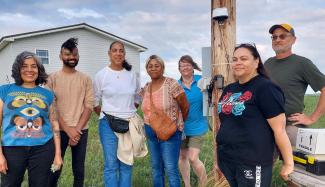
North Dakota Justice Squad
Detroit environmental justice leaders and a tribal member stand beside a recently installed air monitor on Fort Berthold Indian Reservation.

The Ever-Shrinking Sovereign Territory of Fort Berthold

The first stop on the reservation for the Detroit leaders was the Three Affiliated Tribes Museum in New Town, North Dakota, where they learned the history of the tribe and the land. 

Upon entering the museum, there hangs a photo of an indigenous man, head bowed, weeping as he bends to sign a document. The document he is signing will give away the tribe’s land rights to the United States for little in return. And while the photo is from the 1940s, the sentiment captured could be from any time in the last 200 years. 

When first recognized by the Treaty of Fort Laramie in 1851, the Fort Berthold reservation encompassed 12 million acres. Today, the reservation comprises slightly less than a million. Repeated land confiscation by the United States government and the impacts of the Dawes Act, which broke up communally-owned land into individually-owned parcels, resulted in the increasingly shrinking territory of the Three Affiliated Tribes. 

Nonetheless, before the 1950s, the reservation was self-sustaining, with tribal members raising livestock and farming the land around the banks of the Missouri River, which splits the reservation on a northwest-to-southeast diagonal. Sadly, following the Flood Control Act of 1944, the United States Army Corps of Engineers installed the Garrison Dam on the Missouri River, flooding out more than 150,000 acres of reservation land. The effects of the dam on the tribal nation were devastating – 325 families, representing 80% of the tribal membership, were forced to relocate to higher ground when the rising water submerged their homes, towns, churches, and graveyards. The tribe lost nearly all of its agricultural land. 
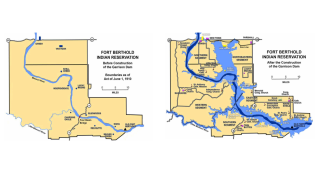
Map of Fort Berthold
Map of the Fort Berthold Indian Reservation before and after the Garrison Dam was constructed. The tribe lost more than 150,000 acres due to dam construction.

When the oil and gas companies came knocking on the tribe’s door in the early 2000s, it’s likely the residents were not surprised that the white people had come to take from them again.

That the reservation was sitting atop rich oil and gas reserves had been well established. But excavating it had been cost-prohibitive until the industry perfected the technique of hydraulic fracturing, known colloquially as fracking. 

The fracking boom in North Dakota took off in 2008 and the state quickly became one of the top oil-producing states in America.

When land is fracked, after drilling deep into the Bakken shale bed, a high-pressure mixture of water, sand, and chemicals is shot horizontally into the bedrock, creating fractures. These fractures are held open by sand in the fracking fluid, from which escapes that treasured substance: oil and gas.

But that’s not all – methane, a highly potent greenhouse gas, is also pushed out during fracking, sometimes so much so that the gas must be flared, or lit, to burn off the excess gas. The flares on the reservation and west North Dakota shine so brightly they can be seen from space. 


Along with methane, fracking operations release toxic petroleum hydrocarbons like benzene, toluene, and xylene, and increase ground-level ozone. The industry also brought heavy-duty truck traffic clamoring through the area, kicking up dust, increasing truck-related traffic fatalities, and further polluting the air with diesel emissions.

Our environmental justice team had come to help investigate these air pollutants. 

“We hold all of Mother Earth sacred, including the air.” 

After learning the history of the land, the group met with a longtime activist and recently elected state House of Representatives member, Lisa Finley-DeVille. Lisa has been working on air quality and environmental justice on the reservation for many years. 

The people of my tribe, The Three Affiliated Tribes, have lived on and cared for our land for millennia. We hold all of Mother Earth sacred, including the air,” said Lisa, as reported by Buffalo’s Fire in 2021. “Since the start of the Bakken oil boom, the oil and gas industry has polluted our air and harmed our health by flaring and venting methane from wells and pipelines.

Lisa and her husband gave their visitors a tour of the reservation, highlighting the toxic legacy of the oil and gas industry. They brought them up to date on how the community had been working to combat the negative impacts of fracking and flaring around the reservation. 

Together, the group installed the last of the seven air monitors on the rolling grasslands, with grazing horses, jutting buttes, and robotic well pumps dotting the landscape behind them. An air sampling device, which pulls air into a canister when toxic compounds are detected, was also installed to provide definitive evidence of pollutants present. 
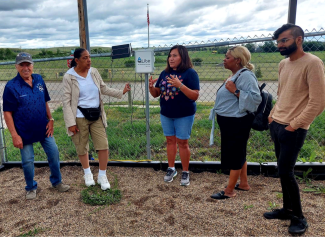
Group in North Dakota
The environmental justice leaders from Detroit tour the reservation with tribal member and House Representative Lisa Finley-DeVille, learning its history and the sources of air pollution. 
 

The data from the monitors will be displayed on an online dashboard to allow people to access real-time information about the air they breathe. After six months, the compiled data will be shared with the community and elected officials so they can take informed action and work on policy solutions. Colorado State University will analyze the samples collected for toxic air pollutants like methane and volatile organic compounds (VOCs) like benzene, toluene, and ethane.

“We need to move away from fossil fuels”

The environmental justice leaders from Detroit were well-versed in community-based air monitoring. The group has worked together for the past two years to install a neighborhood-level monitoring network in their city. Most of the group had worked on environmental justice in their communities for decades. 

Detroit and nearby municipalities suffer more from poor air quality and higher asthma rates than any other Michigan community. The University of Michigan estimates over 700 premature deaths occur annually in Detroit from exposure to pollution. 

One of the decades-long advocates is Theresa Landrum, who lives in southwest Detroit. Her neighbors, mostly Black homeowners, have passed their houses down through multiple generations. Across the street from her neighborhood’s community center is an oil refinery, one of the dozens of industrial sites nearby. Her zip code, 48217, is number one in air pollution in Michigan. According to the EPA, a disproportionate amount of people have asthma and cancer in her neighborhood, likely due to sulfur dioxide emitted from the plant. 

For years, she has raised awareness in her community about the dangers of emissions, brought elected officials and media on toxic tours of the industrial sites, and supported policy and planning efforts to end air pollution. 

Traveling to North Dakota with the Ecology Center to learn about fracking, the area concerns, the history of the area, and forming allies across the country deepened my understanding and urgency of why we need to move away from fossil fuels even more,” said Theresa. 

Like their indigenous allies, air pollution was just one of the problems inflicted on their Detroit communities. Racist planning policies put industrial and manufacturing facilities, an incinerator, and highways in their backyards, impacting their health and local economies and displacing hundreds of families. 

Building Community Power at the Parshall Powwow 

After three days of learning and information sharing, the group celebrated by attending a local powwow in nearby Parshall, North Dakota. They enjoyed traditional Native American foods like fry bread. The sound of drums echoed throughout while folks of all ages, from toddlers to elders, were called up to dance. Those present celebrated their community, culture, and shared resilience in carrying it forward. 

In October, the North Dakota partners returned the visit and came to Detroit to reconnect with the Detroit environmental justice activists and learn about the impact of the oil and gas industry in the city.

Together, the groups will work to build power and share advocacy and policy solutions. And hopefully, one day, the air will be clearer in both communities. 

To view the air quality monitoring dashboard on the Fort Berthold Reservation, visit the Just Air portal.


At Last, Could Michigan Children No Longer Be Poisoned by Lead?

Melissa Garcia

The Ecology Center’s ​​Regional Environmental Health Organizer, Meli Garcia, provides her perspective.

This fall brings unprecedented progress toward ending childhood lead poisoning in Michigan. A set of lead poisoning prevention bills have been reviewed by the legislature. These policies include universal testing of all children at ages one and two years old, installing water filters in all of Michigan’s daycare centers and schools, and giving the state enforcement over the federal Renovation, Repair and Painting Act. Both the universal testing and filter first bills have been signed into law. 

The Ecology Center has been working to remove lead from our homes and environment for almost five decades. We are elated to see this long-overdue progress. 

Our regional environmental health organizer, Meli X. Garcia, works tirelessly alongside the Great Lakes Lead Elimination Network (GLLEN) to end lead poisoning through lobbying and education. But Meli’s advocacy work isn’t just a vocation – it’s personal, too. She was exposed to lead as a child through her bedroom windows and suffered fatigue, brain fog, and trouble concentrating.

Lead has been found on toys, in paint (in homes built before 1978), in the soil, in the water, and in other consumer products. 

Lead is especially dangerous for children. According to the Centers for Disease Control, lead can cause “developmental delays, difficulty learning, behavioral issues, and neurological damage.” There is no healthy amount of lead exposure for children.

Lead poisoning is a public health issue that has persisted for decades. In this interview, we shine a light on Meli’s lead advocacy work, her personal experiences with lead, and the advice she has given the public on what we can do to make things better.

(This interview has been edited for clarity and length.)


Why is lead advocacy work important to you? 

Lead advocacy work is extremely important to me because it should not exist any longer. It’s been over 70 years since the poisoning first started in the United States due to lead paint. Although we have seen progress, we need to see a final end to all lead poisoning! It’s very damaging to our children and family’s health. We need to ensure the safety of our children and be the voice for them. It can cause ADHD, neurological issues, nerve damage, concentration issues, lower IQ, and behavioral issues. 

Although we have seen progress, we need to see a final end to all lead poisoning!

Do you have a personal connection to this work? What motivates you to continue in it?

I do have a personal connection. I was exposed to lead as a child. I had to consume a high vitamin C-rich diet and an iron-rich diet. My symptoms were fatigue, brain fog, irritability, and not being able to concentrate in school. I was exposed through lead-chipped paint in my bedroom windows. This exact problem persists today. 

How did you get involved with lead advocacy work? 

I got involved with lead advocacy work in September of 2022. I was drawn to helping in the efforts to end lead poisoning at a regional and policy level. I also have had the opportunity to hear the stories and work directly with those families directly impacted by lead poisoning.


I am motivated to continue to work with lead issues because children and our families deserve to live a lead-free life.

This is a big, multi-part problem. What do you believe needs to happen to solve it? Is solving it possible, or is progress the best we can hope for?

We need to pass policies that help protect our children. We have to reach lawmakers and strive to pass current lead legislation that provides filtered drinking water and universal testing for our children. We have to get to the source of the problem, which is lead paint! 

My goal for lead advocacy work is to speak with lawmakers and help educate them on the Ecology Center’s lead priorities. The Ecology Center and its lead allies have been working on getting filter first and universal testing bill* packages to pass. I want to help push for those! I also want to help our GLLEN members connect and work together regionally to end lead poisoning. 

(GLLEN is a coalition of non-profit organizations in the Great Lakes states working on solutions to end lead poisoning.)

*Universal testing of toddlers for lead and the filter first policy were signed into law in fall 2023. 

 How does working on lead advocacy make you feel?

I understand that passing legislation takes time. Lawmakers are bombarded with several policies they need to move. We are just one piece of the public health puzzle. I get excited because we have a lot of caring regular people, health professionals, and, of course, the Ecology Center, who are being the voice for our children.

The only way to make real change is to change the mind of lawmakers and keep advocating to move and pass lead legislation, otherwise old bad policies will continue to harm our children.

What can community members do to help? 

Community members can get their children tested for lead. They can test their homes for lead as well. They can also call their lawmakers and urge them to pass current lead legislation. For those who have been directly impacted by lead poisoning, they can testify and share their story with the local press.

Get Involved

In 2021, Michigan ranked 3rd in a nationwide assessment of blood-lead levels in children; 78% of children who were tested had lead in their blood. Learn more about the Ecology Center’s lead advocacy work here
 

Sidewalk Detroit's Eco-Activist Art Initiative Heals Community Through Art and Nature

By Crystal Zanders, Ecology Center’s Communications Fellow 

An ecology-inspired art park is coming to Detroit’s East Canfield this spring, designed by award-winning artist Jordan Weber and sponsored by Sidewalk Detroit. Planned to be built in the footprint of an industrial plant, the art park will include tree plantings to address legacy pollution and pay homage to African queens who resisted colonialism. 

The Ecology Center is grateful for the opportunity to honor the contributions of eco-activist artists in our community. Sidewalk Detroit is an organization working in partnership with Detroit communities to celebrate and facilitate art and joy for the public.

Sidewalk Detroit’s Community Focus

When Ryan Myers-Johnson launched the original Sidewalk Festival in 2012, she envisioned hosting a one-time event celebrating neighborhood streetscapes by putting on a street art, music, and performing arts festival. Sidewalk Detroit, a grassroots arts organization, was born out of that festival. It has been supporting, creating, curating, and celebrating neighborhood art and arts programming in partnership with the communities it serves ever since.  

Today, Sidewalk Detroit works with artists, community partners, and the community itself to increase access to art. According to Augusta Morrison, senior program strategist with Sidewalk Detroit and a celebrated artist in her own right,

“The organization kind of grew into a more specific focus around community engagement through an artistic lens. We think a lot about spatial equity. When we are in different types of spaces, who are those spaces built out for? So, we are intentional on how we engage with residents and stakeholders (such as businesses and community leaders and civic organizations), keeping the community at the heart of the conversation. We want to go a mile deep and one inch wide. Our mission is to advance spatial equity through the lens of arts and culture.”

Jordan Weber, eco-art activist

The award-winning artist Jordan Weber was selected for the 2023 Artist-in-Residence program at Sidewalk Detroit, not just because he is a rising star in the art world but in large part because of his commitment to eco-activism and community engagement with art. He has extensive experience creating public art pieces that are free and open to the public. His past works include repurposed police vehicles that he used to create community gardens/workout equipment in Des Moines and the urban farm he designed in collaboration with community members in Minneapolis during the George Floyd protest.

The Installation*

For Sidewalk Detroit, Jordan Weber has agreed to create an art installation. The site of this installation has been carefully chosen. They will place it in an art park located within the shadow of the Stellantis-Mack Assembly Plant, the toxic fumes of which are responsible for some of the highest asthma levels in the country. As part of the installation, they will plant specific trees that help remove toxins from the air, creating a space that literally heals environmental violence and ecological racism.

Across the street from the park is the Barack Obama Leadership Academy, an elementary charter school that serves a student body that is 99.6% Black children who have been exposed to these toxic fumes. Part of the vision of this installation is that students will be able to walk over and experience and enjoy the art and learn about air quality. The Ecology Center, collaborating with Green Door Initiative, will install air monitors at the school and park, integrating air quality education into the installation design. Within the design of the installation will be space for the school to use as an environmental justice learning center.

Jordan Weber isn’t just deciding what he wants to do and putting in the park; he is working with Sidewalk Detroit to hold community meetings and solicit feedback during every step of the process.

The installation will be completed in stages. In the first stage, they will build 30-foot shiny metal gates as an entrance to the park, representing an entry to the forest, an entrance into healing and nature in the middle of the city. The gate design was inspired by the crowns of Queen Ranavalona III of Madagascar and Queen Idia of Benin from East and West Africa representing East and West Detroit. These African queens are known for their resistance to colonialism.

During this stage, Sidewalk Detroit will also partner with The Greening of Detroit and Aboretum Detroit to plant trees.

Sidewalk Detroit is focused on supporting and creating art that speaks to social, political, environmental, and racial issues affecting the communities that they serve. This project is another avenue through which they are making things better.

To learn more about this project and Sidewalk Detroit, visit their website at: https://www.sidewalkdetroit.com/

*This art installation has not been named yet. Selecting a name is another process involving the community.

Coalition urges MI Legislature: Step up EV support to meet state 2030 goal

Michigan Ranked 26th Among States for Electric Vehicle Policies

September 22nd, 2023 - With the Detroit Auto Show winding down and National Drive Electric Week just kicking off, a broad coalition of organizations supporting bold action on equitable, electric transportation in Michigan called on state leaders to redouble their efforts to achieve the state’s goal of 2 million EVs on the road by 2030. While the Clean Cars 2030 coalition praised the state’s ambitious goal and progress, it cited a recent study from ACEEE ranking Michigan 26th in the nation for EV-friendly policies to suggest the state still needs to double down on its commitment. 

 “While Michigan has been making important strides in preparing for and encouraging the EV transition, particularly in attracting new battery and EV manufacturing investments, it has fallen behind other states in policies that help more Michiganders get behind the wheel of an electric vehicle,” said Charles Griffith, climate and energy program director at the Ecology Center. “If Michigan wants to be a true leader on electric vehicles and achieve its climate goals, policymakers must step up their game to advance policies and programs that improve access to EVs for all Michiganders.” 

The MI Clean Cars 2030 campaign is united around making Governor Whitmer’s goal of having 2 million electric vehicles on the road a reality by making electric vehicles the optimum choice for Michiganders and expanding access to EVs and EV charging infrastructure – especially for the most gasoline-burdened drivers. The campaign also supports preparing the workforce for the transition to 21st-century automobile manufacturing, helping to ensure the retention of good-paying auto jobs. 

The coalition is calling for developing a comprehensive plan and adopting additional policies and programs to ensure Michigan meets its 2030 goal in alignment with recommendations included in the Governor’s MI Healthy Climate Plan

The top priorities of the campaign include the following:

  • A comprehensive Transportation Electrification Plan (TEP) to lay out a strategy for meeting the state’s 2 million EVs by 2030 goal
  • Additional investments and policies to ensure the equitable deployment of EV charging infrastructure, especially in Michigan communities where charging opportunities may currently be limited
  • Vehicle purchase incentives to help offset the higher up-front cost of EVs, targeting low and moderate-income gasoline-burdened drivers
  • Increased funding for job transition and retraining programs to ensure Michigan’s workforce is ready. 

ACEEE’s 2023 State Transportation Electrification Scorecard ranked Michigan 26th overall with 23.5 points out of 100 and noted the progress on electrifying its transit and school bus fleets and the investments of its utilities in EV charging infrastructure. ACEEE’s State Energy Efficiency Scorecard echoes this progress on utility efforts, where Michigan ranked 3rd for utility and public program benefits. ACEEE found that the state could do more to incentivize the purchase of EVs, lags in outcomes such as the number of electric vehicles and chargers per capita, and could do more to ensure equitable outcomes. 

"Michigan received zero points related to equity-focused policies and should dedicate funding to underserved communities to ensure everyone benefits from the transition to electric vehicles,” said Peter Huether, senior research associate at ACEEE and lead author of the report. 

“Michigan is already a leader in creating EV-related jobs and providing EVs for the nation,” said Rob Sargent, policy director at Coltura, an organization focused on maximizing gasoline-use reductions. “But much more can be done to get more Michiganders to switch, starting with low- and moderate-income gasoline-burdened families who use lots of gasoline.”  

Earlier this year, Michigan lawmakers made significant strides toward the goals in this plan by adopting a 2024 budget with several EV-related investments: $125 million for clean and electric school buses, $5 million for EV charging stations along Lake Michigan’s coastline, and $1 million to begin transitioning the state’s vehicle fleet to EVs. These are critical steps forward, but other recommendations that were included in the Governor’s Executive budget from her MI Healthy Climate Plan were left unfunded.

“The transportation sector is the largest contributor to greenhouse gas emissions — and cars and trucks account for about 60% of the total for the sector. This is why it’s so important to focus on a rapid and just transition to all-electric vehicles for the everyday commute,” said Amy Rogge, co-founder of MEVA.” “Every year, it’s becoming easier to buy and drive an EV due to lower-priced new EVs coming into the market, more used EV purchases, and a vastly increasing number of charging stations across our state. Plus, they’re just so fun to drive!” 

While Michigan has made crucial steps forward in the 2024 budget that will help advance MI EVs, more work will be required for MI to establish itself as a leading state, let alone a top 10 state in encouraging EV adoption.   

###

Michigan Clean Cars 2030 Campaign  

The MI Clean Cars 2030 campaign is committed to making electric vehicles the optimum choice for Michiganders by 2030, achieving Governor Whitmer's goal of 2 million EVs and making EVs accessible to everyone--especially the most gasoline-burdened drivers. We must take Michigan's commitment to the next level for this to be possible. 

Ecology Center

The Ecology Center is a non-profit environmental advocacy organization established in 1970 in Ann Arbor, Michigan. The Ecology Center develops innovative solutions for healthy people and a healthy planet in four primary areas: Environmental Health, Climate Action and Clean Equitable Energy, Environmental Education, and Zero Waste. This work is accomplished through educating consumers to help keep their families healthy and safe, pushing corporations to use clean energy, make safe products, providing people with innovative services that promote healthy people and a healthy planet and working with policymakers to establish laws that protect communities and the environment. For more information visit www.ecocenter.org and follow @Ecology_Center.

MEVA

MEVA is a grassroots organization, founded by Michiganders looking to better their community and the world. When we overlaid our diverse experiences in healthcare, automotive, and community organization, we found that electric vehicles can solve problems that Michigan faces While Michigan has made critical steps forward in the 2024 budget to help advance MI EVs, more work will be required to establish itself as a leading state, let alone a top 10 state in encouraging EV adoption. on many fronts. 

Coltura 

Coltura’s mission is to improve climate, health and equity by accelerating the switch from gasoline and diesel to cleaner alternatives. Since 2015, Coltura has made a significant impact on gasoline policy and culture. Building and leading diverse coalitions, Coltura has been a driving force in gasoline reduction policies. Coltura’s groundbreaking research, data tools, polls, articles, reports, papers and law review articles have laid the foundation for innovative policies around the country.

ACEEE

The 2023 State Transportation Electrification Scorecard is the second edition from the American Council for an Energy-Efficient Economy (ACEEE) that evaluates states’ policies to encourage electric vehicle (EV) adoption. States are evaluated on over 40 metrics across five policy areas: EV and EV infrastructure planning, incentives, transportation system efficiency, electricity grid optimization, and transportation electrification outcomes. States are also evaluated on their efforts to incorporate equity and the actions of their regulated utilities. 


Lead Blood Tests Bills Set To Head To Governor's Desk

September 20, 2023 - Legislation to require young children to be screened for lead poisoning cleared its final hurdle Tuesday and is on track to be sent to the governor’s desk.

Members of the Senate concurred Tuesday in an H-1 substitute for HB 4200 Trackedby a 27-10 vote without debate.

Under HB 4200 and SB 31 Tracked, children would be required to be tested for lead poisoning at certain ages and the tests would be recorded on their certificate of immunization. The Department of Health and Human Services would be required to develop rules for implementing the changes. House members passed SB 31 last week.

Sen. John Cherry (D-Flint) said the legislation will help increase protections for children from lead poisoning.

“This is just going to make sure that we help parents know if their child is being exposed and be able to address that exposure,” Cherry said.

He said when someone tests for lead in their blood, the information would be sent on to their local health department so that they can help provide remediation for the source of the lead, whether it be water, lead paint or soil.

Cherry said further steps to help address lead exposure would include legislation waiting on votes in the House to require schools and day care centers to have filtered bottle-filling stations and faucets specific for drinking water (See Gongwer Michigan Report, April 20, 2023).

Cherry said support for the lead testing bills is strong in his district.

“Flint was kind of the canary in the coal mine on this,” Cherry said. “We want to make sure we’re taking those lessons … to try to help everyone else before similar things happen.”

As passed, the bill would require children in the state to be tested for lead poisoning at 12-months old and 24-months old, beginning January 1, 2024. One more test would be required between the ages of 2 and 6 if the child has no previous record of being tested.

Children living in areas with a high risk of lead poisoning would have to be tested at age 4.

###

All Toddlers Will Soon Be Tested for Lead

New measure will help thousands of children each year 

Michigan moved closer to ending lead poisoning today when state lawmakers passed legislation to expand testing.

Senate Bill 31, sponsored by Sen. John Cherry (D-Flint), and House Bill 4200, sponsored by Rep. Helena Scott (D-Detroit) would incorporate two lead tests into the checkup routines of all Michigan children. If lead is detected, children would be treated accordingly and tested more often.

Under current law, only children on Medicaid are required to be tested for lead. But not all children who are exposed to the toxic metal are on Medicaid. About 70% of Michigan homes—the most common source of lead poisoning—were built before 1978, the year lead paint was banned. This means that the 4,000 or so children diagnosed with lead poisoning in Michigan each year is likely an undercount.

See the latest lead levels in your community

"It's a great day for children's health and the health and wellness of the people of Michigan," said TaNiccia Henry—co-leader of the Detroit Lead Advocacy Parent Group, whose grandson was poisoned by lead in Henry's own home. "Lead testing needs to be mandatory for every single child, and the problem I have right next door is the reason why."

The day the lead bills passed the Legislature, next-door renovators showered Henry's home with potentially lead-laden dust, so she shut her windows and called local officials. She said the universal testing legislation will give parents the knowledge and resources to protect their kids.

The legislation is the result of years of advocacy and education from Henry and the other 184 members of the Michigan Alliance for Lead Safe Homes (MIALSH). 

"Universal lead testing would not be possible without the parents and healthcare workers who spent 13 years fighting for it," said Melissa Cooper Sargent, environmental health advocate for the Ecology Center. "Now, lead poisoning can be caught and treated before it devastates children's mental and physical development. All children will be better able to thrive at school, at home, and with friends."

The lead testing bills’ movement comes as other lead poisoning prevention policies gain traction in the Legislature. Bills to install lead water filters in all schools and childcare centers are poised for passage. A bill that would move a key federal remediation program under state control has also been introduced.

"Universal testing will have the most profound impact on ending lead poisoning since lead paint was banned in 1978," said Ellen Vial, Detroit program manager for the Michigan Environmental Council, which has convened MIALSH since its creation. "When paired with other great health legislation underway, 2023 could be a year of truly transformational change."

Now, MIALSH will work to prepare families, organizations, and health departments for the shift toward universal lead testing. It will also continue to educate lawmakers about its other top priorities: lead-safe home repairs and inspections.
 

Bisphenols and alternative developers in retailer receipts from the U.S. market

In 2022, we tested 571 cash register receipts collected from U.S. stores, restaurants, gas stations, and other establishments. We identified the color developer--a chemical layer on the paper that allows for fast printing at the point of sale--on each receipt. We found bisphenol S (BPS) was by far the most common color developer. BPS has been marketed as an alternative to the well-known hormone disruptor bisphenol A (BPA), but evidence is mounting that its hazards are at least as concerning. Our study documented a reduction since 2017 in usage of bisphenol A-containing receipts and an increase in both bisphenol S and non-bisphenol alternatives.  

Our identification of one of the alternatives, called NKK-1304, appears to be the first report in the scientific literature of this chemical in thermal paper.  We were able to identify this chemical using information found in patent applications.

The study was published in October 2023 in the journal Environmental Pollution. 

This study provides the first large survey of U.S. receipts in many years, filling a need for monitoring receipts, which have been demonstrated as significant sources of exposure to endocrine-disrupting chemicals, particularly for workers who handle them. Our data also revealed a significant difference between national retailers versus regional and local retailers in the trend away from bisphenols. Large, national retailers were more likely to be using bisphenol-free alternatives. In contrast, small retailers had mostly stopped using BPA but most frequently had chosen BPS as the alternative.

Our study also showed that a relatively inexpensive and rapid technique, infrared spectroscopy, successfully identified receipt chemicals. Most studies on chemicals in receipts and other uses of thermal paper (such as labels on packaging) have relied on more expensive and time-consuming analytical methods.   

Link to the Environmental Pollution paper

Citation: 
Gillian Zaharias Miller, Daniela Tapia Pitzzu, Melissa Cooper Sargent, Jeff Gearhart, "Bisphenols and alternative developers in thermal paper receipts from the U.S. market assessed by Fourier transform infrared spectroscopy." Environmental Pollution v. 335, 15 October 2023, 122232

Advocates Declare ‘No More Delay,’ Sue EPA for Stalled Lead Wheel Weight Regulation

Millions of pounds of lead wheel weights contaminate the environment, exposing people to a highly toxic heavy metal

WASHINGTON, D.C., August 22, 2023 — Public health advocates represented by Earthjustice today sued the Environmental Protection Agency (EPA) for its unreasonable delay in regulating lead wheel weights, despite granting the advocates’ 2009 petition requesting regulation of the manufacture, processing, and distribution of lead wheel weights.   

EPA granted the petition nearly 14 years ago but has yet to regulate lead wheel weights. Lead wheel weights are used to balance car wheels. Banning their manufacture, processing, and distribution would protect public health by eliminating a source of lead exposure.  

“It is well known that lead is a highly toxic substance for which there is no safe level of exposure, yet EPA continues to permit the manufacture, processing, and distribution of lead wheel weights,” said Earthjustice Attorney Lakendra Barajas. ”EPA must act now to eliminate this unnecessary source of lead exposure and threat to public health.”  

Wheel weights are clipped to rims of automobile wheels for balance, but they often come loose and fall off, releasing about 1.6 million pounds of lead into the environment during regular driving every year, according to EPA. This lead ends up in waterways via storm sewers or in landfills after street cleaning, poisoning fish, wildlife, and communities. The Biden administration placed significant emphasis on lowering lead exposure. Regulating lead wheel weights plays a pivotal role in this necessary objective. 

Lead exposure causes an array of health issues, such as neurodevelopmental harm, cardiovascular disease, nerve damage, cancer, kidney damage, and fertility problems. Despite lead’s known toxicity, EPA still allows the manufacture, processing, and distribution of lead wheel weights. Yet non-lead wheel weights can balance tires just as effectively. In fact, many wheel weights now sold are made of zinc or steel rather than lead. EPA has no excuse to postpone regulating lead wheel weights.  

Several states have already regulated the manufacturing and installation of lead wheel weights within their borders, and some national tire retailers have voluntarily stopped installing lead wheel weights. However, this state-by-state approach has failed to eliminate the lead wheel weight market and does not restrict international imports or interstate transit of lead wheel weights. 

Quotes from our clients: 

“We refuse to stand idle while lead wheel weights persist as a threat to our children’s health,” said Queen Zakia Shabazz, founder of United Parents Against Lead & Other Environmental Hazards. “EPA’s inaction on this matter is inexcusable, considering the proven harms of lead exposure. It’s time for the EPA to stand up for our children by regulating lead wheel weights. The Biden administration made lead exposure reduction a key goal. Regulating lead wheel weights is critical in achieving this much-needed goal. Let’s prioritize our children’s health and the wellbeing of our communities over preventable lead pollution.” 

“Today’s lawsuit against the EPA is a vital step to address the unjustifiable delay in regulating lead wheel weights,” said Kaya Allan Sugerman, director of Illegal Toxic Threats at the Center for Environmental Health. “With more than a decade-long wait since granting the petition, it’s high time for the EPA to banish the continued production, processing, and distribution of lead wheel weights. This is about safeguarding public health, eradicating a hazardous lead source, and championing alternatives that can effectively balance tires without harming our environment.” 

“We’re witnessing the grim reality of these weights releasing lead into our environment, poisoning wildlife, waterways, and harming human health,” said Doris Cellarius from Sierra Club’s National Toxics Team. “EPA must end this dangerous practice by banning lead wheel weight manufacturing, processing, and distribution. Let’s transition to safer alternatives and ensure a cleaner, healthier future for all.” 

“Industry, automakers and public health advocates have been asking for EPA action for two decades; further delay is unacceptable,” said Jeff Gearhart, research director from the Ecology Center. “Europe, Canada and most western nations have already banned this lead use to protect public health. By dragging its feet on regulating lead wheel weights, the EPA is failing in its duty to protect public health and the environment.” 

Michigan's Budget Takes a Green Leap on Transportation Funding

Clean School Buses Get a Big Boost

June 29 was a good day for Michigan’s clean transportation. That’s when the legislature finalized the state’s 2024  budget, which included historic new funding programs for clean and electric vehicles and support for charging infrastructure.

Highlights include:

  • $125 million for clean school buses; 
  • $110 million for expanding public transit and innovative new mobility projects;
  • $21 million for clean energy and electric vehicle infrastructure projects;
  • $5 million for Lake Michigan EV charging circuit; and
  • $1 million for transitioning the state’s fleet to EVs.

We are especially excited about the funding for electric school buses. Most of Michigan’s 17,000 school buses run on diesel fuel, the exhaust from which has been linked to children’s health issues, including asthma and cognitive development. Electric school buses have zero tailpipe emissions. They can also save school districts thousands of dollars per year on fuel and maintenance. This new funding thus makes our communities safer for children while saving taxpayer money in the long term. Definitely a reason to celebrate!    

The budget also included important new funding to expand public transit and mobility projects, as well as new funds to support EV charging infrastructure, especially along Lake Michigan. These funds will complement new federal funding for EV charging stations along major highway corridors.  

Despite these budget wins, however, we still have miles to go. The Governor had included several other clean transportation programs in her Executive budget proposal that the legislature declined to fund. According to the American Council for an Energy-Efficient Economy’s recent State Transportation Electrification Scorecard, Michigan still ranks 26th among states for policies that support electric vehicle adoption. That is an improvement from 2021 when we were in 29th place.  However, Michigan needs to be leading the country on these policies if it wants to maintain its standing as the leading auto state. We clearly have more work to do. 

Specifically, we need to pick up the items from the Governor’s budget that got left behind and, at the same time, work to adopt other proactive state policies that spur EV adoption, like clean vehicle and fuel standards. Budget-related items that still need funding include: 

  • Purchase incentives on new and used vehicles  to make electric cars more affordable;
  • Incentives for additional charging infrastructure, especially to support access for those that can’t charge at home; and
  • Funding to help local government fleet vehicles transition to electric.

We know that your support is why we have made it this far. Thank you so much for staying engaged, responding to our action alerts, and helping us move toward equitable clean energy. Together, we will continue shaping the future and creating a safer, cleaner, more sustainable world. 
 

Michigan Passes Historic Funding for School Bus Electrification

Lansing, MI (June 29th, 2023) – Yesterday, the Michigan legislature passed the state’s annual budget in bipartisan fashion, including a historic $125 million in funding to help school districts across the state bring the benefits of zero-tailpipe-emissions electric school buses to their communities.

In a crucial step toward ensuring the transition to electric school buses is equitable, this funding will prioritize low income and rural school districts, school districts in areas most affected by air pollution, and other environmental justice factors.

Most of Michigan’s nearly 17,000 school buses run on diesel fuel, exposing children across the state to diesel exhaust pollution, which has proven links to serious physical health issues such as asthma and other respiratory illnesses as well as cognitive development impacts. Electric school buses have zero tailpipe emissions of harmful air pollutants, are responsible for the lowest greenhouse gas emissions of any school bus type – even when accounting for emissions from the generation of electric power – and can save school districts thousands of dollars per year on fuel and maintenance.

Building on the Governor’s Executive Budget recommendation, this funding will complement the rebate awards received by 25 Michigan school districts through the first round of the Environmental Protection Agency’s Clean School Bus Program, a program which, while offering unprecedented federal funding for electric school buses, represents only a small fraction of the funding needed to transition all school buses away from diesel fuel to electric. In fact, an additional 53 Michigan school districts requested electric school buses in the first round of Clean School Bus Program funding but were waitlisted.

This victory is due in part to the tireless work of organizations in the state such as the Electrification Coalition, Michigan Environmental Council, Southwest Detroit Environmental Vision, MI Air MI Health, Clean Fuels Michigan, NAACP Grand Rapids, Action for the Climate Emergency, Ecology Center, Environmental Law & Policy Center and others.

Said Sue Gander, Director of WRI’s Electric School Bus Initiative:

“This year’s budget marks a turning point for the 800,000 students in Michigan who depend on the yellow bus to get to school. With this investment, school districts throughout the state can leave toxic diesel pollution in the rear-view mirror and join hundreds of other districts across the country in bringing the benefits of electric school buses to their communities. The air quality and health benefits of electric buses are especially critical for underserved communities, including those near bus depots, who too often bear the burden of transportation pollution. We applaud Governor Whitmer for leading the way in this effort to deliver a healthy ride to school for Michigan’s kids, while generating economic opportunity and protecting our climate. We urge the state, and look forward to working with them, to implement these funds in a manner that maximizes the air quality, health and climate benefits of the program and the opportunities for electrification.”

Said Kindra Weid, RN, air quality advocate, and coalition coordinator of It’s Electric!, Michigan’s electric school bus coalition:

“We are very pleased to hear of the $125 million dedicated to clean school buses for Michigan’s school children.  When air quality, climate and public health are at the front of our minds, protecting our children from dirty tailpipe emissions on their way to school just makes sense.  School districts across Michigan have already displayed success and demand for electric school buses, and this funding will help to support further rollouts- especially among our communities hit first and worst by air pollution.  This action from Michigan’s legislature shows they are putting children’s health, air quality, climate and equity front and center.” 

Said Ross Gavin, Urban Land Use & Infrastructure Policy Director at Michigan Environmental Council:

"We are glad to see the legislature and Governor include significant investments for electric school buses. This critical funding will help school districts phase out aging diesel school buses that emit dangerous exhaust pollution and put our kids at risk for health complications, while also reducing environmental impact as we work to tackle climate change. While it is unfortunate that alternative fuel buses also qualify for this funding, we look forward to working with the department to ensure the money is used for truly zero emissions, electric vehicles—which are safest for our kids."

Said Susan Mudd, Senior Policy Advocate at the Environmental Law & Policy Center:

“The Environmental Law & Policy Center applauds the Michigan state legislature for passing its budget that includes a $125 million Michigan Clean School Bus Program. We were proud to work with other Michigan-based groups to advocate for funding safe, clean buses that will reduce school children’s exposure to diesel emissions that are harmful to their developing lungs. Swapping out loud, dirty diesels for quieter zero-emission electric buses will also improve air quality for entire communities where these buses travel. This program represents the biggest commitment to electric school buses of any Midwest state and continues Michigan’s leadership demonstrated earlier by its successful rollout of Volkswagen funds for ESBs.”

Said Katrina Morris, Executive Director of Michigan Association of Pupil Transportation:

“Investing in a transition to cleaner school buses shows us where Michigan’s priorities lie: in the health and safety of school children.  Electric school buses are already arriving at school districts across Michigan, and not only are these buses safe, clean and quiet, but they are also performing well in cold weather and they are saving districts money on fuel and maintenance.  MAPT applauds this budget investment in a clean ride for kids and we look forward to helping roll out these cleaner buses across the state.” 

###