

Driving away the devil under the hood: Towards 100% electric road transportation for Michigan

By Swapna Nelaballi

The devil under the hood = trouble in the air

It's hard to imagine modern life without sedans, SUVs, pickups, buses, or trucks. We have built our nation to be reliant on these  machines, from boosting our economy to helping us maintain our social connections. Yet, under their hoods, skulks a dangerous killer; an oil burning engine that poisons our air, water, and lungs. And, like other sinister beings, this killer preys on the most vulnerable; children, the elderly, the poor, and people of color, face the greatest risk from breathing air laden with soot, smog, and other toxic chemicals.

Motor vehicle pollution increases our risk of heart disease, asthma, impaired lung function, respiratory illness, cancer, and premature death. In 2015, ~385,000 premature deaths worldwide were caused by soot and smog from motor vehicle emissions. And 70% of these deaths occurred in four countries with the largest vehicle markets, including the US. Each year, more than 20,000 Americans die prematurely from tailpipe pollution, and millions more are affected by respiratory illnesses, lost work days, and lost school days.

Exhaust from tailpipes is also the leading source of climate pollution in the US. In 2020, 27% of greenhouse gas (GHG) emissions in the US were produced by motor vehicles. Between 1990 & 2019, total GHG emissions from the transportation sector, surpassed emissions from all other sectors!

Michigan, the auto industry leader, has the highest auto production compared to any other state. Seventeen percent of production in the US happens here. Annually, a whopping 12 billion dollars are spent on research and development to support the auto industry. But, this growing transportation sector is also among the top sources of air pollution in Michigan, especially in Detroit and surrounding areas.

A significant number of Detroit residents live, and a large number of public schools are located, adjacent to choked roadways and large industries. Thus, while worrisome, it is no surprise that Detroit features on two separate lists of 25 most polluted US cities; those polluted by smog (#24) and those by soot (#16), as per the American Lung Association's recent ‘State of the Air’ report. The combined impact of pollution from point (industries) and mobile (vehicles) sources in this area, causes 721 premature deaths, 1500 hospitalizations, 500000 days of missed work, and more than 990,000 days of missed school, and costs the state 660 million dollars each year!
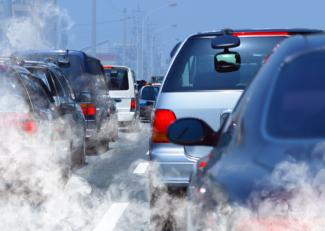
Tailpipe emissions from fuel burning vehicles. Photo source: AdobeStock_18298693
Tailpipe emissions from oil burning vehicles are detrimental to both human and environmental health. Photo source: AdobeStock_18298693

All is not lost

We can make a dent in these terrible numbers. For that, first, we must do away with the devil under the hood. We must wean off vehicles spewing toxic chemicals, to achieve Michigan’s Healthy Climate Plan (MIHCP) goals, for a greener future, where every child, grandparent, and Michigander can breathe clean air. One hundred percent electrification of road transport, powered by clean energy, is the best, most viable, and scalable solution to achieve this goal.

Accelerating the transition from industrial age tech to zero-emission electric vehicles (EVs), will positively impact every breath we take. EVs will help end tailpipe pollution and reduce - billions of tons of harmful emissions, disease burden, and health disparities, and will save hundreds of lives every year. High climate costs (amounting to trillions of dollars) from extracting and burning fossil fuels can also be avoided. Instead, transitioning to EVs can boost our economy, by creating new investment opportunities, and millions of job opportunities in manufacturing, developing and maintaining charging infrastructure, and other required services.

No wonder, consumers across the US are eager for this transition to happen. A 2019 survey of prospective buyers across regions and income groups, showed that 63% were interested in buying EVs. It is time for the auto industry to meet this demand. Some headway has been made with leading automakers committing to “all-electric line-ups” and increasing investments in developing new models of electric vehicles, many of which will be made here in Michigan.  But it is time to pick up the pace and Michigan, as the Motor City state, must lead the way.

We at the Ecology Center, in collaboration with MEVA and with support from other leading environmental and health organizations, are advocating for better EV-friendly policies in Michigan, and a speedy transition to EVs. We are encouraging the state to adopt a tangible goal for this transition i.e., achieve 100% EV sales by 2030, and develop a practical and comprehensive roadmap to help us get there. This is critical for Michigan to achieve its healthy climate goals and still maintain its position as the auto industry leader. Please visit our MI Clean Cars 2030 campaign page and join our fight for a healthier Michigan. 

A Climate Victory Diluted by the Inequity It Will Perpetuate

The Inflation Reduction Act of 2022

In early August, most of us had written off the Biden administration's plans for a Democrat-led climate bill. However, in a surprising turn of events, Senate leader Chuck Schumer struck a seemingly out-of-reach deal with Senator Joe Manchin to pass the first significant climate bill in US history. 

It had been 41 years since the US Congress held its first hearings about “global warming,” and 25 years since  the Kyoto Protocol was approved, committing the nations of the world to address the climate crisis.  For decades, the fossil fuel industry’s stranglehold on US politics kept action at bay.

But over the past decade, the climate and climate justice movements have mobilized millions of people, all over the world, to fight for change.  We elevated the profile of this issue to the highest levels in virtually every sector of the economy, every aspect of our culture, and in one of the US’ two major political parties.  Congress had failed to pass climate legislation dozens of times over the past decades.  Without the mass mobilization of the climate movements, the Schumer-Manchin bill would never have seen the light of day.

The Inflation Reduction Act was signed into law on August 16, 2022, committing $369 billion toward climate emission reduction efforts.

To win Joe Manchin’s vote, however, Democrats accepted major provisions to expand fossil fuel infrastructure and sell out marginalized communities.  The concessions make this historic achievement more than bitter, even painful. It reminds us that something can be monumentally good and bad, at the same time.  

What's monumentally good about it? 

The IRA's climate gains fall into six key areas: clean electricity, clean transportation, clean buildings, clean manufacturing and industrial decarbonization, climate-smart agriculture & forestry, and conservation, environmental and climate justice. 

Through tax credits, consumer rebates, incentive programs, supportive policies, and investments:

  • Solar and wind power will be even more accessible and affordable; 
  • Homes and buildings will be more energy efficient and increasingly electrified; 
  • Cars, trucks, and transportation systems will create less pollution and fewer carbon emissions; 
  • Agriculture will become more sustainable and less carbon-emitting; 
  • Manufacturing and big industries will become less carbon-intensive. 

The Inflation Reduction Act will go a long way toward achieving the US goal of a 50% reduction in greenhouse gasses by 2030 and, based on several analyses,  will: 

"Without a doubt, the IRA is the biggest U.S. investment to date in addressing the existential threat of our current climate crisis and comes at a moment when most climate advocates had given up hope," said Charles Griffith, Ecology Center Climate and Energy Director. "While there is still much work to meet our emissions reduction goals--likely much of it at the state and local level--this breakthrough legislation restores U.S. climate leadership and gives us a fighting chance at tackling the climate crisis." 

What's monumentally bad? 

The IRA's concessions to fossil fuel interests and pipeline operators mean that people will continue to suffer. Neighborhoods of frontline and predominantly BIPOC communities who have borne the brunt of air and water pollution caused by the fossil fuel industry, often referred to as sacrifice zones, will continue to endure injustice. 

Specific concessions include a mandate for offshore oil lease sales in the Gulf of Mexico and Alaska and requirements tying offshore renewable energy developments to moving forward on federal oil and gas leases. These requirements expand opportunities for the oil and gas industry at the very moment science demands us to  rapidly move away from oil and gas. Furthermore, long-suffering communities – along the Gulf Coast, in northern Alaska, and throughout the country near pipelines, refineries, and other facilities – should not be forced to bear the insults to their health and environment.   

While the IRA incentivizes a range of cleaner, low-carbon energy sources and technologies, it does little to regulate oil, gas, and coal.  Its fossil fuel provisions actually do the opposite, perpetuating fossil-fuel sacrifice zones. In a final effort to pass the act, Senator Schumer also agreed to support a separate side-deal to strip environmental protections, jeopardize public health, and fast-track fossil fuel projects.

"We can't separate climate justice from climate action. Doing that will only perpetuate existing injustices and further harm communities that are already overburdened. This is a critical time and an important opportunity to take a stand for justice," said Kathryn Savoie, Ecology Center Director of Equity and Environmental Justice.

The Ecology Center has signed on to letters organized by our environmental justice partners calling on President Biden to take executive action to crack down on fossil fuels. There is still time to fight the Manchin-Schumer side-deal. Biden should declare a climate emergency, and Congress should block all efforts to bolster the antiquated and damaging fossil fuel industry. 

To put it all in context, consider this:  the Inflation Reduction Act devotes only 3% as much money to fighting the climate crisis as the original Green New Deal proposal.  It is less than one-third the size of President Biden’s Build Back Better proposal, which the House of Representatives passed last year.  Yet it makes an unprecedented investment in clean energy, when we need it the most.

For all of us who’ve been fighting for decades to get our leaders to address the climate crisis, it is a historic moment.  We are getting nowhere close to what we asked for, but we are getting so much more than seemed possible one month ago.  The Inflation Reduction Act will jump-start the clean energy transition in the United States, but we’re still going to need to fight for more, and soon, to meet the demands of Nature and our fast-dwindling carbon budget.

We are also going to need to fight the Manchin side-deal, to protect environmental laws and regulations that give communities a small measure of input about the siting and expansion of new pipelines and oil and gas developments. To reach the vision of a just and thriving clean energy economy, it will take even bigger and stronger climate justice activism, along with stronger and more decisive climate leadership to eliminate sacrifice zones so that ALL people benefit.


Wondering What a World Without the EPA’s Ability to Regulate Will Look Like? Rewind to the Burning Rivers of the 1970s.

Yesterday, in West Virginia vs. the EPA, the Supreme Court issued a ruling that threatens planetary health and the ability of our government to protect the health and safety of all Americans. 

The disheartening ruling was issued not even a week after the Supreme Court overturned Roe vs. Wade, an act that repealed the fundamental right to abortion. Millions of Americans' lost autonomy over their own bodies and lives last week. This decision will disproportionately affect those already burdened by social and environmental threats. Far worse, it sent a resounding message to women and transgender people around the country: you are not equal. Read our statement about the overturn of Roe vs. Wade and our commitment to reproductive justice here.

As an organization rooted in the democratic principles of equity and justice, without which a safe and healthy environment is not possible, we are deeply shaken by and condemn both decisions. 

In the West Virginia vs. EPA decision, Supreme Court Justice Gorsuch’s statement notes that the Court is not appointing itself the decision-maker on climate policy and is instead acknowledging that, under our Constitution, the people’s elected representatives in Congress are the decision makers. However, this is a knowing shift to a dysfunctional Congress that has continually demonstrated its inability to govern. 

This dysfunction is how we got here in the first place: The ruling was based on a 2009 lawsuit between the state of West Virginia and the EPA, springing from the implementation of the Obama administration's Clean Power Plan. Unable to move any climate change policies through Congress nor ratify any international climate action treaties, the Obama administration relied on the statutory authority of the EPA to set limits on how much carbon each state could emit from their power plants. 

The Supreme Court’s decision to limit the EPA’s regulatory authority comes just after the Intergovernmental Panel on Climate Change released yet another dire warning about our failure to act, noting "without immediate and deep emissions reductions across all sectors, limiting global warming to 1.5°C is beyond reach." This while we see the impacts of climate change all around us: The American West is again experiencing record-breaking droughts, with people begging for showers at neighbor's houses on Craigslist, as infectious diseases rapidly rise and heat waves smash records across the globe. 

Something more destructive rings true, too: the two Supreme Court decisions feel connected—the control of women's bodies by a predominantly white and male institution and the hamstringing of the federal regulation of business, in this case the almost exclusively white and male-controlled energy sector, to continue pillaging the Earth's resources unchecked. Were these decisions about Constitutional rights or simply about maintaining a power structure threatened by the movement toward equity and justice for people and the planet? We feel it is the latter. 

Our democracy, equality, and planet are in peril. Nonetheless, America has been here before and we know exactly what we need to do. We must continue to organize. Together, we have altered the course of history in our community, region, and the world.We must do it again. 

America has a beleaguered history of colonialism, genocide, and building power by enslaving peoples, but we also have a history of democracy, equality and justice for all. These ideals are being put to the test. Now must be the time when we embrace these principles, at last, because when it comes to the climate crisis, the clock is running out. 

The Michigan Healthy Climate Plan Solidifies Michigan at the Forefront of Clean Energy

After a year of Workgroup and Council meetings, listening sessions, and stakeholder convenings, Michigan’s Governor Whitmer and the Department of Environment, Great Lakes and Energy (EGLE) has now released the MI Healthy Climate Plan. The plan contains recommendations to ensure a greener, healthier Michigan, and is a bold step towards a carbon-neutral future. 

Thanks to the efforts of our many partners and supporters, as well as members of the Michigan Council on Climate Solutions, EGLE made a number of improvements to the draft plan it released for public comment in January.  The final MI Healthy Climate Plan contains important improvements to environmental justice commitments, prioritizing the needs of vulnerable communities who are disproportionately impacted by the climate crisis. The plan mandates that at least 40% of state-wide funding for climate and water infrastructure go directly to BIPOC and low-income Michiganders. The updated plan also provides much-needed relief for residents who are energy-insecure, limiting household energy expenditures to 6% of annual income for low-income households. Critically, these policy measures will be enacted in partnership with devoted community leaders who know their neighbors’ unique challenges and needs best. 

The updated MI Healthy Climate Plan also:

  • makes much-needed provisions for an earlier phase-out of coal and a swifter statewide transition to clean energy,
  • aims to generate 60% of Michigan’s energy from renewable sources and eliminate the use of coal by 2030,
  • seeks to develop the grid and charging infrastructure to support 2 million electric vehicles by 2030,
  • calls for a 15% annual increase in access to public transit and other clean mobility options across the state,
  • strengthens recommendations to reduce carbon emissions from buildings, shifting the state’s building stock to cleaner energy sources, increasing energy efficiency, and lowering costs for Michigan families, and
  • sets a goal of tripling the state’s recycling rate to 45% and cutting food waste in half by 2030.

The MI Healthy Climate Plan solidifies Michigan’s role at the forefront of the clean energy and electrification transition, making the case that we can combat climate change, address equity and advance economic opportunity for all Michiganders at the same time. The plan proposes to work with utility companies, automakers and many other key stakeholders to grow a clean energy sector that is already responsible for adding over 100,000 jobs and $5 billion of economic activity in the state’s economy every year. Job training and additional support for workers that might be impacted will also help to ensure a more just transition that works for the planet and for people.

Charles Griffith, Climate & Energy Director at the Ecology Center and a co-chair of the Transportation and Mobility Workgroup for the Council on Climate Solutions, knows what it took to draft the MI Healthy Climate Plan policy recommendations—and what it’ll take to implement them:  “The final MI Healthy Climate Plan sets a solid foundation for the state to achieve carbon-neutrality while addressing environmental inequities, and we should take a well-deserved moment to celebrate this achievement,” says Griffith. “But now the real work begins. The Council, EGLE and the Whitmer administration will need to continue to engage the public and convene stakeholders to pursue implementation of the plan’s recommendations and policies, as well as work to address gaps and come up with additional solutions.”