

By Trilby MacDonald, Ecology Center Writer
Michigan residents pay among the highest energy rates in the U.S. and experience the longest power outages and the second highest number of winter power outages. Utility assistance calls dominate Michigan’s 2-1-1 emergency support line, and record low temperatures have forced more Michiganders to make heat or eat decisions. With massive data center projects actively proposed in at least 10 Michigan communities, we need affordable and reliable renewable energy more than ever.
Renewable energy reduces the need for continuous rate hikes to update Michigan’s aging and overburdened electrical grid, and is substantially more resilient in winter weather. Moreover, renewables are not subject to geopolitical forces that cause fossil fuel prices to surge, as they are now.
Despite the obvious need to diversify our energy system, House Republicans passed a budget that makes it harder for Michiganders to reduce energy costs by accessing renewable energy and improving the efficiency of their homes. To make matters worse, they are running a misinformation campaign to push through a raft of legislation that would unwind the 2023 clean energy legislation.
“Michiganders want affordability and accountability, not these rollbacks that are disguised as reform. Our high energy burdens stem from long-standing utility performance issues, not clean energy. Clean energy remains the most affordable new power available today, and outdated sources are becoming increasingly expensive for families. We need to preserve the 2023 Clean Energy Laws and ensure stronger oversight so rate hikes actually improve our grid, not pad corporate payouts,” says Alexis Blizman, Legislative & Policy Director of Ecology Center.
Rate Hikes Hit Vulnerable People the Hardest
Consumers Energy increased electricity rates by 2.8% in April and gas rates by 8.1% in September, 2025. In November, 2024, Michigan Attorney General Dana Nessel intervened in DTE’s request to hike natural gas rates by 10% ($237 million annually), stating “If recent history tells us anything, it’s that this new rate hike request will be filled with costs that simply cannot be justified.” The MPSC approved a 4.6% rate increase ($242.4 million) for DTE in March to upgrade the grid, citing recent gains in reliability as justification for continued rate hikes.
A portion of the increases goes to investments in energy waste reduction programs (ERW) and measures for ratepayers. The MPSC 2025 annual report said that these investments will save Michiganders $1.4 billion over the next 12-years. For every dollar utilities spent on EWR programs in 2024, customers see $2.40 of benefits, the report concludes.
While significant, energy efficiency savings will not offset new rate increases. Michiganders pay 18% more than the U.S. average, up 11% since January, 2025. We know that rate hikes have a big impact on low income people, communities of color, and people on fixed incomes. “But I would tell you, one of the things that I think most people don’t understand is that it’s their neighbor who’s suffering,” says Sarah Kile, Director of Community and Partner Engagement for Michigan 211, the emergency support line that connects residents to essential health and human services. “We often ask about the composition of the household, and we find most of the time it’s people who are working people who might be even in retirement,” she says. 211 also encourages callers to reduce their utility bills through programs like The Weatherization Assistance Program. “We’re looking at ways of making those energy audits and energy waste reduction programs more upfront and center when people are searching for utility help so that they have both that short term answer that they need today because they might have a shut off notice as well as that long-term plan,” says Kile.
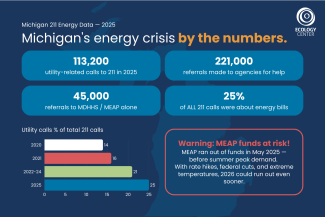
In 2025, 211 callers expressed 113,200 utility related calls, and the agency made 221,000 referrals to 250 agencies including 45,000 referrals to the Michigan Department of Health and Human Services (MDHHS), of which The Michigan Energy Assistance Program (MEAP) is a part. That represents 25% of total calls to 211. The percentage of requests for utility assistance relative to other types of assistance has grown steadily in recent years. In 2020, utility calls represented 14% of total calls. The number climbed to 16% in 2021, and from 2022-2024 it held steady at 21%. According to Planet Detroit, the MEAP program ran out of funds in May, 2025, before the summer season when energy demand is the highest. With the latest rate hikes, cuts to federal programs, increased corporate demand, and extreme temperatures this winter, MEAP funding may run out even sooner in 2026.
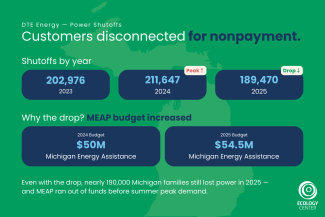
On a positive note, DTE Energy reported to regulators that it disconnected 189,470 customers for nonpayment in 2025, which represents a significant drop from the previous two years. In 2024, DTE shut off power from 211,647 customers, up from 202,976 customers who had their power shut off in 2023. The drop in shutoffs may be due in part to a modest increase in the MEAP budget, from $50 million to $54.5 million. Customers can expect more relief to come. In response to utility rate increases, Michigan lawmakers expanded energy assistance for ratepayers. Public Acts 168 and 169 of 2024 overhaul the Low‑Income Energy Assistance Fund (LIEAF) by removing the old statewide cap, which gradually grows the pot of money available to help households with energy bills. Public Acts 170 and 198 of 2024 and Senate Bills 353, 880, and 881 (signed December 2024), require utilities to participate in either MEAP or an equivalent assistance program, increase total MEAP funding to $100 Million by 2028, and expand income eligibility to 60% of State Median Income. [View more information about the bills here.] Together, these laws will bring relief to hundreds of thousands of Michiganders.
Increases to state-level assistance are timed to ramp up just as Republicans decimated the Low Income Home Energy Assistance Program (LIHEAP,) cutting funding by 74% and terminating all staff on April 1, 2025. The repeal of key federal clean-energy tax credits will make renewable energy projects more expensive, leading to higher wholesale power costs which will get passed onto consumers. Instead of holding DTE and Consumers Energy to account for rate increases and unjustified caps on renewable energy, Republicans are introducing legislation that gives the utilities exactly what they want. As a result, Energy Innovation forecasts that electricity rates in Michigan could rise by 8-15% by 2035. These increases threaten to wipe out the benefit of state-level utility assistance expansions.
The Misinformation Campaign: Blaming Clean Energy for Higher Bills
Most energy rate hikes are used to pay for grid upgrades, yet service only gets worse. Michigan utilities took an average of 12 hours to restore power in 2023, the longest in the U.S. and more than twice the restoration time of neighboring states like Ohio and Indiana, according to Citizens Utility Board of Michigan’s 2025 Utility Performance Report. Power outages in Michigan increased 79% between 2011 and 2021 compared with the previous decade. DTE-linked entities Michigan Energy Promise and Michigan Energy First blame residential solar users for passing costly grid repairs onto low-income rate payers, but this could not be further from the truth. Home solar systems reduce pressure on the grid by shifting excess power to neighboring users rather than sending it back to power stations on utility distribution systems. Locally generated power frees up grid capacity for other users. This extra capacity will be critical to sustaining supply as demand grows. Renewable energy is more resilient in winter storms like those seen in Texas in 2021 when extreme cold and ice froze natural gas wellheads and compressor stations, causing extended blackouts for nearly five million Texans.
What is Driving Higher Costs?
Michigan lawmakers passed a law in 2024 exempting large data centers from the state’s sales and use tax. The projects are required to have a budget of at least $250 million to qualify, but only need to create 30 permanent jobs paying 150% of the local median wage. According to MLive, at least 16 sites in ten counties in the Lower Peninsula have active or proposed data center and cloud computing projects. Oracle, in partnership with OpenAI and Related Digital, is developing a $7 billion, 1.4-gigawatt AI data center campus in Saline Township, equivalent to the power drawn by more than a million homes. This project alone will increase DTE’s system-wide demand by 25%. The University of Michigan in partnership with Los Alamos is also slated to develop a $1.2 Billion data center in Ypsilanti Township, drawing an estimated 110 megawatts of power, and residents will vote on a ballot initiative in Augusta Charter Township to decide on a rezoning proposition to clear the way for a $1 Billion data center project.
The proposed data centers would add enormous new electricity demand to Michigan’s grid. The Saline Township project alone is expected to draw about 1,400 megawatts — roughly a quarter of DTE’s current load — and the Ypsilanti and Augusta Township projects would add still more. That surge in demand could put upward pressure on rates and grid reliability if utilities are allowed to shift upgrade costs onto ordinary customers. The Michigan Public Service Commission says it will prevent that and has imposed safeguards requiring large new customers to cover the costs they impose on the system, but critics — including Attorney General Dana Nessel and consumer advocates — argue those protections are still untested and may not fully shield ratepayers.
At the same time, the explosive growth of AI and data infrastructure is reshaping global energy competition. One reason China currently holds a strategic advantage in the AI race is its ability to rapidly bring massive amounts of new power online — much of it from cheap wind and solar. If Michigan and the United States want to remain competitive, expanding affordable clean energy will be essential not only to power AI data centers, but also to support the onshoring of American manufacturing, including electric vehicles, batteries, and other clean-energy technologies.
What Actually Lowers Bills:
- Home weatherization and energy efficiency
- Community solar and shared solar models
- Regulatory oversight to limit what utilities can pass on to consumers
- Holding utilities accountable for outages and infrastructure failures
Conclusion
Michigan’s energy crisis is not inevitable. Clean energy — paired with efficiency, weatherization, and strong regulatory oversight — lowers long-term costs and makes the grid more resilient, especially during extreme weather. Ratepayers should have the right to choose how their power is generated, to produce energy locally, and to share in the savings when demand is reduced.
Rather than rein in new corporate demand and prevent utilities from continually hiking up utility rates in order to pay for the infrastructure to support it, the state is increasing MEAP monthly surcharges for all ratepayers to subsidize those people who can’t afford to pay. Meanwhile, the long-term economic benefits of energy-hungry data centers are minimal compared with the clean energy technology and electric vehicle manufacturing projects Michigan has already lost to tariffs and rolled-back incentives. The choice facing lawmakers is simple: protect households from rising bills and blackouts — or continue letting utilities write their own ticket.