

By Trilby MacDonald, Ecology Center Writer
“Plants exist on the thin margin where sunlight and matter meet. They convert light into food, forging the living world from thin air and photons.”
— Zoë Schlanger, The Light Eaters
The sun’s limitless energy has fueled life on Earth since the beginning. For thousands of years, humans have searched for ways to harness that energy. Today, technology has advanced enough that, when conditions are right, the average home can generate nearly all of its energy needs from rooftop solar. Households could save tens of thousands of dollars on electricity bills over the life of their systems.
In Michigan, most solar arrays still appear on middle- and upper-income homes — people who can afford the upfront costs that lead to long-term savings. But residents in Southeast Michigan are proving that solar power isn’t just for wealthy homeowners in sun-soaked states. It’s a practical path to lower bills, fewer blackouts, and greater energy independence for everyone. Through creative financing, community networks, and determination, Michiganders are showing that solar can be both practical and affordable for the average person.
Michigan imports around 85% of the fuels used to produce its electricity — including coal, natural gas, and uranium. Only about 15-18% of in-state generation comes from local resources like wind, solar, or hydro. “We spend billions every year sending our energy dollars out of state,” says Missy Stults, Ann Arbor’s Director of Sustainability. “Local solar keeps money here and makes us more resilient.”
Meet Southeast Michigan’s Solar Pioneers
Solar panels are not a new idea. Charles Fritts installed the first ones on a New York City rooftop in 1884, though his panels only converted about 2% of sunlight into energy — barely enough to power a toaster. Today’s solar cells can reach up to 23% efficiency and work well even in cloudy states like Michigan. Despite these advances, only about 1% of Michigan homes have solar panels. So why aren’t more households getting their power from the sun?
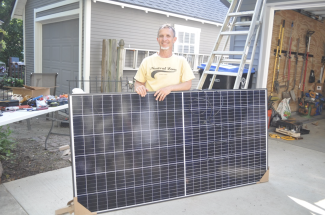
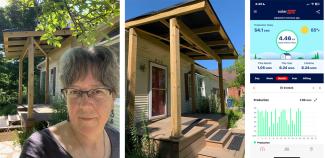
Only about 25% of homes get enough direct sunlight to make it worthwhile, and upfront costs can be significant. For Ann Arbor’s Brigit Macomber, overcoming these hurdles meant thinking outside the box. Their shaded Cape Cod roof and tricky gables made it impossible to put panels on their rooftop panels. So they put panels on their sunny garage and worked with a local contractor to build a small “solar porch” over their front walkway topped with solar panels. Their limited energy use meant that investing in a backup battery didn’t make financial sense, so they plan to purchase an EV when vehicle batteries can serve as home backup power. “An electric vehicle has this huge battery, even more powerful than most of these house backup batteries,” they explain. Macomber’s creative solar solution is working out well. “I’ve been meaning to do this for a really long time.”
Steve Yalisove, in Webster Township, experiences frequent power outages in his neighborhood. He considered investing in a backup generator — until he saw the price tag. “The quote came in at $18,000 for a generator that I’m going to use like three days a year, and it doesn’t add value to the house.” Instead, he looked into solar. With the federal tax rebate, the price of solar panels and a 13kW backup battery came to $19,000. “According to Zillow, solar adds up to 3% value to the house,” and he points out that the system should pay for itself in less than a decade and save his family $2,000 a year on energy. “Solar panels pay homeowners twice — once on the monthly savings, and again when they sell their house,” he says.
The downside is that Yalisove’s panels don’t generate enough electricity for him to run his appliances and air conditioner as much as he’d like.
A typical home solar system can run between $10,000 and $15,000, with a backup battery adding another $10,000. Even after rebates, upfront costs remain out of reach for households on a tight budget.
The median household income in Ypsilanti is just over half that of Ann Arbor’s, yet the city outranks Ann Arbor in solar adoption. In fact, Ypsilanti ranks 37th in the nation for solar generation per resident. Dave Strenski’s grassroots group, SolarYpsi, is a big part of the reason why. “We’re kind of a loose group of volunteers that’ve been around for 20 years,” says Strenski. “And over that time, we’ve gotten Ypsi from zero percent solar to 1.7 megawatts of solar and brought in maybe a half million dollars worth of funding and grants.”
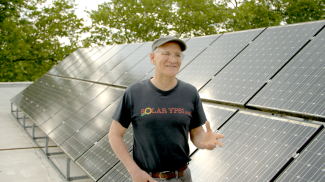
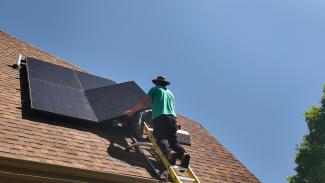
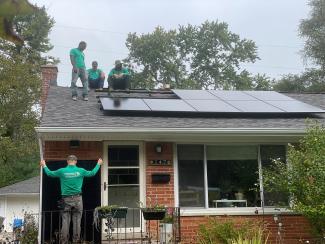
SolarYpsi has made residential solar accessible by using volunteer labor and raising funds to help cover equipment costs. The group has installed solar panels free of charge on 154 sites in Ypsilanti. While the city can’t afford a full-scale municipal program, it does offer a $2,000 rebate for residents installing solar. Between the free installation and local and federal rebates, most residents can pay off their panels in about six years. “We need to bring solar power to the people that need it the most — low-income people,” says Strenski.

Watch Our Video Interview with Dave Strenski of SolarYpsi
Overcoming Barriers
Homeowners in Michigan cities that lack public and private support for solar adoption still have options. Michigan Saves is a nonprofit “green bank” that offers loans up to $50,000 for solar, batteries, and energy efficiency upgrades. These loans are designed to be repaid through cost savings, and participating contractors must meet quality standards to protect homeowners.
Power Purchase Agreements (PPAs) are another option, where a solar company installs and owns the panels and the homeowner buys the electricity at a set rate, often below utility prices. However, PPAs aren’t available in all areas and can be complicated by Michigan’s utility regulations.
Group-buy programs like Solarize Ann Arbor also help make solar more affordable. By organizing neighbors to go solar together, these programs negotiate bulk discounts, lowering installation costs for everyone involved.
Even with financing in place, technical barriers can still prevent residents from getting solar. Roof direction, tree cover, and local permitting rules can derail even well-planned projects. Dave Friedrichs, owner of Homeland Solar in Ann Arbor, has installed solar on over 1,000 rooftops across Washtenaw County and notes that suitable sites are more limited than many homeowners realize: “Only about twenty-five percent are oriented the correct way or have the right dimensions — roof or ground — to allow them to have solar.”
Solar alone also can’t always cover a home’s full energy use, especially in Michigan’s dark winters or in homes with high energy needs. “It’s good to figure out your annual usage,” advises Friedrichs. “It’s common to use 8,000 to 10,000 kilowatt hours, even 12,000. But a single electric car that’s driven daily might use 4,000 or 5,000 a year for itself.”
EVs as a home power source
After Steve Yalisove installed his home solar system, he bought a 2025 Hyundai IONIQ 5 electric vehicle. His energy usage immediately jumped 50%. He plans to add additional panels to his roof that will increase his solar power from 10,000 kilowatt hours (kW) to 15,000 kW a year, “with some losses because of the fact that DTE will not give us full credit for power exported to them,” he explains. But even if it’s not quite enough to recharge his EV, he’ll still save money: “Recharging from the grid overnight translates to about a dollar a gallon of gas. I’m okay with that.”
But Yalisove is frustrated by the fact that his EV’s 80kW battery could easily meet all his home power needs during a blackout if only he could find a way to connect to it. The U-M engineering professor can’t resist a tech challenge and will attempt a workaround.
First, he figures he’ll need to buy a Vehicle to Load Adapter for about $300. Then comes the technical part. He emails, “I believe I can have a transfer electrical box installed with the critical low power circuits I need to run the essential things in my house. Then I can connect a reverse feed circuit breaker from my vehicle to load adapter to run the low power circuits (less than 1.4kW) if I end up in a situation where I run out of power from my Powerwall.”
This method requires a licensed electrician to perform the work. It can also be impacted by local regulations. But one thing is for sure: Future generations of EVs will be equipped to easily serve as backup home batteries. It’s one more reason why going electric makes sense.
State Policies Drive Local Innovation
In 2018, Michigan replaced its traditional net metering system with a Distributed Generation Tariff. Under this system, homeowners earn credits for surplus solar energy sent back to the grid — but at rates lower than the full retail price, typically around 7 to 10 cents per kilowatt-hour compared to retail rates of about 16 to 18 cents. Residents can still make money, but solar advocates see this as a step backwards.
A promising new effort is Solar for All, a federal program through which Michigan is receiving $156 million to help low-income households access solar power, either through home installations or participation in community solar projects. Currently in its pilot stage, the full program is expected to launch in 2026.
Ann Arbor offers a variety of ways to make solar more accessible. Beyond Solarize, residents can participate in the city’s innovative Sustainable Energy Utility (SEU). The SEU is an opt-in, supplemental service that works alongside DTE’s main grid, allowing residents to install city-owned solar and pay only for the energy they use. Residents who don’t have the right conditions for solar can also join future microgrids that let neighbors share power.
Under Michigan law, private companies are generally prohibited from sharing solar power across property lines. But Ann Arbor established the SEU through local authority and overwhelming voter approval, making it exempt from state restrictions. This allows the SEU to offer community solar and neighborhood microgrids that share clean energy within city limits. As Missy Stults, Ann Arbor’s Director of Sustainability, explains, “No single part of this is unique, but together, it’s transformative,” describing how the SEU combines proven ideas into a new model for community-driven energy. The SEU includes programs for businesses, nonprofits, and multifamily housing, ensuring the benefits of clean energy reach all parts of the community.
From DIY innovators and city-led programs to private financing and new government incentives, Michiganders are proving that solar power works — even in a state with cloudy skies and regulatory hurdles. The bad news is that the 30% federal rebate was canceled under the GOP's "Big Beautiful Bill," and homeowners only have until December 31, 2025 to claim it. But even without the rebate, homeowners can still improve reliability and save thousands on their energy bills by going solar.
There’s never been a better time to explore solar energy. Find out how you can harness the cheapest source of electricity — the sun!