

So why aren’t more of them being filled?
By Trilby MacDonald, Ecology Center Writer
Over many decades, Michigan nurtured talent, invested in R&D, and built the advanced manufacturing capabilities that launched the global auto industry. Today, the state is winding the mainsprings of its industrial legacy to spring into high-growth industries, such as renewable energy, semiconductors, autonomous driving, and electric vehicles. Strategic investments in workforce development and public-private partnerships are helping strong companies reach new heights.
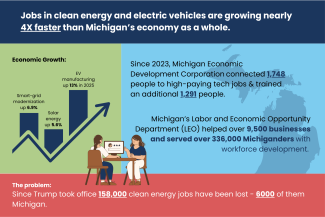
These investments are paying off. According to Fast Company, jobs in clean energy and electric vehicles are growing nearly four times faster than the state’s economy as a whole — with employment in EV manufacturing up 13% in 2025, smart-grid modernization up 6.9%, and solar energy up 5.6%. Michigan is home to more engineers per capita than anywhere else in the U.S., and is in third place for semiconductor jobs.
Why are Michigan’s labor force and population declining?
Many of these good jobs are going unfilled because we don’t have enough qualified workers. Meanwhile, workers and young people move to other states in search of jobs they can fill. The policy imperative is clear: prepare our workforce to fill open jobs or lose opportunity to other states. The state is not sitting on its heels. Key agencies have matched Inflation Reduction Act and Infrastructure Investment and Jobs Act funding to upskill its workforce through over a dozen programs.
In the first year of the Statewide Workforce Plan, launched in early 2024, The Economic Development Corporation’s Talent Action Team connected 1,748 people directly to good-paying high-tech roles and trained an additional 1,291 workers. Labor and Economic Development (LEO) served more than 9,500 businesses across the state, helping them recruit talent and increase their competitiveness, and served more than 336,000 Michiganders with workforce development support, the most of any state in the Midwest. Further, millages have been passed in many areas to educate K-12 students in careers in technical education, including Washtenaw County.
How did we fall behind?
The energy crisis of the 1970s spurred massive federal investment in the research and development of alternative energy, including solar, wind, and natural gas. It led to the creation of the Department of Energy and a raft of tax incentives and supportive policies that allowed the sector to flourish. President Jimmy Carter even put solar panels on the roof of the White House. America was leading the world in the development of green technologies our scientists invented, including solar panels and electric vehicles.
All of that momentum came to an end when Ronald Reagan entered the Oval Office after a successful campaign paid for in large part by the fossil fuel industry. In the name of limited government and free market capitalism, he dismantled the policies and programs that nurtured the growing industries, including the symbolic removal of President Carter’s solar panels from the White House roof. Renewable energy and EV development came to a grinding halt. But where Reagan-era conservatives saw costly government programs, countries like Germany and China saw economic opportunity, and now our industries are eating their dust.
We are experiencing the same cycle of investment, disinvestment, and missed opportunity again.
The Biden Administration made the largest investment in renewable energy and technology innovation in the nation’s history with the Inflation Reduction Act, investing hundreds of billions of dollars to jump start the industry. It gave rise to new companies, expansions of existing industries, and major infrastructure projects across all 50 states.
And now the Trump Administration is attempting to reverse that progress. Not only was the U.S. absent from the UN Climate Change Conference in November, we are seeing a freeze in new R&D funding for clean energy technology and the illegal clawback of billions in federal dollars approved by Congress for climate-related projects. Tariffs on products connected with renewable energy and electric vehicles create more economic uncertainty, further discouraging businesses from pursuing clean energy and technology projects. According to Climate Power, 158,000 clean energy jobs have been lost across the U.S. since Trump took office for his second term, 6,000 of them in Michigan.
Not surprisingly, the oil and gas industries were among Trump’s top campaign contributors.
States like Michigan are running hard to stay in the lead of the clean energy transition. Part of our strategy to stay competitive are strong cross-sectoral collaborations between state, corporate, and nonprofit partners to create the workforce we need to keep industries and talent here. We need to keep this momentum going so that young people will see their future in Michigan.
Disconnect between workers and jobs
Roughly 26,000 new clean energy and clean vehicle jobs have been created since 2022, part of over 127,000 in the state, according to The Clean Jobs Midwest Report. This growth is partly the result of major federal policies like the 2022 IRA that incentivized private sector initiatives and a raft of supportive state legislation. Michigan lawmakers created the 2022 MI Healthy Climate Plan, which built a policy framework to pursue a clean energy transition, and the 2023 clean energy legislation including workforce development. However, the number of new jobs created falls short of the Whitmer administration’s projections—and it’s nowhere near enough to offset Michigan’s shrinking labor force, which lost 45,000 workers between March and September of 2025, according to the Michigan Department of Technology, Management & Budget.
The gap between projected and actual job growth is due to a few factors, including automation, project cancellations caused by tariffs and unfavorable policies, and lack of qualified candidates.
With so many people out of work, it’s hard to believe that 88% percent of clean energy employers in Michigan report at least some difficulty hiring workers, according to a 2023 report by Clean Jobs Midwest. Michigan is facing shortages in several types of jobs, including EV manufacturing and maintenance technicians, battery engineers, energy efficiency specialists, solar and wind power installers, HVAC and building automation techs, and skilled trades tied to clean infrastructure. The Michigan Growth Office and Make Michigan Home program are working to attract people with those skills to live in the state. But rather than import qualified workers, wouldn’t it be better to train local workers for these positions?
Closing the employment gap: when opportunity meets preparation
The cost to replace an employee can range from half to twice the position’s annual salary, according to Gallup. As industries change to meet shifting market demands, corporations that invest in their talent pool save money, have higher retention, and are more nimble in a shifting market. Transitioning a workforce requires an upfront investment, and that’s where state leadership is key. Government agencies including the Michigan Infrastructure Office, Office of Labor and Economic Development, and Environment, Great Lakes, and Energy (EGLE) are partnering with corporations, nonprofits, and higher education to deliver apprenticeships and training programs that allow the workers of today to qualify for jobs in construction, energy efficiency, and cutting edge industries that would otherwise go to workers outside of the state.
The private, nonprofit, and government sectors each bring unique tools and expertise to close the employment gap:
Private Sector
- Innovates to meet emerging market demands
- Develops curricula and technical training
- Offers on-the-job training and career pathways
- Provides paid apprenticeships
Community-Based Organizations, Labor Unions & Higher Education
- Identify and recruit prospective participants
- Provide training and credentialing
- Offer wraparound services (transportation vouchers, stipends, childcare) that make training accessible
- Offer coaching and case management to help workers navigate barriers
- Track participant progress and outcomes to refine programs
Government Agencies
- Establish policies and regulatory frameworks
- Provide funding for workforce development
- Incentivise collaboration by high-road companies, including mandates and contracting preferences
- Build connections between sectors to support coordinated transitions
- Align training investments with statewide climate, energy, and economic transition goals
The Continuous Partner Collaboration Cycle model is one method to coordinate the public, private, and nonprofit sectors by fostering just transitions through social dialogue and refinement of training programs to keep up with advancements in green technologies and labor market conditions. The Midwest Air Source Heat Pump Collaborative uses the CPCC model, aligning training with market demands and policy goals, preparing workers for emerging green tech and energy sectors through shared tools, data, and feedback loops.
Predictive workforce planning can better align training programs with climate action plans by using data to forecast the supply and demand of skills and workers needed for emerging green sectors. Tracking labor markets and creating feedback loops between employers, educational institutions, and training providers allows collaborators to adjust workforce development strategies proactively.
Germany’s dual system is an example of a national strategy that runs apprenticeships and vocational training programs within a strong public, private, union partnership dating back to the Middle Ages. Companies have found that the best way to recruit highly skilled personnel that fit their cultures is to provide apprenticeships and on the job training. Meanwhile, state-sponsored vocational schools provide the classroom education and theoretical framework to support hands-on learning. The system works so well that 50% of high school graduates that don’t go to college enter the trades through this program.
Conclusion
Like the auto revolution a century ago, Michigan can lead the clean energy transition—if it invests in its people. According to the U.S. Department of Energy, Michigan ranks #1 in the U.S. for new clean energy projects and #1 in advanced manufacturing job growth. We can’t let companies continue to import workers to fill high-quality jobs, or worse, jump to other states where skilled workers are waiting. We have the infrastructure, production chains, and culture to lead the renewable energy and green technology sectors. GoPro Talent Fund Michigan, the Energy Workforce Development Consortium, the EV Jobs Academy, and EV Workforce Hub are examples of public/private collaborations to upskill Michigan workers to take the high skill, high wage jobs the state has worked so hard to attract.