

By Trilby MacDonald, Ecology Center Writer
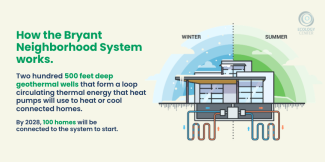
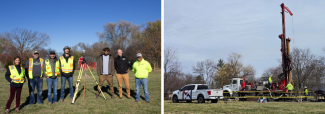
On a cool September morning in 2025, the Ann Arbor Office of Sustainability (OSI) invited local residents to gather at the Bryant Community Center to feel the ground shake. A drilling rig pushed a geothermal pipe 500 feet into the earth — the first of roughly 200 wells that will eventually heat and cool homes across the neighborhood as part of what city officials hope will become the nation’s first city-owned, neighborhood-scale networked geothermal system of its kind, and the country’s first fully carbon-neutral retrofitted neighborhood. For OSI Director Missy Stults, transparent communications have been vital to the project’s success. “We’re trying to be really candid about the disruption this will cause so that people trust the process as it unfolds.”
The demonstration offered a preview of a project that could reshape how cities across America deliver energy. Unlike places like Boise, Idaho, where a hydrothermal reservoir close to the surface has supplied naturally heated water to warm much of the city for more than 130 years, Ann Arbor isn’t blessed with any special geological advantage. Its underground temperature holds steady at about 55 degrees, which is the average for most of the country. That is exactly what makes Ann Arbor such a compelling test case: if district-scale geothermal can work there, it could work in almost any city with the political will and public investment to build it.
In 2022, Ann Arbor received technical assistance through the U.S. Department of Energy (DOE) Communities LEAP program to design the Bryant neighborhood geothermal system. Bryant was selected as the test case because it is a working-class neighborhood of single-family households that experience high energy cost burdens. The homes were built in the 1970s and have poor energy efficiency, frequent flooding, and mold and other health and safety issues. In October, 2025, the City won an $11 million grant from the DOE to build the geothermal system designed for Bryant, which includes a wellfield capable of heating and cooling the Bryant Elementary School, Community Center, and all 262 homes in the Bryant neighborhood.
Ann Arbor is matching the DOE investment with funds to connect neighborhood buildings to the system and making home energy efficiency upgrades. The first 100 homes will be connected to geothermal by 2028, and additional homes will be connected as funds become available. The Bryant Elementary School was originally part of the project, but was dropped due to the need for expensive mechanical upgrades to the school building. When those upgrades are in place, the school can be served by the same geothermal system used by the homes and community center in the Bryant neighborhood.
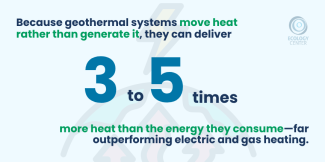
Energy use in buildings accounts for roughly 70 percent of Ann Arbor's carbon footprint, but state law prevents the City from requiring developers to adopt renewable energy technologies. That leaves cities with a challenge: how do you encourage investment in systems that cost more upfront but save money over time? Geothermal is one example. Because it moves heat rather than generating it, a geothermal system can deliver three to five times more heat than the electricity it consumes. Yet, many developers still choose less expensive conventional systems because they are focused on minimizing construction costs. Ann Arbor's strategy is to reduce that barrier by investing in shared geothermal infrastructure, making it easier and more affordable for residents and businesses to participate.
The Bryant neighborhood geothermal system is part of Ann Arbor’s Sustainable Energy Utility (SEU), a voter-approved initiative that allows the City to deliver independently owned and operated renewable energy to residents beyond what the utility company DTE provides. The SEU is the nation’s first opt-in, city-owned utility that runs parallel to an investor-owned utility company. As a utility provider, Ann Arbor can devise creative strategies for deploying renewable energy across the city as part of its plan to reach carbon neutrality by 2030. Though the City is unlikely to achieve full carbon neutrality by the self-imposed deadline, the goal has galvanized city leaders to take on systemic changes that could someday make carbon neutrality possible.
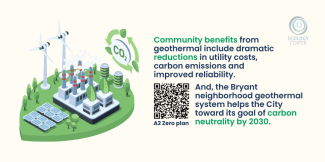
Networked geothermal in a moderate-income residential neighborhood is the kind of systems-level solution that is only possible when city leadership and residents share a willingness to invest in bold experiments. The potential payout is huge: dramatic reductions in utility costs and carbon emissions, and improved reliability in a city plagued by frequent power outages. If successful, cities across the country may follow suit. But the substantial upfront costs may be a barrier to large-scale implementation.
Many of the Bryant neighborhood homes require substantial investments in energy efficiency as well as health and safety measures to ensure that the geothermal system will function at its best. Further, lopsided demand may overtax the system. In a strictly residential neighborhood, peak demand is after business hours when most people are at home. If everyone is heating and cooling at the same time, there is less energy to go around. A neighborhood with a mix of homes, businesses, and public buildings is better suited to networked geothermal because it distributes energy usage more evenly throughout the day.
OSI is drilling experimental wells across the City to see where networked geothermal might be feasible, including in the mixed-use Kerrytown neighborhood. “We need to run these models. We need to actually understand and then optimize,” says Stults, who cautions that “geothermal is not going to work everywhere in the city.”
Creating innovative alternatives to our costly and unreliable energy system requires patience and willingness to invest in breakthrough technologies that carry some risk. The federal government has a long history of supporting innovation and could be a strong partner in this work. While federal policy is actively working to dismantle solar and wind energy projects in favor of oil and gas, geothermal remains a renewable energy that the administration may support. Technological advances in oil and natural gas extraction are proving to be useful in drilling geothermal wells. OSI will continue to apply for public dollars, but the level of investment necessary to deliver resilient, clean, inexpensive geothermal heating and cooling will require Ann Arbor residents to share the costs. The good news is that once the pipes are in the ground, geothermal systems require little maintenance over their 50-100-year life cycle, and they reduce energy bills between 25% and 50%.
A citywide geothermal system would cost billions and take decades to implement, but is still far more cost-effective than creating separate geothermal systems for each structure. Stults explains that financing this investment could follow the model used by utilities when paying for grid upgrades. “We pay for our utilities by taking out capital dollars, and you pay back that capital debt through rates,” she says, explaining that paying for geothermal energy through the SEU “is the exact same thing.”
Geothermal makes so much sense that Ann Arbor Public Schools and the University of Michigan are also in on the action. But there aren’t enough geothermal installation companies to meet demand. Closing that gap remains a sticky problem that requires out-of-the-box thinking. “We're thinking about all kinds of solutions,” says Stults. “Do we buy a rig for Ann Arbor? Do we recruit a business to come set up in Ann Arbor to meet all of our demand and the county's demand? Do we sequence our projects in a certain way? Do we drill central wells?” Whichever solution the City settles on will expedite the clean energy transition and lower costs for all local institutions that are striving towards net neutrality.
Jason Bing is the Director of Capital Programs for AAPS and has been overseeing geothermal projects for the school district. From managing the complex budgeting processes and competing for the few available drilling rigs, to overseeing construction and fielding complaints about the noise, it’s a big job. Bing is excited about the potential savings of geothermal, but won’t know dollar amounts until the systems are fully operational. “By converting to an all-electric solution, which geothermal allows, and then developing a plan to offset the remaining energy usage with clean energy assets, we can potentially significantly reduce our operating costs with a reduction in utility costs,” he explains. AAPS already generates 5.8 MW of solar — more than any other school district in the state — and may add even more in the future.
Even with the high up-front costs, Bing is optimistic that AAPS will save money in the long run. Utility rates are rising swiftly, and “it’s just going to get worse with all of our data center investments and the heavy investment in electrical infrastructure right now,” Bing says.
Of all the strategies the City is using to generate energy and improve efficiency, geothermal has the highest up-front costs. But it is also far and away the most resilient and cheapest to maintain. Getting heat from heat is much more efficient than from electricity or fossil fuels, and the technology is relatively simple. The City is in the pilot stage of various geothermal projects to see which strategies work best. “We're doing this in lots of different ways,” says Stults. “We're getting all of this wonderful data about thermal efficiency, cost per unit, when it makes sense and when it doesn't make sense,” she says, adding that this is an “exciting moment” in the future of energy for the city. While older generations may never see the full benefits of today’s geothermal investments, they are bequeathing their descendants a sustainable, reliable, and inexpensive energy future. As the proverb goes, “A society grows great when old people plant trees in whose shade they know they shall never sit.”