

By Trilby MacDonald, Ecology Center Writer
Michigan leads the nation in clean energy job growth. This is a ray of hope in a rust belt state hard hit by auto industry layoffs. These high-paying jobs were made possible by groundbreaking investments during the Biden administration, most notably through the Inflation Reduction Act (IRA) and Bipartisan Infrastructure Law. In fact, Michigan has received more federal dollars for clean energy projects than any other state. Private, state and local government investments soon followed, with businesses pouring billions into new projects.
In 2023, Michigan lawmakers answered this federal investment with landmark clean energy legislation known as the Clean Energy & Jobs Act, establishing a target of 100% clean energy by 2040, and 60% renewable energy by 2035. In passing this historic legislation, the Governor and legislature intentionally sought to maximize and leverage the once-in-a-lifetime opportunity made possible by the federal government’s clean energy investments.
But the Trump administration’s climate funding freeze and tariffs policy, followed by the OBBBA budget bill in Congress, have killed projects and created financial uncertainty. Polls clearly show that Michiganders from both parties want energy independence, emissions reduction, and economic revitalization. To break the political deadlock that now stands in the way, it’s vital to set the record straight about the costs and benefits of clean energy.
Government investment pays for itself
Many of America’s best inventions were made possible by public money. Without it, Michigan’s auto industry would not have become the envy of the world. Clean energy and low-carbon innovation is no different--from solar cells and wind power technology to electric vehicles and biofuels, government investment has powered the research and development that has allowed these industries to lead the global marketplace. Our robust supply chain, natural resources, top research universities, and skilled workforce make Michigan an ideal place to build on that legacy. That’s why the Inflation Reduction Act (IRA) and Bipartisan Infrastructure Law invested $28 billion in Michigan’s clean energy sector. Michigan’s Clean Energy & Jobs Act builds on that investment with state-level incentives and regulatory reforms that promote renewable energy development and require utilities to invest more heavily in renewable and other clean energy technologies.
The private sector took note, investing an additional $27.85 billion in clean energy projects, according to Climate Power. New development includes large-scale solar farms in rural counties, EV battery plants in Mid-Michigan, and innovation hubs in Metro Detroit and Ann Arbor. While not all clean energy projects make it to the finish line, and some are now threatened, projects like these have already generated 26,000 good jobs in the state.
But the economic benefits don’t end there. In 2023, over 117,000 Michigan households received $134 million in energy tax credits through the IRA, saving an average of $1,143 per household. That’s money that stays in the economy and creates high paying jobs in construction, retrofitting, and solar installation. Tax credits for home energy efficiency and would have remained in place until 2030, credits for electric vehicles until 2032, and credits for installing rooftop solar panels and home battery storage until 2034. But the GOP’s Big Beautiful Bill cancelled all of that. If you want to get a federal tax credit for buying an EV, you have to act before the end of September; for installing solar and home energy efficiency upgrades, before December 31, 2025.
Luckily, Michigan Home Energy Rebates (MiHER) for efficiency and electrification upgrades will remain in place. Homeowners can get up to $20,000 for efficiency upgrades like insulation, air sealing, and HVAC improvements. They can receive an additional $14,000 for efficient electric appliances, wiring upgrades, and heat pumps.
Cleaner Air, Healthier Communities
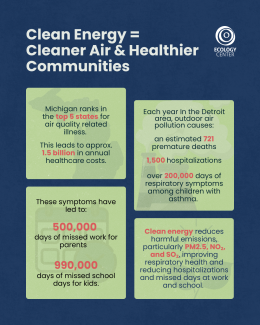
The human costs of air pollution never appear on corporate balance sheets. According to the American Lung Association, Michigan ranks among the worst states for air-quality-related illness, much of it due to dirty energy production. Research done by University of Michigan School of Public Health reveals that in the Detroit area, outdoor air pollution is responsible for an estimated 721 premature deaths, 1,500 hospitalizations, and over 200,000 days with respiratory symptoms among children with asthma each year. These symptoms have led to 500,000 days of missed work and more than 990,000 days of missed school. That translates to $7.3 Billion in lost productivity and learning that Detroiters will never get back. Cleaner energy and vehicles would greatly help to reduce these harmful emissions, particularly for PM2.5, NO₂, and SO₂, improving respiratory health and reducing hospitalizations and missed days at work and school.
Reliability and Resilience
Clean energy is proving to be not only better for our health and our wallets, but also more reliable than fossil fuels. As our electric grid faces swiftly growing demand from AI, higher temperatures, and harsh winter storms, new research shows that a cleaner system can actually perform better. Studies by the Congressional Research Service (CRS) and Energy Innovation confirm that the U.S. can reach up to 80% clean electricity without sacrificing grid stability.
In Michigan, power outages have increased 78% over the last two decades, and utilities are asking for an average of 12% in rate hikes to pay for the next round of grid improvements. Surplus energy generated by solar panels does not rely on utility companies’ long distance transmission systems. Instead, it largely travels on the local distribution system to the nearest building, relieving strain on the grid and reducing the need for expensive upgrades. And while fossil fuel advocates often argue for natural gas as a more reliable fuel source, those systems have repeatedly failed in cold temperatures. During Winter Storm Elliott in 2022, a staggering 86% of outages were caused by coal and gas system breakdowns. Just a year earlier, Winter Storm Uri revealed the same vulnerabilities in Texas, where gas shortages and frozen plants prolonged statewide blackouts by days.
Clean energy sources such as solar and wind are proving to be more resilient than fossil fuels in times of stress. When paired with battery storage, solar power provides reliable energy independent of the grid. It’s also insulated from global price shocks and supply chain disruptions that make fossil fuels so volatile. In a time when energy independence has become a catchphrase of advocates for the fossil fuel industry, solar power is proving to be the cheapest, safest, and most reliable way to achieve it.
Federal Funding Freeze Leaves Michigan in the Cold
In January 2025, the federal Office of Management and Budget ordered federal agencies to halt all funding for climate-related projects, despite questionable authority to withhold funds approved by Congress. Court orders have sought and sometimes been successful in resuming the flow of these authorized funds, many projects have been canceled while these cases work their way through the legal system.
A Michigan Public report found nearly $21 billion worth of clean energy tax credits, upgrades, manufacturing, and loan guarantees were cancelled because of decisions made by the Trump administration. As a result, many companies are pausing hiring, canceling builds, and re-evaluating Michigan as a place to do business.
California-based chip manufacturer SanDisc recently announced that it is pulling out of a planned $55 billion facility in Genesee County that could have created up to 10,000 jobs in the area. The company cited economic uncertainty, federal policy shifts, and tariffs as the major factors. In February, Nel Hydrogen’s planned electrolyzer manufacturing facility in Plymouth—expected to bring $400 million and create over 500 jobs—was put on hold. The company cited IRA tax credit uncertainty as a major concern.
Navigating Local Concerns While Advancing Statewide Energy Goals
Opposition from townships and agricultural groups concerned about property rights and local land use would also impede Michigan’s progress in reaching its clean energy goals. The Clean Energy & Jobs Act gave the Michigan Public Service Commission (MPSC) the authority to override local ordinances prohibiting solar and wind farms, and to take control of the siting process if local governments exceed statewide guidelines. In 2025, several bills were introduced to repeal or roll back the state’s clean energy siting law, but those have so far been unsuccessful.
The Ecology Center has been a leading voice defending Michigan’s 2023 clean energy legislation while advocating for balanced policies that protect both property owners and renewable energy growth. A streamlined siting process is essential to overcoming local barriers that have historically stalled renewable energy development.
By investing in renewables, Michigan is building true energy independence. While Michigan isn’t Nevada, it receives enough free sunlight to power every home and car—if we choose to invest. Doing so won’t just reduce infrastructure and energy costs; it will pay dividends in the form of high-quality jobs. The global solar industry is booming, and foreign companies are racing ahead. Michigan has all the attributes to lead: a strong supply chain, renowned research universities, and a skilled workforce. Yet, according to the U.S. Energy Climate Report, more than four in five clean energy employers struggle to fill open positions.
Homegrown energy sources like solar and wind are abundant, domestic, and stable in both price and reliability. When paired with advanced battery storage, they provide a steady supply of power—and greater resilience to global disruptions.
It’s hard to have a rational debate about an issue as politicized as clean energy. But the facts remain: voters consistently back policies that deliver lower energy bills, better health, more jobs, and national self-relliance. Slashing clean energy programs now would not only undercut economic progress, but also defy the will of voters who want energy independence.
Clean energy has created more than 26,000 jobs in Michigan, including over 10,000 in solar. Federal programs have driven this progress. When governments operate at full potential, they provide the scale and patience to fund breakthroughs in every sector. Nearly every transformative innovation begins with public investment. When government delivers healthier, safer, more prosperous communities, it fulfills its purpose. As global leaders recognize the universal benefits of renewable energy, Michigan can lead the transition and build a future as bright as the sun.