

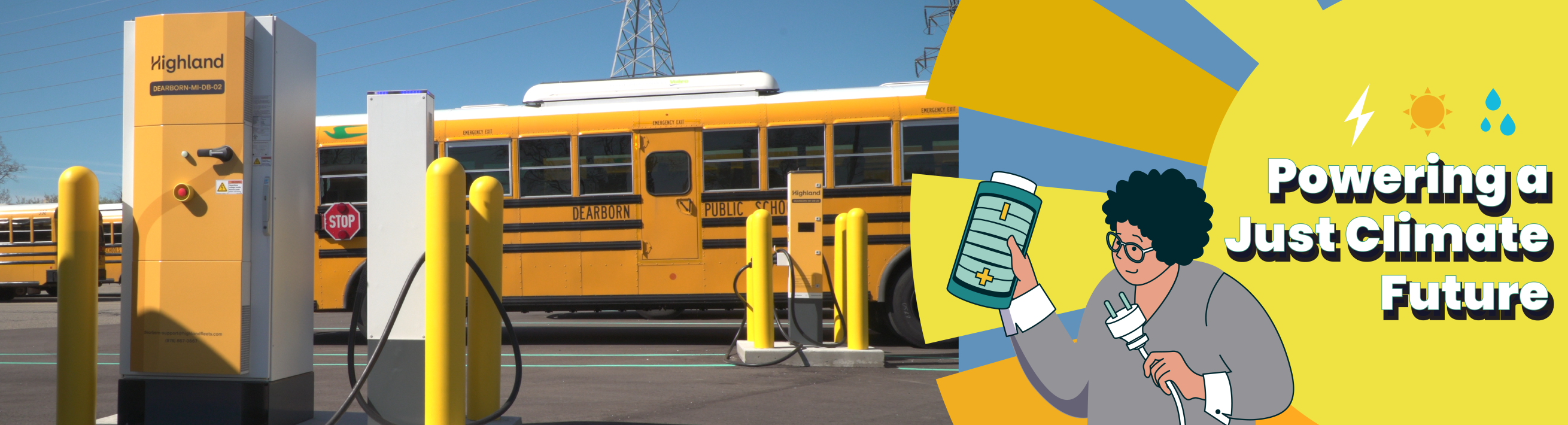
Electric school buses are winning over students and drivers with their surprisingly quiet, clean, and smooth rides
By Trilby MacDonald, Ecology Center Writer
Unlike the popular cartoon series, Michigan’s school buses aren’t equipped to take students through the intestinal tract or into the heart of a volcano. But our fleet of 17,000 buses do take close to a million students to and from school, sports practice, clubs, and field trips each year. A bright yellow school bus rumbling down the road is a happy sight. But the roar of bus engines and the smell of diesel is received with less joy. Wouldn’t it be magical if school buses were quiet and clean?
Miraculously, about 900 of them are, thanks in part to $5 billion in Inflation Reduction Act funding to support states in acquiring zero-emission school buses through the EPA's Clean School Bus Rebate Program. And that number is growing. The Michigan Department of Education has stepped up with its own grant program, the Clean School Bus Energy Grant, and just released a call for proposals to help 23 schools add 87 electric buses, using a combination of state and federal funding. Applications for this final round of funding are due Dec. 18, 2025.
The Ecology Center was a strong supporter of the MI Clean School Bus program, joining a coalition of groups advocating for $125 million to be allocated toward its creation in the state budget. “Not only does the program help to reduce childhood exposure to harmful diesel emissions, but it advances the state’s climate goals while also reducing costs for participating school districts,” said Charles Griffith, climate and energy program director at the Ecology Center. “That’s a win-win-win for kids, the climate, and our schools.”
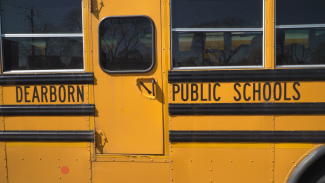
The Dearborn Public School District received $1.2 from the Michigan Department of Education and two EPA Clean Bus Energy grants totaling $7.4 million, allowing it to purchase 18 Blue Bird All American Type D electric-powered buses and 20 charging stations. It was the largest single rollout of electric school buses in Michigan.
“The addition of these 18 electric buses is another example of how our district is leading the way and taking actions that will benefit students and the greater Dearborn community,” comments Dr. Glenn Maleyko, Dearborn Public Schools Superintendent. “There is also a lesson here for our students about the importance of being good stewards of the environment and taking steps to be a role model.”
Dearborn has the third-largest school district in Michigan with over 20,000 students attending 37 schools, all located in residential areas. Over four thousand of these students take the fleet of 76 Blue Bird buses to school and extracurricular activities every day. Transportation is the second largest source of air pollution in the state, and has a direct impact on children’s health. Early exposure to heavy traffic emissions and pollutants from industrialization can cause cognitive delays and result in lower test scores for students.
According to the EPA, Dearborn is one of the more polluted communities in Michigan, with multiple air permit violations and ongoing exposure to particulate matter and chemicals like nitrogen dioxide, sulphur dioxide, and volatile organic compounds. Consequently, asthma rates among Detroit-area youth are nearly twice the Michigan average. The Clean School Bus Rebate Program and Clean Bus Energy Grant target districts like Dearborn where local pollution burdens are higher.
“The Dearborn Public Schools has a history of being one of those districts that likes to try new initiatives,” explains David Mustonen, Director of Communications for the Dearborn Public Schools. The electric buses are a highly visible example of the Dearborn School District’s innovative spirit that has immediate benefits for students. “Another benefit of EV buses is that you don’t have idling diesel buses parked outside of schools as students are entering or exiting the bus,” Mustonen adds. “Any steps we can take to create environmentally friendly conditions around our schools and students is going to be worth exploring.”
Students and drivers have embraced the new buses. Lisa Brook, Transportation Supervisor for Dearborn Public Schools, says that when an electric bus has to be pulled for service, the drivers “really don’t like going back to their diesel buses. We get every day ‘Is my bus back? Is my bus back?’”
“The student reaction is they think it’s so cool,” says Rosanna Hubbard-Schwenke, who has been driving school buses for the Dearborn Public Schools for 27 years. “When they first heard that we were going to get electric buses they were like ‘Miss, When are you going to get one? When are you going to get one? When are you going to get one?’ I was like, okay calm down!”
Hubbard-Schwenke likes the way her electric bus handles and is now breathing easier. “Without the fumes, it’s 100% better. And the noise, it’s barely even there. There isn’t even a little noise, to let the people know that something’s coming down the road!”
“It’s very, very quiet,” says Elias Hall, who is in the 11th grade at Dearborn High School. The electric buses offer a more “comfortable experience,” he says. “The old buses, the diesel ones, they used to spit out like gas fumes all the time,” noting that “Helping out the planet with electric vehicles is always a good feeling. So I love riding the bus.”
Beyond the health and environmental advantages, the district hopes that the electric buses will cost less to run and maintain. According to Blue Bird, which manufactures both the district’s diesel and the EV buses, customers report fuel costs of up to 79 cents per mile for their diesel buses compared to an average 14 cents per mile in energy costs for electric buses. They travel up to 120 miles on a single charge and can be fully charged in 6-8 hours.
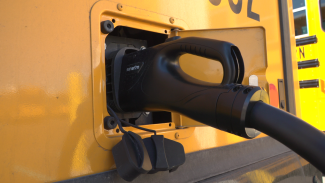
“Children and others in their communities benefit from cleaner air,” said Interim State Superintendent Dr. Sue C. Carnell. “We are happy to work with our partners at the Michigan Department of Environment, Great Lakes, and Energy (EGLE) to make our state greener. The Clean Bus Energy Grant program helps us move toward Goal Three in Michigan’s Top 10 Strategic Education Plan, to improve the health, safety, and wellness of all learners.”
Transportation accounts for twenty eight percent of all pollution in Michigan, and bringing that percentage down is part of the MI Healthy Climate Plan. EGLE collaborates closely with the Department of Education on the grant program, contributing funding, environmental oversight, collaboration, and program support.
While the advantages of the electric buses are immediately evident, they are significantly more expensive than diesel buses and it will take time to assess if Dearborn will convert its entire fleet to electric. But it’s clear that going electric fits squarely within their larger goals.
“I’m not going to say that Dearborn Public Schools buying 18 buses is going to solve all the climate issues that exist,” admits Mustonen. “But what I will say is this, if we do nothing, if we don’t take any steps, that’s the real crime here.”
Twenty-eight school districts across Michigan received state and federal grants for electric school buses, from Ann Arbor, Ypsilanti, and Detroit, to Traverse City, Bessemer, and Ojibwe Charter School. Applications for $44 million in Clean Bus Energy Grant program funding are due Dec. 18, 2025.