Founded in 1970, the Ecology Center serves one purpose: protecting healthy people and a healthy planet. We believe that the central question of our time is how human beings are going to thrive in the world without destroying the earth's ability to sustain us. This can only be achieved as a strong movement. Sign up to receive emails about ways you can get involved, take actions and learn about important updates from the Ecology Center.
Coalition stands in solidarity with Michiganders for Money Out of Politics following the submission of more than 562,000 signatures.
LANSING, MI — Michigan Energy Michigan Jobs (MEMJ) recognized Michiganders for Money Out of Politics (MMOP) for submitting over 562,000 petition signatures to the Secretary of State.The coalition called the moment a clear reflection of how fed up Michigan residents and small businesses are with the utilities companies wielding political influence while continuing to drive up rates.
"Michiganders have sent a message that cannot be ignored. When utilities spend freely on the politicians who are supposed to regulate them, families foot the bill. Consumers Energy has requested over $700 million in rate increases in less than three months alone, and this petition is giving voters the power to demand better," said Sergio Cira-Reyes,Climate Justice Catalyst Urban Core Collective.
"Expanding access to more affordable energy sources and avenues, including renewable energy, has been slower and more expensive than it needs to be because utilities have monopolized that access to protect their profits. When they can also fund the politicians overseeing them, ratepayers pay more and wait longer. This initiative gets to the root of that problem," said Andrea Pierce, Deputy Director of Programming, Michigan Environmental Justice Coalition.
MEMJ members expressed this petition demonstrates the larger movement around utility accountability, energy affordability, and fairness taking hold across Michigan. If MMOP's petition is certified by the Board of State Canvassers, the proposal will appear on the November 2026 ballot.
"Utility accountability is not a partisan issue. Michigan families across the state are struggling with rising energy costs and deserve a government that works for them, not one that is funded by the utilities setting their bills," said Alexis Blizman, Policy Director, Ecology Center.
“Preventing rate hikes is in the interest of public health, as affordable, reliable energy can keep household conditions safe and medications and medical equipment stable,” said Teresa Homsi, MPH, Michigan Clinicians for Climate Action. “This petition addresses a serious conflict of interest that currently buys utilities and other major government contractors like Blue Cross Blue Shield disproportionate access to our policymakers.”
“While Michiganders struggle through an energy affordability crisis, DTE and Consumers Energy posted record profits in 2024 and 2025 and continued opposing cost-saving measures like community solar. The people of Michigan want accountability from their utilities and this petition shows they’re ready to demand their voices are heard,” said Patty O’Keefe, Senior Midwest Regional Director, Vote Solar.
"Michigan families don't just need lower bills -- they need a government that isn't being bankrolled by the companies setting those bills. The energy affordability crisis is as real as the political influence fueling it, saidAshley Rudzinski, Climate & Environment Program Director for Groundwork Center. “We stand with every resident who signed that petition and every ratepayer still waiting for relief."
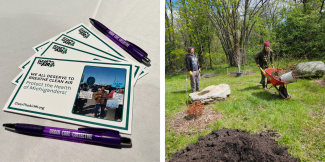
Clear the Air, a statewide coalition that Ecology Center is a founding member of, hosted Michigan’s third annual Air Quality Awareness Week in the first week of May, 2026. This week of events brought together Michiganders throughout the state to advocate for the right to breathe clean air for all communities.
Regions with a heavy industrial presence and limited access to green spaces bear a disproportionate burden of air pollution, leading to increased respiratory issues and reduced well-being for vulnerable populations. State-level pollution regulation is a primary line of defense against the hazards of living in polluted conditions. Clear the Air (CTA) is pushing for Michigan to hold polluters accountable and manage policy shortcomings that allow permitting for degradation of air quality in and around residential areas.
Air Quality Awareness Week is an opportunity for organizational partners, community members, and environmental justice advocates to come together and organize for the right to clean air.
A Week of Events to Advocate for Our Right to Breathe Clean Air
Clear the Air Virtual Press Conference: April 30, 2026
A virtual press conference kicked off the week, where Ecology Center representatives were joined by leaders from Clear the Air partners. The coalition announced this year’s community programs and detailed the opportunities to follow, highlighting the educational and advocacy priorities for the events. Amongst this year’s enthusiastic speakers were Raquel Garcia from Southwest Detroit Environmental Vision, Ned Andree from the Community Collaboration on Climate Change, Patrick McNeal and Mona Munroe-Younis from the Environmental Transformation Movement of Flint, Lucas Aguirre from Detroit’s Eastside Community Network, and Salam Beydoun from the Ecology Center.
Filter Forest Tree Planting & Letterpress Printing: May 2, 2026
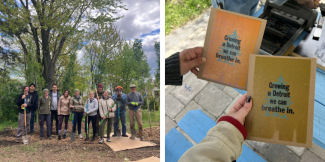
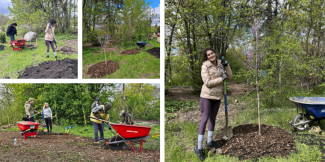
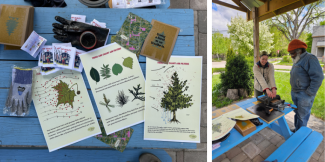
The first event of the week was a tree-planting and letterpress-printing event hosted by Arboretum Detroit. Clear the Air representatives, community members, and tree enthusiasts joined in to take matters into their own hands and get them dirty for clean air. This offered a platform for residents and visitors to connect about their frustrations with air pollution, while providing an opportunity to actively counter its effects by planting trees.
Everyone enjoyed being outside in an invigorating green space, broadening their horizons through an artistic activity. Participants learned about air quality issues through interacting with creative educational materials, which included illustrations of trees’ impact on air quality, informational zines, letterpress cards that read “Growing a Detroit We can Breathe in”, and thematic coloring pages.
This tree planting expanded the Filter Forest green buffer around pollution-impacted neighborhoods in Detroit. 50 new climate-resilient trees and native shrubs were planted to withstand changing and future conditions, ensuring this beautiful resource will remain to provide filtration and recreational benefits to Detroiters for a long time.
Cinco de Mayo Parade: May 3, 2026
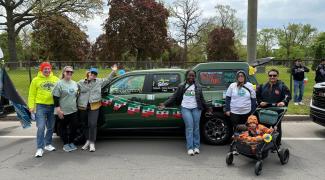
The next day, Clear the Air partners, including Southwest Detroit Environmental Vision, Ecology Center, and Trucks Off Our Streets, walked in the annual Cinco de Mayo Parade to celebrate the community and culture and to distribute air quality materials to over 6,000 community members in Southwest Detroit.
Hundreds of vibrant floats, school marching bands, mariachis, Charros, and dignitaries traveled a 2.5-mile stretch along West Vernor Highway, showcasing local businesses and commemorating the Battle of Puebla in 1862. Families and residents in attendance partook in the festivities as well as learned about Clear the Air’s mission. Now, more than 6,000 Detroiters are better equipped to identify, report, and protect themselves from poor air quality.
Community Conversations About Clean Air
Fueled by the success and statewide interest of previous years, Clear the Air branched out from a single statewide conversation event to three separate community conversations in various cities to better connect with and amplify local concerns and voices. The cities of Flint, Grand Rapids, and Detroit all hosted their own unique Community Conversations for Clean Air events, focusing on regional priorities:
In Flint: May 6, 2026 —
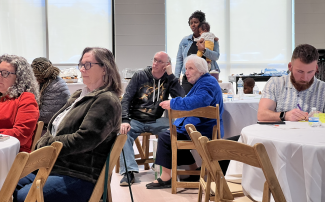
The Environmental Transformation Movement of Flint (ETMF) raised awareness and discussed opportunities for collective action among residents affected by unhealthy air. Activities included a lesson on health impacts of poor air quality by resident Registered Nurse Tarnesa Martin (affectionately known as Nurse T), a presentation by ETMF’s own Mona Munroe-Yunis on ways to improve air quality in Flint at household, neighborhood, and community scales, a share-out conversation with attendees on their own air quality experiences, concerns, and ideas for action, and a raffle for one resident to win an air purifier! All residents, however, were able to pick up coalition handouts with further information and resources about air quality and how to make DIY air filters.
Attending members reported a warm and energized atmosphere, with unanimous support for future collective action measures such as organizing for a no-idling ordinance, rollbacks on industrial pollution permits, the acquisition of electric equipment for Genesee County Land Bank’s Clean & Green program, and staying involved in upcoming advocacy opportunities that CTA hosts. At the end of the event, ETMF connected with neighborhood leaders to host smaller-scale versions of this conversation for clean air across Flint later in the summer.
In Grand Rapids: May 6, 2026 —
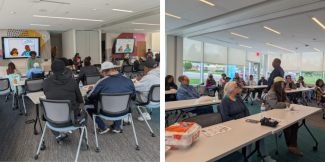
The Community Collaboration on Climate Change (C4) celebrated Air Quality Awareness Week at the MLK Park Lodge to learn about local air quality and hear from community experts. This gathering was designed to educate and empower the community, providing practical tools and resources to help individuals and families take action on air quality in their homes and neighborhoods. Presenters included Ned Andree from C4; Ericka Lozano-Buhl from Clear the Air; Hannah Napolillo and Rusty Flewelling from the Kent County Health Department; Benjamin Rance and Ingrid Scheer from the City of Grand Rapids Office of Emergency Management; Nate Rauh-Bieri from JustAir; Wende Randall from the Kent County Food Policy Council; and Nancy Morales from the Urban Core Collective. Presenters shared data from their areas of specialization, focusing on pollution's health impacts, how to monitor air quality, and what is being done locally.
Participation was high and enthusiastic as attendees discussed the various sources of air pollution in Grand Rapids and shared their questions and concerns about air quality with the group. Most recurring topics for Grand Rapids were truck traffic and what residents could do to monitor and improve local air quality. This event included a giveaway finale, with nine large air purifiers, N95 masks, lead filters, and smaller air purifiers raffled off to participants. This community conversation equipped, informed, and engaged residents of all ages and backgrounds for a truly transformational evening!
In Detroit: May 9, 2026 —
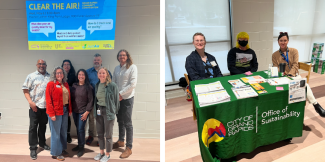
The Eastside Community Network hosted this year’s Community Conversation for Clean Air in Detroit. As one of the most heavily impacted regions in Michigan with poor air quality, this event highlighted the need to provide resources for health management and care to residents. To this end, the ECN invited various healthcare providers to offer services and educational materials on asthma, health, and air quality, as well as vendors offering vaccines for children and blood tests. Presenters there to further explain health concerns and protective measures included the Michigan Asthma and Allergy Foundation, Detroit Children's Healthcare Services, Bloom Pediatric Unit, Detroit Mobile Access, and Community Action to Promote Healthy Environments (CAPHE). These organizations connected residents with resources to protect themselves from adverse health impacts of air pollution, especially in the upcoming summer months and wildfire season.
Detroiters in attendance discussed the importance of taking protective measures and demanding better pollution control simultaneously, and were keen to advocate for clean air in their communities. Keeping with the theme, this event included a raffle for 2 air purifiers and a DIY air filter workshop so attendees could leave with their very own air filter!
Let’s Clear the Air!
The 2026 Air Quality Awareness Week wrapped up with many more informed and energized Michigan residents ready to take action and demand polluter accountability and protections for our natural resources and public health. With newly planted trees and better-resourced communities, the fight for the universal right to clean air is moving forward as strongly as ever.
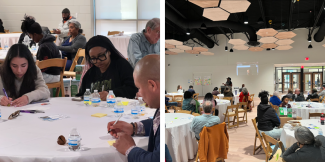
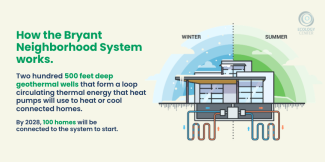
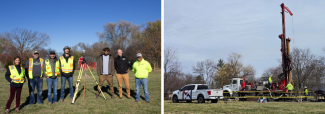
On a cool September morning in 2025, the Ann Arbor Office of Sustainability (OSI) invited local residents to gather at the Bryant Community Center to feel the ground shake. A drilling rig pushed a geothermal pipe 500 feet into the earth — the first of roughly 200 wells that will eventually heat and cool homes across the neighborhood as part of what city officials hope will become the nation’s first city-owned, neighborhood-scale networked geothermal system of its kind, and the country’s first fully carbon-neutral retrofitted neighborhood. For OSI Director Missy Stults, transparent communications have been vital to the project’s success. “We’re trying to be really candid about the disruption this will cause so that people trust the process as it unfolds.”
The demonstration offered a preview of a project that could reshape how cities across America deliver energy. Unlike places like Boise, Idaho, where a hydrothermal reservoir close to the surface has supplied naturally heated water to warm much of the city for more than 130 years, Ann Arbor isn’t blessed with any special geological advantage. Its underground temperature holds steady at about 55 degrees, which is the average for most of the country. That is exactly what makes Ann Arbor such a compelling test case: if district-scale geothermal can work there, it could work in almost any city with the political will and public investment to build it.
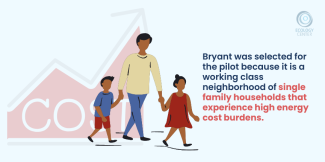
In 2022, Ann Arbor received technical assistance through the U.S. Department of Energy (DOE) Communities LEAP program to design the Bryant neighborhood geothermal system. Bryant was selected as the test case because it is a working-class neighborhood of single-family households that experience high energy cost burdens. The homes were built in the 1970s and have poor energy efficiency, frequent flooding, and mold and other health and safety issues. In October, 2025, the City won an $11 million grant from the DOE to build the geothermal system designed for Bryant, which includes a wellfield capable of heating and cooling the Bryant Elementary School, Community Center, and all 262 homes in the Bryant neighborhood.
Ann Arbor is matching the DOE investment with funds to connect neighborhood buildings to the system and making home energy efficiency upgrades. The first 100 homes will be connected to geothermal by 2028, and additional homes will be connected as funds become available. The Bryant Elementary School was originally part of the project, but was dropped due to the need for expensive mechanical upgrades to the school building. When those upgrades are in place, the school can be served by the same geothermal system used by the homes and community center in the Bryant neighborhood.
Bryant Neighborhood geothermal site surveying & project test well
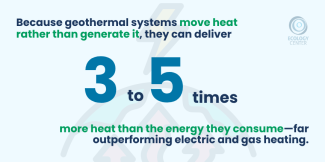
Energy use in buildings accounts for roughly 70 percent of Ann Arbor's carbon footprint, but state law prevents the City from requiring developers to adopt renewable energy technologies. That leaves cities with a challenge: how do you encourage investment in systems that cost more upfront but save money over time? Geothermal is one example. Because it moves heat rather than generating it, a geothermal system can deliver three to five times more heat than the electricity it consumes. Yet, many developers still choose less expensive conventional systems because they are focused on minimizing construction costs. Ann Arbor's strategy is to reduce that barrier by investing in shared geothermal infrastructure, making it easier and more affordable for residents and businesses to participate.
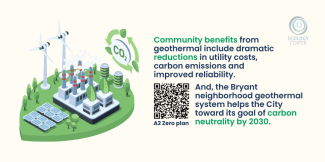
The Bryant neighborhood geothermal system is part of Ann Arbor’s Sustainable Energy Utility (SEU), a voter-approved initiative that allows the City to deliver independently owned and operated renewable energy to residents beyond what the utility company DTE provides. The SEU is the nation’s first opt-in, city-owned utility that runs parallel to an investor-owned utility company. As a utility provider, Ann Arbor can devise creative strategies for deploying renewable energy across the city as part of its plan to reach carbon neutrality by 2030. Though the City is unlikely to achieve full carbon neutrality by the self-imposed deadline, the goal has galvanized city leaders to take on systemic changes that could someday make carbon neutrality possible.
Networked geothermal in a moderate-income residential neighborhood is the kind of systems-level solution that is only possible when city leadership and residents share a willingness to invest in bold experiments. The potential payout is huge: dramatic reductions in utility costs and carbon emissions, and improved reliability in a city plagued by frequent power outages. If successful, cities across the country may follow suit. But the substantial upfront costs may be a barrier to large-scale implementation.
Many of the Bryant neighborhood homes require substantial investments in energy efficiency as well as health and safety measures to ensure that the geothermal system will function at its best. Further, lopsided demand may overtax the system. In a strictly residential neighborhood, peak demand is after business hours when most people are at home. If everyone is heating and cooling at the same time, there is less energy to go around. A neighborhood with a mix of homes, businesses, and public buildings is better suited to networked geothermal because it distributes energy usage more evenly throughout the day.
OSI is drilling experimental wells across the City to see where networked geothermal might be feasible, including in the mixed-use Kerrytown neighborhood. “We need to run these models. We need to actually understand and then optimize,” says Stults, who cautions that “geothermal is not going to work everywhere in the city.”
Creating innovative alternatives to our costly and unreliable energy system requires patience and willingness to invest in breakthrough technologies that carry some risk. The federal government has a long history of supporting innovation and could be a strong partner in this work. While federal policy is actively working to dismantle solar and wind energy projects in favor of oil and gas, geothermal remains a renewable energy that the administration may support. Technological advances in oil and natural gas extraction are proving to be useful in drilling geothermal wells. OSI will continue to apply for public dollars, but the level of investment necessary to deliver resilient, clean, inexpensive geothermal heating and cooling will require Ann Arbor residents to share the costs. The good news is that once the pipes are in the ground, geothermal systems require little maintenance over their 50-100-year life cycle, and they reduce energy bills between 25% and 50%.
A citywide geothermal system would cost billions and take decades to implement, but is still far more cost-effective than creating separate geothermal systems for each structure. Stults explains that financing this investment could follow the model used by utilities when paying for grid upgrades. “We pay for our utilities by taking out capital dollars, and you pay back that capital debt through rates,” she says, explaining that paying for geothermal energy through the SEU “is the exact same thing.”
Geothermal makes so much sense that Ann Arbor Public Schools and the University of Michigan are also in on the action. But there aren’t enough geothermal installation companies to meet demand. Closing that gap remains a sticky problem that requires out-of-the-box thinking. “We're thinking about all kinds of solutions,” says Stults. “Do we buy a rig for Ann Arbor? Do we recruit a business to come set up in Ann Arbor to meet all of our demand and the county's demand? Do we sequence our projects in a certain way? Do we drill central wells?” Whichever solution the City settles on will expedite the clean energy transition and lower costs for all local institutions that are striving towards net neutrality.
Ann Arbor Public Schools & Geothermal Energy
As part of its commitment to environmental sustainability, Ann Arbor Public Schools is moving forward with geothermal systems across the district. Three schools already have geothermal installed, four schools are in the process of installing systems, and two more have plans for systems that will be initiated as soon as possible.
Jason Bing is the Director of Capital Programs for AAPS and has been overseeing geothermal projects for the school district. From managing the complex budgeting processes and competing for the few available drilling rigs, to overseeing construction and fielding complaints about the noise, it’s a big job. Bing is excited about the potential savings of geothermal, but won’t know dollar amounts until the systems are fully operational. “By converting to an all-electric solution, which geothermal allows, and then developing a plan to offset the remaining energy usage with clean energy assets, we can potentially significantly reduce our operating costs with a reduction in utility costs,” he explains. AAPS already generates 5.8 MW of solar — more than any other school district in the state — and may add even more in the future.
Even with the high up-front costs, Bing is optimistic that AAPS will save money in the long run. Utility rates are rising swiftly, and “it’s just going to get worse with all of our data center investments and the heavy investment in electrical infrastructure right now,” Bing says.
Of all the strategies the City is using to generate energy and improve efficiency, geothermal has the highest up-front costs. But it is also far and away the most resilient and cheapest to maintain. Getting heat from heat is much more efficient than from electricity or fossil fuels, and the technology is relatively simple. The City is in the pilot stage of various geothermal projects to see which strategies work best. “We're doing this in lots of different ways,” says Stults. “We're getting all of this wonderful data about thermal efficiency, cost per unit, when it makes sense and when it doesn't make sense,” she says, adding that this is an “exciting moment” in the future of energy for the city. While older generations may never see the full benefits of today’s geothermal investments, they are bequeathing their descendants a sustainable, reliable, and inexpensive energy future. As the proverb goes, “A society grows great when old people plant trees in whose shade they know they shall never sit.”
You may have recently seen ads — on social media, television, even your front door — from the “Responsible Energy Coalition,” attacking an Ann Arbor proposal to transform electricity distribution in the city.
But don’t be fooled. These ads come from a front group for DTE, spending an unprecedented amount of political money to ward off a ballot proposal that would move the City further along in the development of a municipal utility.
According to campaign finance filings, DTE has already invested $1.8 million in the ballot committee, even though the citizens’ initiative hasn’t even qualified for the ballot. Just to put that in perspective, less than $200,000 was spent on ALL municipal elections combined in Ann Arbor in 2022.
There are good arguments for and against the municipal utility proposal, but consider the source. DTE has a long track record of spending ratepayer money to influence elections. In Lansing, DTE is one of the state’s largest political donors, contributing to virtually every legislator. In Ann Arbor, DTE is spending profits from the electric bills paid by city residents and businesses to lobby them against a ballot proposal.
That’s right. That’s a monopoly utility, using our own money against us. There should be a law.
As it turns out, 23 states have just such a law. They prohibit regulated utilities from donating money to political campaigns. A grassroots coalition has collected signatures to put a similar proposal on Michigan’s November ballot, and submitted them on May 27 to state officials for verification.
As for the Ann Arbor ballot initiative, please form your own opinion about it and find responsible sources of information on the topic. Just know that the Responsible Energy Coalition is not one of them.
Last year, Becca Nielsen was appointed the Director of the Environmental Education department at the Ecology Center. She is an experienced science educator and place-based, EcoJustice practitioner with experience in both traditional and non-traditional educational settings for a wide variety of audiences. Nielsen worked with Al Gore on his Inconvenient Truth Project, co-led a statewide coalition connecting children with nature, and is also one of the original members of the leadership team that built the Southeast Michigan Stewardship (SEMIS) Coalition, a group focused on integrating EcoJustice-focused place-based education (PBE) across K–12 and higher education.
Nielsen became interested in education because her parents were teachers and she experienced struggles as a young student within the traditional education system. She wanted to find ways to effectively support students and teachers who are often limited by the rigidity of the standardized curriculum.
Despite her career as a science educator, she initially thought she was “bad” at science until a biology professor she worked for at the Museum of Natural History in college scouted her to switch from English to biology. This experience pushed Nielsen to reconnect with her love for nature and the outdoors and develop her dedication to helping all students find the right path for learning through science education. It also demonstrates the power of one teacher to turn a challenging subject into a lifelong career path.
Nielsen’s specialty, place-based education (PBE), is a practice that views physical, cultural, and historical aspects of our environment as crucial starting points for teaching and learning. She also uses an EcoJustice approach in her place-based education practice. Nielsen describes EcoJustice as environmental justice that digs into the root causes of issues that we see. An EcoJustice approach treats environmental and cultural issues as intertwined and inseparable. Using a place-based, EcoJustice approach purposefully connects scientific knowledge to local places to solve real-world cultural and ecological issues that are directly experienced by students. PBE expands the classroom into the community and places collective care and justice at the center of learning alongside the content. The power of a PBE approach is its ability to connect students to place and community, to help students learn content more deeply, and to empower students to take action on local issues around them.
Nielsen aims “to equip people with the skills and knowledge necessary to thrive in healthy, sustainable, and just communities.” For her, EcoJustice is the core of her educational work because “teaching and learning isn’t possible without a safe and healthy environment.” Nielsen sees “EcoJustice work as where all of [my] interests and the pressing issues of our time coalesce.”
Nielsen explained that, “the secret to framing a lesson with a place-based, EcoJustice lens is to use larger questions of inquiry [that are action-oriented and locally specific] upfront at the beginning of a lesson or unit and to tailor the unit around answering those questions.” Applying that idea to some of the Ecology Center’s environmental education program topics, she offered the following questions as examples:“How can I participate in the circular economy in my local community? What zero waste practices can I use at my school and at home to make better decisions for my environment and my community?” These questions allow students “to connect with community partners, get out into the community to learn more about the practices, and design action projects to showcase what they’ve learned in the classroom and to make a difference in their community at the same time.”
The Cody Youth Ambassadors program is one example of a place-based educational approach from Nielsen’s previous work with the SEMIS Coalition. The Youth (student) Ambassadors worked with teachers and local partners to embed Rouge Park into the ninth-grade curriculum across subjects. Through this program, students learned about the history of the land and water in the Cody Rouge community, the ongoing litter and pollution issues at the park, and the Rouge River’s water quality problems. The students gained a multi-perspective exploration of their community, experienced the importance of stewardship, and witnessed the power of civic action. The program was the first of its kind to integrate such topics into all core subjects during regular school days instead of isolated one-off lessons. (More examples of PBE programs are available on the SEMIS student gallery page)
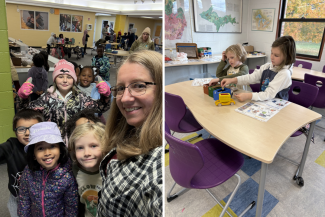
Integrating environmental topics into subjects beyond science may be difficult for some to imagine — but it is not only possible but can also lead to deeper, more meaningful learning and a more engaging experience for students. For example, in January, Nielsen led Green Training workshops for all 10th graders in their geometry classes at Ypsilanti High School. “We connected landfill construction, zero waste, and circular economy ideas to geometry. We also discussed other sustainability projects at the schools that connect to math, science, and community.” As part of the Washtenaw County Recycling Education Program, these individual lessons can feed into “larger inquiries such as a schoolwide waste audit to investigate how they are doing at keeping recyclable things out of the trash.”
PBE conducted with an EcoJustice lens offers a grounded approach to connect traditional education to the material realities of our lives. It answers the common “why do we need to know this” question in a powerful and local way, and it calls on us to apply our education to actions that connect to a future beyond ours.
Ecology Center’s Environmental Education Department
Nielsen joined the Ecology Center staff because its mission and work align with her lifelong interests and allow her to take PBE even further. She is thoroughly impressed by past Ecology Center Environmental Education initiatives. She sees her job as deepening the connections between existing environmental education programs and other Ecology Center programs, as well as working more closely with other campaigns in the future. She also would like to strengthen partnerships with other organizations doing complementary work to build capacity for transformative programs across the region.
One of her major goals is to “get a seat at the table” in larger conversation spaces as a way to connect environmental education to effective policy decisions. Environmental education is not just about informing children or concerned residents about recycling and composting; it is about educating decision-makers and voters about making systemic choices that ensure a safe and healthy future. Effective environmental education reaches not only youth, but also community members who can model stewardship and civic actions as a result of their education experiences.
According to Nielsen, a “lack of answers” is a core shortcoming for many education programs. Many programs present overwhelming information about environmental challenges, much of which can sound depressing or scary. Often, those programs do not include insights about what is being done to find solutions or how to take action at the individual level, which can leave learners feeling paralyzed or helpless. She believes that information about environmental concerns “should always include actionable opportunities to make a difference” as a result of what has been learned, especially at the K-12 level. Using a place-based, EcoJustice approach to environmental education builds in those connections between science, community, and the call to action that can lead to deeper understanding as well as protective and regulatory policies in the real world.
Making Decades of Environmental Education Available to Everyone
The Environmental Education team is launching an Education Resources Online Library (EROL), a digital library of downloadable resources to help K-12 students, educators, and families take action on key environmental issues. These materials focus on topics like renewable energy, green chemistry, and waste reduction, providing practical tools to inspire informed, hands-on learning and positive community impact.
While going into the classroom to lead students, teachers, and families through various lessons is incredibly powerful, it is not always possible. This is why we created the EROL library that provides lesson plans and activities that people can use on their own. These resources transform our engaging lessons on environmental issues from one-time special events into opportunities for on-demand, easily accessible, long-term learning.
EROL is available to everyone. Each lesson is labeled by target grade level, but can be used by a variety of different age groups. For example, an adult who is new to a concept might benefit from a lesson meant for a 3rd grade classroom. On the other hand, a student who has had multiple experiences with a topic may be successful with a lesson that is above their grade level. This resource has been created with flexible learning goals in mind for anyone in the community who is interested in learning more about environmental issues.
The Environmental Education team has many other exciting ideas in the works. Nielsen looks forward to expanding EROL offerings, infusing PBE into existing programs, and continuing to develop new place-based education experiences around different Ecology Center topics with her team.
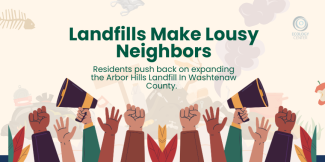
In northeastern Washtenaw County, on the border of Salem and Northville Townships, sits Arbor Hills landfill. Active since the 1970s as a gravel pit, Arbor Hills has functioned as one of Michigan’s 60-plus landfill sites for decades. More than 50 years after its creation, Arbor Hills is running out of space and is looking for an expansion. Northville residents are not pleased.
A Lousy Neighbor
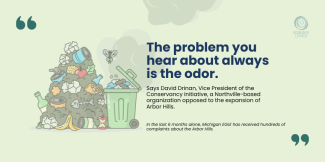
“The problem you hear about always is the odor,” says David Drinan, Vice President of the Conservancy Initiative, a Northville-based organization opposed to the expansion of Arbor Hills. Based on tracking by the Conservancy Initiative, the Michigan Department of Environment, Great Lakes, and Energy (EGLE) has received hundreds of complaints about the Arbor Hills site just in the last six months. Arbor Hills Landfill has been a nuisance to the community of Northville for years. Since 2020, Arbor Hills has been owned and operated by GFL Environmental, a Canadian waste management firm.
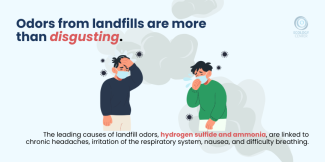
Since 2016, Arbor Hills has been hit with more than $1 million in fines under multiple owners, including a $355,109 EGLE settlement for failing to contain noxious odors. The agreement also required the landfill to invest millions in monitoring equipment and tree planting. Unfortunately, these measures have not prevented the continued uptick in landfill odor complaints since the acquisition in 2020. Locals have every reason to fear the continuation of these problems — odors from landfills are more than disgusting. The leading causes of landfill odors, hydrogen sulfide and ammonia, are linked to chronic headaches, irritation of the respiratory system, nausea, and difficulty breathing. Observational studies also indicate that chronic exposure to landfill gas can lead to increased rates of lung cancer.
Beyond issues with the smell are fears of pollution and the health risks associated with waste. Arbor Hills Landfill was identified as a PFAS site by the state of Michigan in 2019, and subsequent research by independent organizations like Ecology Center and its allies has shown the problem goes beyond the waste site itself. Thanks to help from Great Lakes PFAS Action Network in 2023, members of the Northville community discovered that the forever chemical PFOS was present in nearby Johnson Creek at levels several times higher than official safety standards. PFOS is known to cause pregnancy complications, thyroid disorders, and liver cancer. Local fish also tested positive for PFAS contamination, raising concerns about wildlife preservation and health risks for fishers in the area.
While Northville residents are expected to endure the difficulties of life next to an active landfill, they receive few direct financial benefits, as most proceeds accrue to Washtenaw County and Salem Township across the border. Similarly, Northville residents don’t have a direct public vote on the expansion, even though the township has representation on the planning committee. This is a common problem with landfills — such undesirable industries are placed at the border between one municipality and another, minimizing the host municipality’s negative consequences while exposing those externalities to another community. Northville residents are not alone in suffering from landfill-related pollution. Many residents of the rural community of Salem use well water in their homes, raising possible concerns about PFAS contamination that are likely to increase with a larger site.
The Landfill Economy
Arbor Hills is a pollution hazard for the communities that live near it, but its expansion threatens to worsen a much bigger issue facing our state. Michigan is a state filled to the brim with landfills, afflicted with a surplus going back decades. According to a 2025 study by the Department of Environment, Great Lakes, and Energy, Michigan has 23 years’ worth of landfill space left, and right now, Arbor Hills is not the only landfill in Southeast Michigan looking to expand. A similar project is under consideration at Pine Tree Acres landfill in Macomb County, while the expansion of Woodland Meadows landfill in Wayne County is already underway.
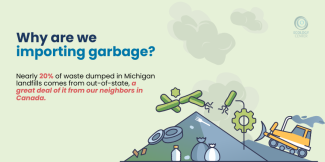
Nearly 20% of waste dumped in Michigan landfills comes from out-of-state, a large portion of it from our neighbors in Canada. “In 2020,” Drinan says, “when we couldn’t cross the border into Canada, when Canadians couldn’t cross the border and come here, the trash was still coming in like always.” This booming import of waste is the direct result of the extremely low waste disposal charges in Michigan compared to other Midwestern states. Those extremely low charges are a direct result of Michigan’s enormous landfill oversupply.
Beyond the Landfill Economy
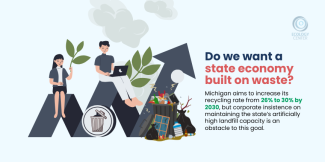
Do we want a state economy built on waste? Michigan currently aims to increase its amount of recycled waste from 26% to 30% by 2030 as part of its sustainable development goals. Still, corporate insistence on maintaining the state’s artificially high landfill capacity can get in the way of this achievement, which will almost certainly make further progress towards its long-term goal of 45% more difficult. Michigan’s consistent approval of landfill construction and expansion has created a regionally anomalous overcapacity, which can only be maintained at the expense of investment in waste recycling. Just as cheap oil reproduces dependence on oil and hampers the development of renewable energy, cheap dumping of trash reproduces dependence on landfills.
Michigan can instead choose to support investment in the recycling industry rather than landfills, making recycling an even more economically competitive option in the long run. Most recent landfill expansion projects are expected to remain in operation for up to 50 years. The externalized cost may be the health of Southeast Michigan’s ecosystem and the well-being of locals in Washtenaw and Northville counties. The expansion of Arbor Hills reproduces this economy of perverse incentives and restricts the willingness to invest in waste reduction technology and infrastructure.
This is not the first time Southeast Michigan has had to reckon with a leaky landfill. In the 1980s, the City of Ann Arbor, with the support of the Ecology Center, engineered a massive expansion of its recycling system in response to its dangerously full and out-of-compliance municipal landfill. The greater development of recycling infrastructure is one part of the shift towards a zero-waste economy, alongside reductions in solid waste and the infrastructure that enables it. In March of 2026, four state legislators proposed a bill to the Michigan Senate. SB 818 would make it more difficult to expand landfill sites like Arbor Hills by banning landfill construction within one mile of an existing dwelling. In a best-case scenario, new impediments to landfill construction and expansion could reset the state’s relationship between waste creation, recycling, and reduction.
Opposition to landfill expansion goes beyond the concerns of locals, who themselves deserve a clean township. The expansion of these landfills will lock Southeast Michigan into a cycle of cheap waste and high environmental tolls for decades. Michigan does not need to be a garbage dump for the Midwest. If the people of Michigan want a healthy environment and a green future for the state, preventing the growth of the state’s landfill surplus is a necessity.
Michigan’s slow but steady population decline is not news, but recent data from the Michigan Department of Management and Budget is alarming: 45,000 workers lost from March-September, 2025, most from the auto industry. And yet, 85% of employers in the clean energy sectors report having trouble filling open positions. In an effort to close the gap, government agencies, trade associations, and public-private partnerships have successfully leveraged corporate, state, and federal funding to train tens of thousands of workers in fast-growing fields like solar installation, energy efficiency, advanced manufacturing, and EV technologies.
But instead of ramping up these efforts to keep pace with the shifting sands of the workforce, the state is slashing the budget of one of its biggest and most successful programs, the GoingPro Talent Fund, by 42%. As a result, LEO projects about 300 fewer employers will receive awards and 10,000 fewer Michigan workers will receive training support over the two award cycles. Michigan's Community & Worker Economic Transition Office and EGLE clean energy grants continue supporting sector-specific training, but there will be no new funding to fill the gap. Without state investment, Michigan is poised to lose more workers than ever before.
Michigan has a vested interest in upskilling its workforce to ensure that the jobs in our state are filled by our workers. The Going PRO Talent Fund and Clean Energy Workforce Grants are examples of state-funded programs that partner with employers who upskill new and incumbent workers into higher-paying jobs with bright futures. This strategy allows companies to retain workers that may otherwise have been replaced with qualified candidates from out of state.
Trade associations such as Clean Fuels Michigan, along with public–private partnerships like the Michigan Economic Development Team Talent Action Team, BlueGreen Alliance, Michigan Energy Workforce Development Consortium, EV Jobs Academy, and the Community & Worker Economic Transition Office are aligning workforce training with evolving industry needs. Together, these initiatives are building strong pipelines that equip and place workers in clean energy careers, ensuring that employees, unions, and employers advance in step as Michigan leads the nation’s energy transition and advances towards MI Healthy Climate Plan goals.
In the story ahead, we look closely at how this ecosystem works in practice — spotlighting energy efficiency company Walker-Miller Energy, a B-Corporation that channels both novice workers and seasoned professionals into clean energy jobs using a braided mix of utility dollars, Workforce Innovation Opportunity Act funding, state grants such as the GoingPRO Talent Fund, and philanthropic support.
Walker-Miller Energy Services
Walker-Miller Energy Services is a Detroit-based, Black woman-owned B-Corporation delivering energy efficiency and clean energy solutions to residents, utilities, private companies, and nonprofits. As a B Corporation, Walker-Miller is bound to a triple bottom line that measures success by social equity, environmental sustainability, and financial stability metrics. This three-pronged approach makes it uniquely positioned to work at the intersection of public, private, utility, and nonprofit sectors to deliver MI Healthy Climate Plan workforce goals.
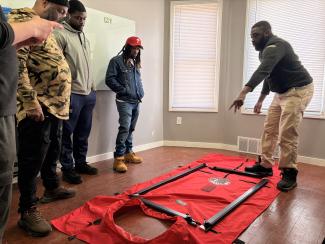
Walker-Miller has a number of programs designed to fill the energy sector’s employment gaps, from utility companies in search of energy efficiency experts, to small business incubation, to training and apprenticeships for a range of specializations. Walker-Miller collaborates with the LEO Going PRO Talent Fund and utility companiesDTE and Consumers Energy to ensure that opportunity reaches all parts of the state. Walker-Miller is a registered proprietary school with the State of Michigan and graduates of the UpSkill Cohort and Building Performance Institute Training Program are qualified to accept state and utility company contracts.
Recruitment is keenly focused on communities of color and women. Of the over 200 graduates from Walker-Miller training programs since 2020, 92% are people of color, and 40% are women. Michigan’s Black labor force is on par with the White labor force relative to population sizes, but white men hold a 17% employment lead over Black men. This indicates that Black workers are entering the workforce but encounter barriers to actually landing a job. Women represent 50% of Michigan’s workforce, but nationwide only hold about 28% of clean energy jobs and 5% of construction apprenticeships. Factors like racism and sexism are out of a candidate’s control, but knowing how to perform well in a job interview can be just as important to employers as having the skills to do a job. Walker-Miller helps close the employment gap by providing soft skills training as part of workforce development.
Data from the Michigan Environmental Justice Screen Tool shows that communities with low income and low educational attainment have been disproportionately impacted by climate change and high energy costs. These communities also tend to be racially diverse. By focusing recruitment for clean energy workforce development in these areas, Walker-Miller is maximizing the benefits of family sustaining jobs that do not require a college degree.
Derrick Meeking, Director of Workforce Development at Walker-Miller, engages individuals and business owners looking to gain additional credentials that allow them to expand. “We are trying to grow and scale businesses, also introduce individuals to the clean energy economy through workforce trainings,” he explains. “We find ourselves really being that educational beacon and providing opportunities for folks to enter into these ecosystems.”
Most recruits can’t afford to take training programs, even if they’re tuition free. That’s why wraparound supports are crucial to the program’s success. Trainees receive a stipend and funding for basics like transportation and childcare, as well as instruction in interview skills, resume building, and money management to ensure that they get, and stay, employed. “Many people think the program is a scam because it seems too good to be true,” says Meeking. It costs $12,000 to put one person through the Upskill program, an investment the utilities believe is more than worthwhile to meet the demand for skilled energy efficiency professionals. Word has gotten around, and there are more than 20 applicants for each open spot in the next Upskill Cohort.
The program has created a positive feedback loop in the business community. “Our number one key performance indicator is employment,” says Meeking. “We train and place. We don’t train and pray.” He sees the results every day. “We found that empowering those businesses and helping them scale and grow, in return they come back and hire our folks that have gone through our novice program. So it’s kind of full circle.”
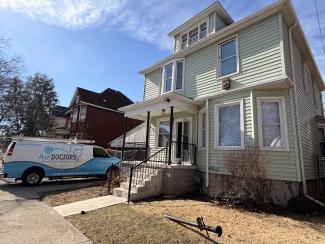
Jonathan Jenkins owns energy efficiency company Target AIR HVAC based in Livonia. He attended the Upskilled Cohort program to expand his business beyond installing high efficiency equipment, because “we’re just more efficient at wasting dollars if we don’t address the envelope as well.” Jonathan explains how a lot of homeowners have oversized heating and cooling equipment that pumps out more energy than they need. With efficiency measures in place, they can downsize equipment, and by adding solar panels, they can save even more money on utilities. He jokes that after the program, he realized how much he had to fix in his own house. “It’s an eye opener!”
Jenkins says there is tremendous room for growth in the field of energy efficiency. “Everybody’s a lot more conscious of their utility bills … So, it’s a great time for us, because it directly correlates with HVAC,” as well as installing clean energy alternatives like solar and geothermal energy.
Jonathan has hired two UpSkilled graduates and has an employee who is currently going through the program. Walker-Miller takes on a few students in each program for on the job training and commits to hiring students out of each cohort. Partnering businesses will typically invite workers that train with them to apply for open positions. “In the current cohort, all fourteen trainees have secured jobs with employment partners in week six in the program,” says Meeking.
Additional Walker-Miller training allowed Jenkins to open a second company, Michigan Energy Auditors, to help people see inefficiencies in their home and business energy systems. “It’s just been such a wonderful experience just from the top down in regards to the Upskilled program,” says Jenkins.
Michigan’s workforce development for clean energy exemplifies a “whole ecosystem” approach, where state tools, utility funding, and community-rooted employers like Walker-Miller Energy Services and Target Air HVAC/Michigan Energy Auditors forge tangible pipelines into high-demand careers in EV manufacturing, battery engineering, energy efficiency, and clean infrastructure trades. Integrating housing, transportation, competitive wages, benefits, and clear career ladders will be essential to attract, train, and retain talent, complementing initiatives like the MI Growth Office and Make MI Home. As federal funding dries up and state budgets tighten, programs like UpSkilled and GoingPro Talent Fund face uncertain futures despite their success in advancing equity and opportunity in clean energy.
With sustained synergy among government, business, nonprofits, and unions — bolstered by predictive planning — Michigan can bridge critical shortages and lead the national energy transition.
Clear the Air partners in Detroit, Flint, Grand Rapids host family friendly events from tree planting to health screenings
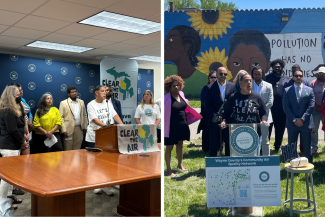
MICHIGAN – Clear the Air partners from Grand Rapids, Flint and Detroit will join a virtual press conference to announce the group’s third annual statewide slate of events for Air Quality Awareness Week. This year, activities run the gamut from tree planting to health screenings to community gatherings with food and conversation.
Residents who attend the community conversations will have a chance to build or win air filters for their homes to protect their families from wildfire smoke and local sources of pollution. Attendees will also learn how to contact regulators and elected officials to urge them to combat air pollution and protect health.
Air Quality Awareness Week is a national observance to increase awareness of the need to reduce and remove sources of air pollution and the health hazards that come with it. This year, it officially runs from May 4 to May 8. Clear the Air will begin its statewide week of observance with a tree planting with Arboretum Detroit, Saturday May 2. More information is available at www.ClearTheAirMI.org.
What: Press Conference - Statewide Events for Air Quality Awareness Week Who: Clear the Air member groups in Grand Rapids, Flint and Detroit
Raquel Garcia, Southwest Detroit Environmental Vision
Ned Andree, Community Collaboration for Climate Change (C4)
Nancy Morales Community Collaboration for Climate Change (C4)
Patrick McNeal, North Flint Neighborhood Action Council
Mona Munroe-Younis, Environmental Transformation Movement of Flint North Flint Neighborhood Action Council
Clear The Air is a coalition of concerned residents, community groups, and environmental justice organizations working to protect Michiganders health by working for everyone’s right to a clean, safe, healthy environment. Our goal is to build a stronger movement to protect clean air, promote environmental justice, build collaboration on air quality issues, and advance policies that protect clean air and public health in Southeast Michigan and across the state.
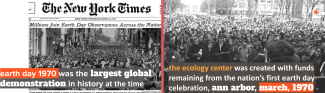
On the first Earth Day in 1970, 20 million people joined together in thousands of events around the U.S. in what was then the largest protest in world history. Of all the nation’s events, the “Teach-In on the Environment” in Ann Arbor drew the largest crowd, attracting 50,000 people in the community. The event marked the launch of the modern environmental movement, and led to the passage of the country’s foundational laws for clean air, clean water, and environmental protection. It also led to the creation of the Ecology Center.
Over the decades, Earth Day took on a gentler and less confrontational manner. Featuring tree plantings, river clean-ups, and kids’ activities, most Earth Day celebrations today are joyous and apolitical. Some even attract corporate sponsors. These gatherings broaden the audience for environmental action, and the Ecology Center sponsors and participates in a number of events taking place in southeast Michigan.
But it’s important to never forget the origin story of Earth Day. Especially now.
Today, the Trump Administration is threatening to overturn virtually all of the bedrock environmental laws and safeguards that were adopted in the 1970s. The Administration has begun the process of rolling back hundreds of legal protections, shuttered federal environment and public health divisions, and eliminated vital scientific research. They have been hard at work on that project since their first day back in office, when President Trump issued an Energy Emergency executive order that put the backsliding in motion.
We have been hard at work too. Our partners have been challenging unconstitutional orders in court. We’ve been fighting back in state legislatures, and joining together with other movements and ordinary citizens in mass protests all year long. Little by little, our protests are bearing results, even if the outcome is still uncertain.
The Ecology Center supports these efforts to push back, and we’ve doubled down on our work to support the communities most impacted by environmental injustice.
We advocate with, and for, communities across Michigan whose water and land have been contaminated with PFAS.
We work with, and for, families and communities who’ve suffered from lead poisoning, providing them with resources, and getting them involved in policy debates.
We work with, and for, communities hard-hit by asthma and other health problems caused by high levels of air pollution.
We work on behalf of families forced to choose between paying their heating bill and their grocery bill, and with the social service agencies that support them to fix energy policy.
And, we fight for regulations surrounding new data centers, so impacted residents are guaranteed transparency and know they have a voice in the use of their local resources.
Best wishes to all on this year’s Earth Day. Whether you prefer to celebrate at a festival or a protest march, please don’t forget what we’re celebrating. It wasn’t easy to get rights and protections for people and the planet in the first place. And we need to keep on fighting to keep them.
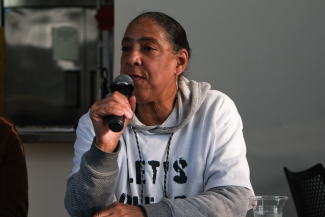
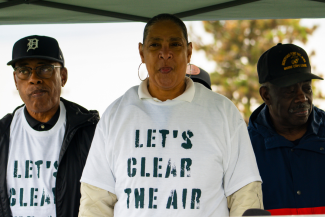
In celebration of Black History Month in February and Women’s History Month in March, the Ecology Center wants to spotlight Theresa Landrum, a crucial figure for environmental justice efforts in Southeast Detroit. Recently, her efforts as a Sierra Club Member led to the historic February 17th federal ruling that ordered DTE and EES Coke to pay a $100 million civil penalty and a $20 million investment for community health projects for violating the Clean Air Act. As a resident of Detroit’s 48217, Landrum describes her entry into environmental justice work as a necessity. “I wasn’t trained or desired to be [an environmental justice advocate]. It was out of necessity," she says.
Theresa grew up in Detroit’s 48217, an area known as one of the most polluted zip codes in Michigan. The area always had heavy industry presence that caused grey air, foul smell, ground sinking/cracking, disruptive and damaging levels of noise, and many other visible and tangible consequences. Her parents washed “dust” off their cars every morning before leaving for work.
In her childhood, health conditions — like the prevalence of asthma — were normalized without knowing industrial pollution was the cause. During our conversation, Theresa talked about how many neighbors and family members were diagnosed with cancer — an unmistakable pattern that revealed just how deeply pollution had shaped daily life in her community. Every person she mentioned that dealt with cancer reemphasized how grave the impact of industrial pollution was on her hometown.
The Right To Speak For The Community
There was no singular incident that led her down the path of activism — the everyday reality of living in 48217 motivated her to take action. For example, the community was excluded from the evacuation order during the 2003 Northeast Blackout, despite being closest to the factories that lost power to their pollution control systems. Residents were only able to evacuate because they were able to hear the information secondhand.
When there was a class-action lawsuit against Marathon Oil after the 2003 incident, residents of 48217 only managed to be included because they rushed to the courthouse after a resident happened to read about it at the last minute. The lawsuit ultimately did not serve the residents’ best interests, so instead, the community organized to provide legal support to residents to individually sue the company.
When local authorities tasked with keeping people safe fail to fulfill their duties, impacted communities are forced to take matters into their own hands for their survival. Landrum stressed that advocacy work is crucial because, “We [the residents] have the right to speak for the community,” as they are harmed by the pollution everyday.
She was not alone in noticing the necessity to speak up and speak for the community. Dr. Dolores Leonard and Rhonda Anderson — local residents, long-time members of the Sierra Club, and advocates for environmental protections — were significant collaborators for Landrum since the beginning. Her work in and for the community led her to become the current president of the Original United Citizens of Southeast Detroit and has facilitated many other important developments that paved the way for the recent federal ruling.
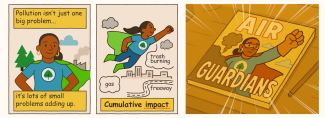
When creating an animation about cumulative impact, Clear the Air modeled our Air Quality Superhero after Theresa Landrum to honor her commitment to fighting air pollution
Testing Soil For PFAS at the Gordie Howe Bridge Site
We have collaborated with Landrum on many projects, including testing for PFAS in the soil at the Gordie Howe Bridge Construction Site, which we covered in a previous story. It was Landrum who wanted to focus the Ecology Center’s attention on soil testing at the site, going beyond the traditional water testing of the time.
Her concerns for PFAS started in 2017 as more articles about the dangerous levels of PFAS contamination across the globe started to come out. She felt the ubiquity of PFAS and the urgency to address it when “[she] was only able to find one item in her entire home that did not already contain PFAS” while preparing for an environmental justice-themed game for her Christmas party.
At the time, most PFAS discussions and testing focused on water. But her lived experience in 48217 — seeing contaminated dust, debris, soil, and more — told her to test the earth. Construction projects create a lot of dust and particles that spread through the wind. She “felt a strong need to test the soil to show the importance of testing PFAS in various forms” and to see the full picture of contamination.
“Pollution has no borders”
Landrum urges us to act now by stressing that “pollution has no borders.” Pollution does not discriminate: It directly impacts everyone regardless of gender, race, class, age, or location. As corporations continue to pollute, the lines drawn between our neighborhoods are arbitrary.
While certain communities are impacted before others, no one is truly safe or protected from pollution unless we all are. As awareness spreads and local testing increases, Landrum says more and more people, even those far away from 48217, are reaching out to her seeking advice. This is why strong prevention measures are necessary along with accelerating clean up efforts.
We must recognize the work by advocates like Landrum who have been forced to be on the frontlines and continue to lead the fight for our collective future. We cannot forget the enormous sacrifices these activists have made to dedicate themselves to environmental justice.
Thank you, Theresa Landrum, for your decades of advocacy work. Your dedication and generosity continues to inspire us and teach us the power of community care.